Friday, August 10, 2018

URS BLÖCHLINGER / CHRISTOPH BAUMANN with CADAVRE EXQUIS – Music By Two Composers... (LP-1988)


Label: Creative Works Records – CW 1014
Format: Vinyl, LP / Country: Switzerland / Released: 1988
Printed and manufactured in the Federal Republic of Germany.
Style: Contemporary Jazz, Free Improvisation, Avantgarde
Recorded at Soundville Studio, Luzern, in October 1987.
Layout, Design – Bernd Wendt
Engineer – René Zingg
Liner Notes – Hansjörg Schneider
Liner Notes [Translation] – Ursula Meyer
Producer – Christoph Baumann, Mark Wider, Urs Blöchlinger
Composed By – Urs Blöchlinger (A1, A2, B1, B2), Christoph Baumann (A3, B3)
Matrix / Runout (runout side A, stamped): CW 1014 A-1 | P
Matrix / Runout (runout side B, stamped): CW 1014 B-1 | P

Side A
A1 - March Is An Introduction ........................................................................... 10:54
A2 - Kinderlieder Nach A. Wölfli ......................................................................... 2:58
A3 - Wucherung II ............................................................................................. 12:59

Side B
B1 - La Belle Et La Bête ..................................................................................... 4:53
B2 - Kännsch Höngg ? ..................................................................................... 15:48
B3 - Ballade ........................................................................................................ 6:08

Personnel:
Urs Blöchlinger – alto saxophone, soprano saxophone, bass saxophone
Christoph Baumann – piano
Nat Su – alto saxophone
Martin Schlumpf – soprano saxophone, bass clarinet
Ian Gordon-Lennox – trumpet, flugelhorn
Roland Dahinden – trombone
David Taylor – bass trombone
Tom Varner – french horn
Hämi Hämmerli – bass
Dieter Ulrich – drums, percussion

Creative Works Records is an independent Swiss record label was founded in 1983 by Mike Wider in Root in the canton of Lucerne. Wider, who had built up a recording studio in Lucerne and worked as a music producer, recorded on his first album the American alto saxophonist Marion Brown.
Since then, the label has published between two and four productions a year. In particular, modern and contemporary jazz and avant-garde music are released. The label is run by Wider sideline and is not designed for profit: profits earned always flowed in full in the next productions.
The label has released such musicians as Corin Curschellas, Urs Blöchlinger, John Wolf Brennan, Christy Doran, Urs Leimgruber, Evan Parker, Alfred Harth, Marion Brown, Bernd Konrad, Peter Schärli, Ned Rothenberg, Hans Kennel, Lucas Niggli, Tscho Theissing and Franz Koglmann. Also albums of the deceased musicians Klaus Koch and Werner Lüdi were published by the label. Both sound carriers and DVDs have been released.
Currently, the focus is on Swiss musicians of the jazz and improvisation scene, such as Luigi Archetti, Christy Doran or Peter A. Schmid, and the Swiss composers, who are Marianne Schroeder and Brennan in the Groupe Lacroix (including collaboration with the Moscow Rachmaninov Trio Russia and the Ensemble Sortisatio from Germany). The philosophy of the label today is "to accompany a band or an artist over several years and to offer him the opportunity to introduce themselves at different intervals with different projects."
The label aims to build up the musicians over a longer period of time without curtailing their artistic freedom. Quote Wider: "For certain productions, I am already involved in the creation process, but I'm not one who talks everywhere. However, it is important for me to find a personal connection to the musicians. " Unlike many other labels, the rights remain with the musicians.


Urs Leo Blöchlinger (born June 4, 1954 in Wettingen, † March 3, 1995 in Turgi) was a Swiss jazz musician (alto saxophone, soprano, bass saxophone, flute) and composer.
Blöchlinger first learned to play guitar and trumpet as an autodidact before turning to the saxophone. He studied for a short time at the Swiss Jazz School in Bern (inter alia, Andy Scherrer), then moved to the Music Academy in Zurich, but broke off his studies shortly before the diploma. He ran a multimedia cabaret with Christoph Baumann with the Jerry Dental Kolllekdoof, founded his own trio (with Thomas Dürst, Thomas Hiestand), introduced his own compositions to the Ensemble Lekfek in 1982, and then founded groups such as Saint Bimbam, Kuddeldaddeldu or Tettet. He also played with Day & Taxi or Bermuda Rectangle; He also appeared with George Gruntz, Carla Bley, Hans Koch, Werner Lüdi, Peter Schärli, John Wolf Brennan, Martin Schütz, Fredy Studer, Christy Doran or Hans Kennel.
Blöchlinger, who had been married to pianist Valérie Portmann since 1981, wrote multistilistic compositions between modern jazz and new music and also performed experiments with improvisational concepts. He wrote theater and film music ("Paddy or the Lily on the Bottom of the Bottle") and the musical "Der Kranich" (with a libretto by Hansjörg Schneider), performed in 1991 in Berne, but also compositions for the "Schlieremer Chind". "The passionate frontier worker and cheerful and melancholy avant-gardist was restlessly traveling between styles, between slapstick and an aesthetics of resistance." At the age of forty, Blöchlinger committed suicide.


Christoph Baumann (born June 26, 1954 in Baden AG) is a Swiss pianist of modern jazz and free improvisation music.
Baumann worked as a teacher for a short time after completing his training at the Wettinger Lehrerseminar. From 1975 to 1979 he graduated from the Swiss Jazz School in Bern. In 1975 he founded the cabaret influenced Jerry Dental Kollekdoof. Then he directed the Baumann-Hämmerli-Sextett with Hämi Hämmerli and the great formation Cadavre Exquis and the recession orchestra with Urs Blöchlinger. He founded the Latin experimental formation Mentalities and the crossover project Symphonic Salsa. With Jacques Siron he directs the groups Afro Garage, Nuit Balte (with Petras Vyšniauskas) and the Septet Rouge, Frisé & Acide 7. With his own groups or as a sideman he toured in Switzerland, Europe, Latin America, India and Madagascar and played on the Leipzig jazz days and other festivals, such as Montreux, Willisau, Vilnius etc. He also worked in groups such as Omnibus, the Swiss percussion ensemble and Potage du Jour, "Swiss Improvisers Orchestra" and performed with the French Orchester National de Jazz and La Marmite Infernale.
Between 1982 and 1990 he was a teacher of improvisation at the Zurich Conservatory; He also taught at the Jazz School St. Gallen and at the Lucerne School of Music, where he is professor of jazz piano and improvisation. In addition, he was one of the organizers of the "Conference for Improvisation" in Lucerne between 1990 and 1999 and was responsible as program designer for various jazz series. Since 1976 he has written music for film and theater music. He wrote the speech operas "Attinghausen", "Ds Grais" and "Behind the Seven Mountains".

(Data retrieved from: de.wikipedia.org)


If you find it, buy this album!

Wednesday, August 1, 2018

AMON DÜÜL II – Yeti (Liberty Records – LBS 83 359/60 X / 2LP-1970)


Label: Liberty – LBS 83 359/60 X
Format: 2 × Vinyl, LP, Album / Country: Germany / Released: 1970
Style: Krautrock, Psychedelic Rock, Free Improvisation
Printed By – Carl v. d. Linnepe, Lüdenscheid / April 1970 on Liberty Rec.
Design [Cover Design] – Amon Düül II
Engineer – Willy Schmidt
Producer – Amon Düül II, Olaf Kübler
Co-producer – Siegfried E. Loch
Composed By, Lyrics By, Arranged By – Amon Düül II
Matrix / Runout (A-side, stamped): C 83359 A-1 Made in Germany
Matrix / Runout (B-side, stamped): C 83359 B-1 Made in Germany
Matrix / Runout (C-side, stamped): C 83360 A-2 Made in Germany
Matrix / Runout (D-side, stamped): C 83360 B-1 Made in Germany

Side A
A1 - Soap Shop Rock ........................................................................................ 13:47
        a) Burning Sister .......................................................... 3:41
        b)  Halluzination Guillotine ........................................... 3:05
        c)  Gulp a Sonata ......................................................... 0:45
        d)  Flesh-Coloured Anti-Aircraft Alarm ......................... 5:53
A2 - She Came Through the Chimney ................................................................. 3:01

Side B
B1 - Archangels Thunderbird ............................................................................... 3:33
B2 - Cerberus ....................................................................................................... 4:21
B3 - The Return of Rübezahl ............................................................................... 1:41
B4 - Eye-Shaking King ........................................................................................ 5:40
B5 - Pale Gallery .................................................................................................. 2:16

Side C
 C1 - Yeti (Improvisation) ................................................................................... 18:12

Side D
D1 - Yeti Talks to Yogi (Improvisation) ................................................................. 6:18
D2 - Sandoz in the Rain (Improvisation) ............................................................. 9:00

Personnel:
Renate Knaup-Krötenschwanz – vocals, tambourine
John Weinzierl – guitar, twelve-string guitar, vocals
Chris Karrer – violin, guitar, twelve-string guitar, vocals
Falk Rogner – organ
Dave Anderson – bass
Peter Leopold – drums, percussion
Christian "Shrat" Thierfeld – bongos, vocals

Guests on "Sandoz in the Rain":
Rainer Bauer – guitar
Ulrich Leopold – bass
Thomas Keyserling – flute

Yeti is the second studio album by German rock band Amon Düül II, first released in April 1970 on Liberty (Germany: LBS 83359/60 X; United Kingdom: LSP 101) as a double LP. The album was produced by Olaf Kübler and Amon Düül II, and engineered by Willy Schmidt, "with a little help of Siegfried E. Loch". Including both short songs and longer, improvisational tracks, British avant-garde music magazine The Wire describes Yeti as "one of the cornerstones of both Amon Düül's career and the entire Krautrock movement.

Note:
The cover was designed by the band's organist, Falk Rogner, and features a collage depicting the Grim Reaper (German: Der Sensenmann), made from a photograph of Wolfgang Krischke. Krischke, who had worked with the band as a sound man, had died of hypothermia while under the effects of LSD. Rogner said: "When he died I thought that the photo would be a perfect tribute to his memory. He never managed to find his way into Amon Düül properly when he was alive, so maybe his image as Der Sensenmann will work as a strange cover image and he could be remembered as a magical person."


Although "Tanz der Lemminge" is largely considered as the best classic Amon Duul II album, I prefer "Yeti". It is also a double LP, but the musical journey produced on this album by this crazy bunch of hippie experimentators surpass even the toughest and the most daring listeners' expectations! It is almost one long, trippy, psychedelic acid rock improvisation streched across four sides of an LP set. Pumping and intoxicating rhythm section accompanied by the screaming solos of jangly guitars and occasional violin makes its peak here on "Yeti". Crumbs of VELVET UNDERGROUND "dirty" sound and of San Fransico acid scene are heard here and there but they are ever more expanded into a dangerous, unknown experimental territories, at least up to this point of time (remember, the year is 1970!).
Unlike their later, more refined efforts, this embryonic recording showcases the more urgent sound of a band with strong ties to the European counterculture barricades of 1968. The music is almost raw in spots, but not without a certain primitive beauty, moving from the dreamy psychedelia of "She Came Through the Chimney" (complete with bongo drums and more than a whiff of cannabis) to the feedback-soaked power of "Archangel Thunderbird", on which the strident upper-octave singing anticipates Johnny Rotten's angry vulpine growl by more than half a decade.


Spaced-out one-chord guitar jams with pounding drums and thrashing cymbals, ghostly violins in Middle Eastern echo chambers, and the amps all cranked to maximum distortion. For lack of a better comparison (always the cheapest form of criticism, to be sure) think of a shotgun marriage between "Space Ritual" HAWKWIND and the more cosmic digressions of early PINK FLOYD, circa "Ummagumma".
Centerpiece is the 24 minute jam session Yeti which was devided in 2 parts. A magical mystery tour from the beginning to the end. Absolutely fascinating and I'm quite sure this could only played in that way under well dosed drug influence. Psychedelic guitars, often very sentimental and melancholic, various bass playing, hypnotic repetitive but also detached as a solo instrument and a very interesting drum timing. By all means a unique Krautrock gem. Sandoz in the rain afterwards is for relaxing after the Yeti was around - a nice flower power piece with acoustic guitar, flute and percussion.

I am aware that listening of this album can be a painful and rather devastating experience for novices or the people who prefer melody, arrangement and nice production. But for those others, go ahead and try this potion - you may well experience rather different realities without chemical abuses. This is one of the most powerful and uncompromising records I ever listened and definitely among the top 10 Krautrock albums!

(Review by Neu!mann–Seyo–Rivertree / Prog Reviewers)


If you find it, buy this album!

AMON DÜÜL II – Tanz Der Lemminge (Liberty – LBS 83 473/74 X – 2LP-1971)


Label: Liberty – LBS 83 473/74 X
Format: 2 × Vinyl, LP, Album / Country: Germany / Released: 1971 
Style: Krautrock, Psychedelic Rock, Free Improvisation
Printed in Germany by Carl v. d. Linnepe, 1971, Lüdenscheid.
Engineer – K.-H. Hausmann
Mixed By – Kalle Hausmann
Producer – Amon Düül II, Olaf Kübler
Original Film-Musik Cham Sin mit Maria Schell
Written-By – Karrer, Rogner, Weinzierl, Meid
Matrix / Runout (A-side, stamped): C 83473 A-1 Made in Germany
Matrix / Runout (B-side, stamped): C 83473 B-1 Made in Germany
Matrix / Runout (C-side, stamped): C 83 474 A-1 Made in Germany
Matrix / Runout (D-side, stamped): C 83 474 B-1 Made in Germany

Side A
"SYNTELMAN'S MARCH OF THE ROARING SEVENTIES" ..................... (15:51)
A1 - In the Glass Garden ......................................................... 1:39
A2 - Pull Down Your Mask ....................................................... 4:39
A3 - Prayer to the Silence ........................................................ 1:04
A4 - Telephonecomplex ........................................................... 8:26

Side B
"RESTLESS SKYLIGHT-TRANSISTOR-CHILD" ......................................... (19:33)
B1 - Landing in a Ditch ............................................................ 1:12
B2 - Dehypnotized Toothpaste ................................................. 0:52
B3 - A Short Stop at the Transylvanian Brain-Surgery ............ 5:00
B4 - Race From Here to Your Ears .......................................... 5:20
        a)  Part I - Little Tornadoes
        b)  Part II - Overheated Tiara
        c)  Part III - The Flyweighted Five
B5 - Riding on a Cloud ............................................................. 2:33
B6 - Paralyzed Paradise .......................................................... 3:07
B7 - H.G. Wells' Take Off ......................................................... 1:26

Side C
"CHAMSIN SOUNDTRACK" ........................................................................ (18:05)
C  -  The Marilyn Monroe-Memorial-Church ...........................18:05

Side D
"CHAMSIN SOUNDTRACK"......................................................................... (15.00)
D1 - Chewing Gum Telegram .................................................. 2:41
D2 - Stumbling Over Melted Moonlight ................................... 4:33
D3 - Toxicological Whispering ................................................. 7:45

Personnel:
Renate Knaup-Krötenschwanz – vocals, tambourine
Chris Karrer – electric guitar / acoustic guitar, violin, vocals
John Weinzierl – guitars, piano, vocals
Falk Rogner – organ, electronics
Lothar Meid – bass guitar, double bass, vocals
Peter Leopold – drums, percussion, piano
with:
Jimmy Jackson – organ, choir-organ, piano
Al Gromer – sitar
Rolf Zacher – vocals


Through the trials and tribulations that life has to offer comes a vast wealth of inspiration and karmic balance and thus the members of AMON DÜÜL II were collecting their just dessert after having a series of setbacks. One of the most terrifying events was at the Keks Club in Cologne, Germany in 1971 when a fire not only destroyed all of their musical gear but snuffed out four youths in attendance and then soon thereafter their new equipment was ripped off which lacking any insurance and not totally paid, ended up bankrupting the band as royalties for their previous two records were garnished to pay off creditors. As can be expected, such incidents create extreme tensions with members of a fledgling band simply trying to make their way in the cult recesses of the music scene and as a result bassist Dave Anderson was the first to bail and immediately hooked up with Hawkwind while founding member Chris Karrer (violin, guitars) would take off to join Embryo. Meanwhile Renate Knaup who never really left the band, only contributed when she felt like it and pretty much sitting this one out with the exception of the one teeny weeny track "Riding On A Cloud" which she clearly was and found that more interesting. Likewise Falk Rogner stuck around on a part-time basis and as a result organ playing duties are shared.


Such was the rotating door lifestyle of 70s commune life yet all the turmoil resulted in a very different creation process for TANZ DER LEMMINGE than "Yeti" which only came out a year before but sounds light years away in sound and overall feel. No longer were Anderson's signature bass playing style present as Lothar Meid took the helm and had a completely different artistic direction. However, despite all the odds stacked against them, the collective commune that had garnered much attention with their first two albums retreated to the eye of the hurricane and reformed, took a deep breath and still managed to release their second double album in a two year timespan. The very first startling thing you will notice when putting on their third album is how very, very different it sounds compared with the previous two. But despite it all, it wasn't only a bloody miracle that it was created at all but actually stands up as one of the band's most varied, creative and ambitious releases of their entire career. This album came out just months after their series of catastrophes under the German title TANZ DER LEMMINGE but was released in the US as DANCE OF THE LEMMINGS. It also found a repackaging in Italy where it was retitled VIAGGIO IN UN SOGNO ("Journey Into A Dream").

The evolving aspects from "Yeti" to TANZ DER LEMMINGE also reflect the turbulence of early 1970s Germany as idealistic hippie and leftist values turned to full-fledged violent revolutionary attempts to use terrorism in order to protest the state apparatus. The Red Army Faction (Baader-Meinhof Gang) shook the entire country to its core and inevitably the arts and musical culture were equally affected. While "Phallus Dei" and "Yeti" were more free flowing and psychedelic rock oriented with a sense of naive innocence running through their course, TANZ DER LEMMINGE is not only more sophisticated in the musical sense but runs the gamut of the emotional spectrum equally as if the band just like the land in which they resided was facing the most uncertain of futures and in the process were throwing any zany idea possible at the wall to see what would stick. The result of this nosedive into the world of fastidious experimentation resulted in a sprawler of a concept album that contains four progressive rock suites with each offering completely different moods and objectives. While these grails convene to take the listener on a wild roller coaster ride of musical diversity, they all coalesce into a larger sense of creating a surreal and psychedelic narrative of the era.


TANZ DER LEMMINGE is most certainly a more thoughtful and provocative album than what came before and will require ample periods of uninterrupted attention with plenty of after time rumination. Upon first listen i was actually disappointed with this album, big time, as i was expecting a clearcut continuation of "Yeti." While i may have put this back on the shelf for a while, it had planted its seeds and summoned my nonjudgmental return. Upon reflection and ample listening time i have fallen under its hypnotic spell as it mesmerizes my restlessness while stimulating my creative cranial cortex. The diversity of sounds, tones, styles and twisted tales of the imagined or not comes off as a playful nerdy paradise of sounds that slinks and swirls in every foreseeable direction of the sonic palette while earning an A+ for tenacity on the trip-o-meter. No you don't need drugs to enjoy this but then again, maybe you do. You without doubt need patience and above all a very open mind. This is certainly a grower as it strives for a 10 on the progometer but really only scaling up to a 9. For 1971 this is some pretty daring stuff. It far outreaches other Krautrock contemporaries. While Can and Faust were limiting their respective sounds to a certain niche market, AMON DÜÜL II were taking the rock approach to the jazzy stellar other worlds of Sun Ra and his Magic Arkestra as if they were abducted by alien beings and implanted with creativity chips. Man, that commune idea really worked for these guys at the time but like all good parties it must come to and end and such is the case with the highest peak of their career as the following albums incrementally became tamer and commercial. TANZ DER LEMMINGE, however was and remains one of the highest peaks of the early Krautrock world.

(Review by siLLy puPPy / Prog Reviewer)


If you find it, buy this album!

Friday, July 20, 2018

EMBRYO – Father, Son And Holy Ghosts (United Artists – UAS 29 344 I / LP-1972)


Label: United Artists Records – UAS 29 344 I
Format: Vinyl, LP, Album / Country: Germany / Released: 1972
Style: Krautrock, Fusion, Free Improvisation, Prog Rock
Recorded March 1972 at Studio 70, Munich.
Original German pressing
Design Concept [Coverideas] – Embryo
Photography By – Uta Hofmann
Engineer – Jürgen Koppers
Producer, Arranged By  – Embryo
Matrix / Runout (A Side): UAS 29 344 I A1/ Made in Germany
Matrix / Runout (B Side): UAS 29 344 I B1/ Made in Germany

A1 - The Special Trip .......................................................................................... 5:56
A2 - Nightmares .................................................................................................. 1:01
A3 - King Insano ................................................................................................. 4:50
A4 - Free ............................................................................................................. 6:25
B1 - The Sun Song ............................................................................................. 8:52
B2 - Marimbaroos ............................................................................................... 2:59
B3 - Forgotten Sea ............................................................................................. 9:18

Musicians:
Sigi Schwab – acoustic guitar [twelve-string], electric guitar, veena, bulbul tarang
Edgar Hofmann – violin, soprano saxophone
David King – bass, flute, marimba [alto-marimba], vocals
Christian Burchard – drums, percussion, marimba [marimbaphone], vibes, vocals

Everyone that is familiar with Embryo already knows the story behind this and the two ensuing albums. In the 8 months following their second album Rache, the band recorded 3 albums worth of material but their label refused most of it due to the lack of "commercial potential". Only the songs that ended up on Father Son and the Holy Ghost were deemed accessible enough. Luckily, the other material was eventually released by Brain.
During these 8 months, the band changed musicians as swiftly as they wrote material, and each of the 3 releases contains a different line-up. It's something that very much defined the sound of each album.


In search of a bassist Embryo would recruit Dave King, who would later appear in several Kraut/Jazz Rock bands, with Bunka focusing on guitar.Recordings for a new album begun already from September 71', but Embryo's label United Artists, afraid that the fresh material would be a commercial failure, refused to release it, somehow forcing the band to smoothen their style. By the dawn of 72' there was enough material for two album, but Embryo kept producing music, now having joined forces with talented guitarist Sigi Schwab with Bunka remaining behind the scenes. Eventually the album, which was to be titled ''Father, son and holy ghosts'', was along the strict lines of Embryo's label and it was eventually released in 1972.


It is quite hard to imagine what really turned off the management of United Artists, because Embryo's third effort sound no less complex than their previous releases, maybe the addition of a pair of happier or more funky tunes was enough for them to keep the whole thing rolling. Otherwise ''Father, son and holy ghosts'' sounds quite close to Embryo's previous efforts with enigmatic spaced-out experiments, lots of Ethnic tunes and a fair dose of complicated, twisting grooves with powerful, psychedelic tones. Once more the ability of the band to deliver stretched, instrumental themes with long sax solos and elaborate passages with archaic flute drives displays their talent on Ethnic Jazz/Fusion. Schwab's freaky guitar solos is a new element in Embryo's style, but generally the Germans managed again to create a diverse and interesting album, which gets the principles of Kraut/Psychedelic Rock, passes them through Ethnic filters and put it up there with the freedom of Jazz. The result is often outstanding, featuring extended instrumental exercises with only sporadic vocals, either led by the jazzy saxes, the elegant flutes or the folky violins, powering them finally into majestic experiments, full of loose solos, intense bass playing and drumming and hypnotic rhythms. They still lack the more emblimatic moments of the previous album, but nevertheless this is a very dynamic Kraut Rock album with tremendous changing moods.
Add another winner in Embryo's discography. Apparently the band was in an orgasmic inspiration with tons of material written in 1971/72, some of it ended up to be this cool release.

(Review by apps79 / Prog Reviewer)


If you find it, buy this album!

Wednesday, July 18, 2018

DZYAN – Electric Silence (Bacillus Rec. – BAC 2033 Ⓩ Quadro/Stereo/LP-1974-ST)


Label: Bacillus Records – BAC 2033 Ⓩ
Format: Vinyl, LP, Album, Quadro/Stereo / Country:Germany / Released: 1974
Style: Krautrock, Jazz-Rock, Experimental
Recorded and remixed at Dierks Studios, Stommeln, Germany, October 1974.
Design, Painting [Front Cover] – Helmut Wenske
Photography By – Dieter Weis
Engineer – Toby Robinson
Producer – Peter Hauke
Written-By – Marron, Giger, Karwatky
℗ 1974 Bellaphon Records
Manufactured and distributed by Bellaphon Germany
Matrix / Runout (Side A, runout stamped): BAC 2033 SST - BLPS 19218-A
Matrix / Runout (Side B, runout stamped): BAC 2033 SST - BLPS-19218-B-2

A1 - Back To Where We Come ............................................................................. 9:00
A2 - A Day In My Life ............................................................................................ 4:05
A3 - The Road Not Taken ..................................................................................... 5:00
B1 - Khali .............................................................................................................. 5:01
B2 - For Earthly Thinking ...................................................................................... 9:38
B3 - Electric Silence ............................................................................................. 4:40

Musicians:
Eddy Marron – guitars [acoustic, 6/12-string], sitar, baglama [zaz], tambura, mellotron, vocals
Reinhard Karwatky – electric bass, double bass, strings [super string synth.], mellotron
Peter Giger – drums, percussion

Note:
Rolf Gehlhaar (Feedback Studio, Cologne) played something called the Super String.
[Rolf Gehlhaar is incorrectly credited as Rolf Gehlhar on the cover.]
Bassist Reinhard Karwatky and drummer Peter Giger joined on quest as well.
Karwatky doubled on synthesizers and this 'Super String', an undefined electronic device invented by a protégé of Karlheinz Stockhausen. Giger added an assortment of ethnic tablas, steel drums, and tuned African woodblocks to his percussion arsenal, and was even allowed a brief, accompanied solo (with himself) in "For Earthly Thinking".


With Electric Silence, Dzyan develops the ethnic-based fusion trend that had been so thoroughly insilled in the amazing predecessor Time Machine: this line of work meets in Electric Silence its ultimate expression, as well as the last stance (sadly). One thing is clear, the trio is more robust than ever, feeling more secure individually and collectivelly to expand the sonic pallet they had been working on so far. The attentive listener can notice traces of similarity to Annexus Quam, Gila, Malesh- era Agitation Free, as well as the most exotic vibes of Yeti-era Amon Düül II. The opener gest started in a very chaotic fashion, creating a psychedelically driven restlessness based on the ad libitum aglomeration of tuned percussions, guitar and synth effects. Not being oppressive, it certainly is turbulent. While the ensemble goes gradually forming a more ordained sonic structure, things turn into a mixture of tribal atmospheres and free-jazz improvisations - all this lands into an exercise on jazz- rock with funky undertones. The marimba fade-out briefly hints at the starting point, in this way ending the track in a full circle. As the fade-out wanes, the massive shades of Arabic colors in 'A Day in My Life' give way to the sitar and tambora to indulge in a fabulous, expansive dialogue, craftilly yet subtly augmented by the contrabass. It's eas yto tell that the spirit is one of celebration, but the joy is somehow constrained. 'The Road Not Taken' is also focused on exotic tonalities and ambiences, only this time the instrumentation is mostly electric: the soaring, partially constructed moods set nuances that stand halfway between the dreamy and the mysterious. The climatic frenzy shared by the contrabass and the drumkit in order to encapsulate the minimalistic guitar phrases brings fire to the air...


The album's second half starts with 'Khali', yet another piece inspired by the colors and moods of India and the Middle East: the presence of mellotron and guitar layers adds a clear spacey edge to the whole exotic atmosphere. 'For Earthly Thinking' elaborates a musical journey that is very weird, although not shocking or obtuse. The rhythm pattern is quite catchy, full of candid pulsations; the synth adornments emulate some sort of tropical percussion; the alternation between the zaz and the lead guitar are mostly aimed at the enhancement of the rhythmic pace; the bass lines get particularly impressive at some point, and there is also a very impressive drum solo; the chaos emerging for the last section bears a strange appeal. Dzyan seems to have built the perfect bridge between Agitation Free and early 70s Weather Report. Only a few times will the listener find this level of performative refinement in the krautrock area. Perhaps I would have preferred a louder inception of sonic display for the climax, but nothing can really keep me from regarding this piece as a definite highlight. The album's last 4 ½ minutes provide a moment of relaxed meditation set on a slow, jazz-driven tempo: it's not a soft piece really, but it is clearly designed to evoke images of mental relaxation. "Electric Silence" is a must for all krautrock collectors, as well as modern fusion lovers and psychedelic rock freaks. Dzyan shines brightly among other jazz-friendly krautrock acts such as Gila, Annexus Quam, Ibliss.
(I dedicate this review to my PA friend Sinkadotentree).

Review by Cesar Inca / Prog Reviewer


If you find it, buy this album!

Tuesday, June 26, 2018

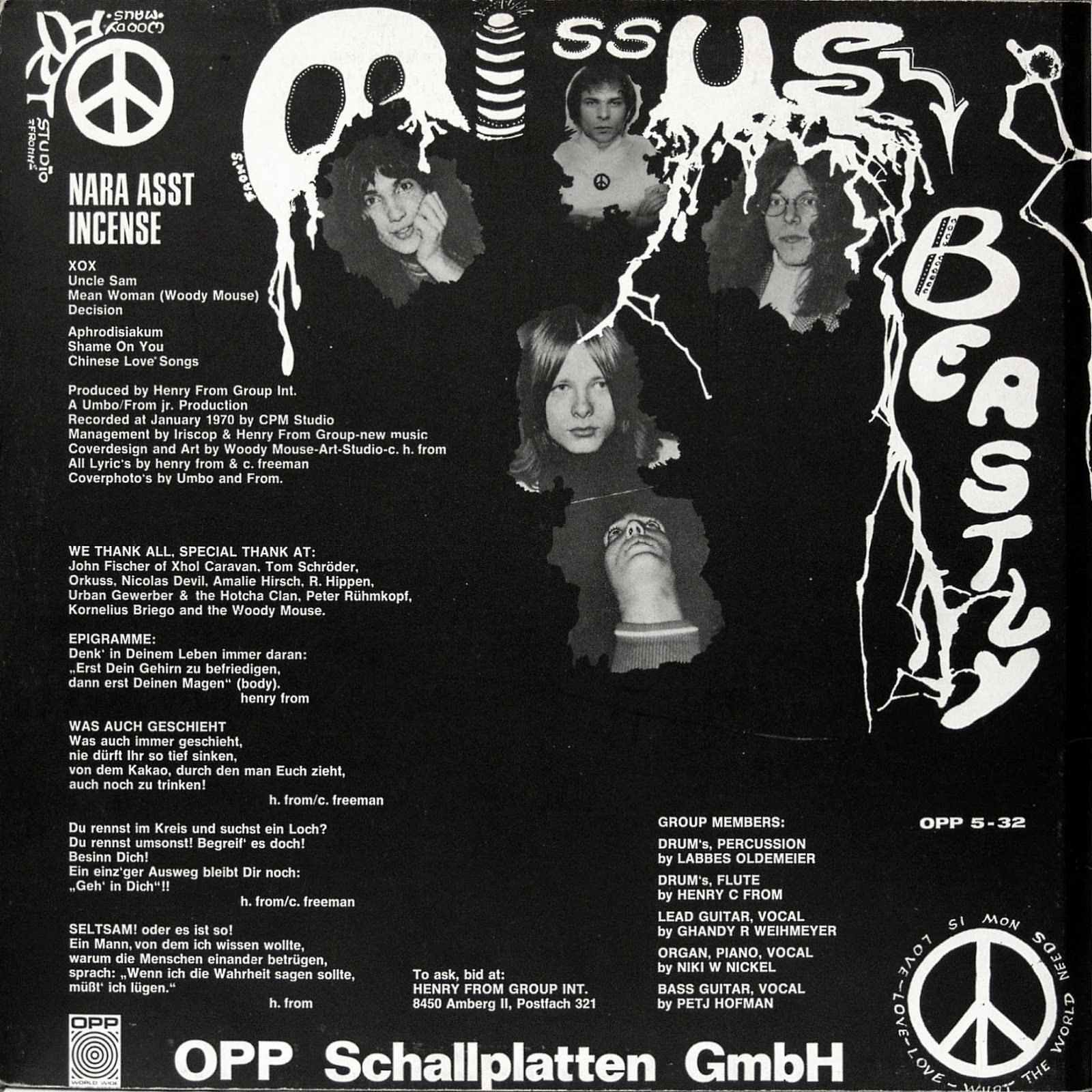
MISSUS BEASTLY – Nara Asst Incense (OPP World Wide – OPP 5-32 / LP-1970)


Label: OPP World Wide – OPP 5-32
Format: Vinyl, LP, Album, Partially Unofficial / Country :Germany / Released: 1970
Style: Blues Rock, Krautrock, Psychedelic Rock, Prog Rock
Recorded at January 1970 by CPM Studio, Germany.
Design – Woody Maus Art Studio
Coverphoto's by – Umbo and From
Produced by – Henry From Group Int.
Matrix / Runout (A digits stamped, literals etched): OPP 5-32 A
Matrix / Runout (B digits stamped, literals etched): OPP 5-32 B

Note:
This is Unlicensed release of the initially private CPM release from the same year with different artwork and slighty different tracklisting. Laminated front cover. / Wrongly printed the name of bassist Petja Hofman. (writes Petj, the letter "a" is omitted).
Original released: CPM ‎– LP S 002
Reissue / Garden Of Delights ‎– LP 012 (Limited Edition of 1.000 copies)

A1 -  XOX .............................................................................................................. 1:26
A2 - Uncle Sam ..................................................................................................... 5:39
A3 - Mean Woman (Woody Mouse) ...................................................................... 7:57
A4 - Decision ......................................................................................................... 2:55
B1 - Aphrodisiakum ............................................................................................... 8:56
B2 - Shame On You ............................................................................................... 8:57
B3 - Chinese love Song ......................................................................................... 1:01

Line-up / Musicians:
Atzen Wehmeyer / guitar, vocals
Wolfgang Nickel / keyboards
Petja Hofman / bass, vocals
Lutz Oldemeier / drums, percussion

Guests:
Hansi Fischer / flute
Chris Karrer / guitar
John Weinzierl / guitar
Dieter Serfas / drums


The first two LPs of Missus Beastly did not have a title, a circumstance causing considerable confusion. The first one appeared on CPM in 1970, the second on Nova in 1974.
On September 2nd, 1974, shortly after putting out their second LP, Missus Beastly had a gig in the Bremen Post-Aula. The concert was broadcast by Radio Bremen in their program "Jazz live". Luckily, the master tape was kept by the station over the decades and was made available for the CD/LP release. The three long tracks are not to be heard on any Missus Beastly LP. Keyboarder Dieter Miekautsch had meanwhile left the group; instead, the great guitarist Eddy Marron – well-known for playing with Vita Nova and Dzyan and his long-standing co-operation with Peter Giger – had joined them.

"Missus Beastly" from Herford were among the most famous German psychedelic and jazz-rock bands, with the most confusing history of all of them.
Formed circa 1968 in Herford near Munich, the history of Missus Beastly is confused to the extreme! Apparently the reason for such confusion is three-fold: because of their manager, constant line-up changes, and that being born in the psychedelic era they were obviously all pretty spaced! The original band were among the most underground and psychedelic of German bands.

MISSUS BEASTLY 's/t' LP-1970
The re-issuance was made the same year, (Partially Unofficial) on the label OPP World Wide (OPP 5-32) under the name "Nara Asst Incense" with the same tracks in a different order and with a totally new cover artwork.

 Original released: CPM ‎– LP S 002

This is the (first) nameless album of MISSUS BEASTLY - a band from my little hometown Herford. When they produced it in 1970 I was 14 years old - a litte bit too young to follow up the first steps of the band. Later I had closer contact to guitarist Atzen Wehmeyer for some time - but not related to music primarily. We worked together in a social project for children and he had formed another band named EINHORN in the meanwhile after he left MISSUS BEASTLY. So to review this album is something special for me because reminding a lot of experiences from that time.
They had chosen a psychedelic painting for the cover which was absolutely reflecting the music they played at that time. Their gigs often worked like happenings though, differing to what normally would be considered as a concert. They simply played what came into their minds in an intensive stirring mood - breaking all rules - and that finally caused the band's special reputation and success. They had been invited to play at two important german music events - at Burg Waldeck Festival and the Essener Pop & Blues-Festival. It is also known that someday the audience catcalled the main group THE MOVE at the Herford Jaguar-Club because they wanted to hear more from their favourite band.

It is fairly applicable to say that this is krautrock. MISSUS BEASTLY offers a blend of different music styles based on the blues - sometimes psychedelic coloured, sometimes jazz influenced and decorated with some weird insertions. The song material was worked out by accident in the same way as the gigs happened. It didn't match with what the band played live. Some of the songs never were presented on a stage. Hansi Fischer, the flute player of XHOL CARAVAN, appears on one song and the sessions were additionally supported by the AMON DÜÜL II members Dieter Serfas, Chris Karrer und John Weinzierl...


...The short opener XOX is presented in a weird krautrocked mood - a short jam with distorted organ and guitar later fading into a backward spoken word part contributed by Atzen Wehmeyer. The textual content is harsh as it was usual at that time and defends the hippie subculture. Uncle Sam follows as a more blues inspired song - composed by Petja Hofman when the soundman was justifying the microphones! Vocals are rare and then the band jams once more in free form returning back to the main theme at the end.

Shame On You comes much more hippiesque first with acoustic guitar, percussion and flute. And then the band suddenly switches to a jazzy atmosphere whereas Wolfgang Nickel and Atzen Wehmeyer are swirling around nicely with their instruments. Another song which was composed spontaneously during the recordings was Decision - heavy rocking this time and one of the most accessible songs of the album. Chinese Love Song belongs to the highlights by all means because very weird - the vocals are a pun somewhat with rhyming words in german and this could be used at Halloween for eample - to frighten a lot of people without any problem. The deep bluesy Mean Woman and the instrumental and more grooving Aphrodisiakum are finally usual proper played songs with some improvised portions here and there.

Generally MISSUS BEASTLY is associated with jazz rock/fusion. And considering the whole discography this suits by the way. But this band has an eventful history with some changes and a lot of musicians. And they started with a krautrock album as many other german bands did in the same way. Definitely recommendable if you are searching for early german output reflecting the transition from the 60s to the 70s with a special spirit of optimism and pleasure to experimentalize.

(Review by Rivertree / Prog Reviewer)


If you find it, buy this album!