Thursday, December 5, 2013

The UNIT: CECIL TAYLOR in 1978 – "Cecil Taylor Unit" (LP-1978), "3 Phasis" and "Live In The Black Forest", LPs-1979


Label: New World Records – NW 201
Format: Vinyl, LP, Album; Country: US - Released: 1978
Style: Free Jazz, Avantgarde, Free Improvisation
Recorded in April 1978 at Columbia Recording Studios, 30th Street, New York, NY.
Artwork [Cover] – David X. Young; Design [Cover] – Elaine Sherer Cox
Engineer [Recording, Editing, Mixing] – Don Puluse
Mastered By – Ted Jensen

A1 - Idut  14:40
A2 - Serdab  14:13
B - Holiday En Masque  29:41

Cecil Taylor (piano) Jimmy Lyons (alto saxophone) Raphe Malik (trumpet) Ramsey Ameen (violin) Sirone (bass) Ronald Shannon Jackson (drums)

The Cecil Taylor Unit (band and album) announces itself with “ Idut, ” a piece running just under 15 minutes. The first sound we hear is Ameen’s violin, bolstered by Sirone’s bowed bass. The two men attack the strings in sharp and jagged fashion, reminiscent of an Elliott Carter string quartet. After a few seconds, Malik’s trumpet enters, a fountain of rich, full notes like a fanfare announcing a king. Lyons, for his part, offers boppish phrases full of life and joy. This is an erupting music.

Behind everything else, Taylor is there, striking the keyboard with great force, rumbling at the low end of a ninety-six key Bösendorfer, similar to the instrument he plays on the solo albums Air Above Mountains and The Willisau Concert, from 1975 and 2000 respectively. This is an imposing instrument, the ideal vehicle for a player of Taylor’s intensity and rigor. But it’s best heard by itself; surrounded by other sounds, its strength is diminished slightly. At the 90- second mark, when all the other instruments drop away, leaving only the piano, the purpose of all that hurtling exposition becomes clear—the band was setting the stage for Taylor, whose high-speed runs and teeth-rattling rumbles are accented by thunderous rolls from Ronald Shannon Jackson. The piece shifts again and again in this manner, offering solo piano passages, duos between Taylor and various other bandmembers, duos and trios, and explosive sections involving the entire band.

The album’s second track, “ Serdab, ” is much quieter. There are still moments of thrilling fire and fury, but Taylor’s solo passages are longer and more frequent, with Jackson pitter-patting behind him, creating rhythm (he ’ s a totally unique jazz drummer in that he plays marching-band and militaristic rhythms as often as he swings or grooves) without imposing it. It’s an interlude of gentle beauty, a bridge between the opening fanfare and thunder of “ Idut ” and the cataclysm that is the album’s second half.

“ Holiday en Masque ” is a half-hour, album-side-long avalanche of sound. The liner notes to the album, written by Spencer Richards , describe it as a “ masterful achievement in ensemble playing, ” and it truly is that and more. The dominant voices are Taylor’s and Ameen’s, with Jackson rattling and crashing in the back. At times the horns and strings and piano are so loud the drums can barely be discerned, even though they’re being played with as much energy as any other instrument in the studio. At other times, Jackson’s rhythms are quite clearly audible, his kit sounding more like one belonging to a hard rock drummer than a jazz player. He’s got a massive kick drum sound going on, and his toms slam like heavy wooden doors battered by a hurricane. Unison passages, arising out of the overall storm of sound like rainbows arcing between thunderclouds, reveal the scored nature of this music and the intense, focused rehearsals Taylor called before the recording began. As Ameen, who also contributed liner notes to The Cecil Taylor Unit (and was the only member of the band to do so), points out, “ Because in fact he has continued to make music of overwhelming originality, Cecil Taylor has been increasingly successful in exercising his right to determine the working conditions such music requires—in particular, pianos of the best quality, and extensive practice and rehearsal…This record was prepared under Taylor’s artistic direction and is a document not only of his power of musical expression but also of the success of the comprehensive working methods and the fierce independence he has developed and maintained during the past quarter of a century. ”


Label: New World Records – NW 303
Format: Vinyl, LP, Album; Country: US - Released: 1979
Style: Free Jazz, Avantgarde, Free Improvisation
Recorded in April 1978 at Columbia Recording Studios, 30th Street, New York, NY.
Artwork [Cover] – Paul Jenkins; Design [Cover] – Michael Sonino
Engineer – Don Puluse
Mastered By – Ted Jensen

A - 3 Phasis, Side One  28:22
B - 3 Phasis, Side Two  28:50

Cecil Taylor (piano) Jimmy Lyons (alto saxophone) Raphe Malik (trumpet) Ramsey Ameen (violin) Sirone (bass) Ronald Shannon Jackson (drums)

The second album by this group, 3 Phasis, was recorded on the final day of the sessions, and the issued take is the final one (of six), a performance that ran beyond the scheduled time and into overtime. According to the album notes by jazz critic Gary Giddins , the earlier versions all ran in the 20-30 minute range. The issued performance is a marathon, even an endurance test, at 57:17, but not a moment of that is wasted on vamping, casting about for inspiration, or anything but the most intense playing of which the group members are capable.

The piece begins with solo piano, but again the strings are the first instruments to join the fray. Ameen and Sirone come in bowing, with Lyons ’ alto saxophone keening romantic ballad melodies, Malik ’ s trumpet squalling in a less florid, more sardonic way than on the previous album…and Jackson announcing his arrival with tremendous, rolling-thunder assertiveness.

The horns keep dropping out, though, and the piece becomes chamber music with drums. Passages of violin and piano, or violin and bass, Ameen jabbing sharply into the airspace between himself and Taylor with shrieks of the bow not unlike Bernard Herrmann ’ s famous score for Alfred Hitchcock ’ s movie Psycho. Ameen adds more than classical filigree to this music, though. He ’ s also prepared to be a hillbilly fiddler when the occasion calls for it, conjuring the spirit of African-American string bands (violin, banjo, upright bass) with a single raucous phrase behind the horns.

Giddins was present at the recording, and wrote the liner notes to the album. He describes the recording engineer’s panic as the take that was eventually released runs longer and longer, finally coming to a halt just shy of the one-hour mark (and consequently nudging the limits of 33 1/3 rpm vinyl’s storage capacity).

“ Previous takes had averaged twenty to thirty minutes and seemed to get tighter each time,” Giddins writes. “ The fifth take produced a splendid array of dynamics and a rollicking dance exuberance, but saxophonist Jimmy Lyons was dissatisfied with his solo, and there was a general feeling that an earlier take had been more successful. Taylor decided to work on some of the other pieces, and it wasn’t until midnight that they returned to the suite. From the first notes, there was an excitement in the studio, an electricity, and after about twenty minutes producer Sam Parkins said, ‘ This is the best yet by far. If Jimmy Lyons holds up in the shuffle, I don’t care how long it goes. ’ Later Parkins noted, ‘ This is more of a piano concerto than the others.’ A significant difference between this and earlier versions was that Sirone, the bassist, who had previously played mostly against the rhythm, now fell into a steady 4/4 shuffle meter (heard in the second half). Taylor conducted the music from the piano without eye contact, as the others stood poised. Lyons, awaiting his entrance, lit a cigarette. Then the shuffle started: Taylor instigated a rocking stomp with chords in both hands; Sirone bore down on the time; drummer Ronald Shannon Jackson alternated between mallets and sticks; Lyons steamed through like a train. After about forty minutes, Parkins exulted, ‘ We’ve got a record now! ’ —but ten minutes later he was worried about whether Taylor would stop in time: ‘ I hope he stops pretty soon, because I’d hate to cut this. I ’ ve never been to anything like this before, have you? ’ Taylor punched out a riff, his hands leaping as fast and deft as a cheetah, his arms almost akimbo. Everyone was eyeing the clock nervously and with giddy excitement. And then, nearing fifty-seven minutes, just short of the maximum playing time for a long-playing album, Taylor began to wind down for a dramatic finish. Observers burst into the studio with excited praise, and the laconic Taylor was heard to say, ‘ Well, you know we knew it was good, too. ’”

Taylor didn’t typically go on the road with the same bands he recorded with. Throughout his career, studio sessions have been relatively rare; live recordings make up the bulk of his discography. But in 1978, he took this Unit on the road for several weeks of shows in Europe, at least three of which were documented, two of them on albums that are among his greatest work.


Label: MPS Records – 0068.220
Format: Vinyl, LP, Album; Country: Germany - Released: 1979
Style: Free Improvisation, Free Jazz
Recorded live on 3 June 1978 in SWF-Radio JazzConcert in Kirchzarten, Black Forest, West Germany.
Artwork – Müller & von Frankenberg
Engineer – Norbert Klövekorn; Producer – Joachim E. Berendt

A - The Eel Pot   24:57
B - Sperichill On Calling   25:08

Cecil Taylor (piano) Jimmy Lyons (alto saxophone) Raphe Malik (trumpet) Ramsey Ameen (violin) Sirone (bass) Ronald Shannon Jackson (drums)

Live in the Black Forest was the first to appear, on the unjustly obscure MPS label. Featuring two 25-minute pieces recorded on June 3 for broadcast on German radio, it’s a somewhat more “ crowd-pleasing ” and less abstruse set of music than the Unit ’ s self-titled debut or the crushing 3 Phasis. The first piece, “ The Eel Pot, ” begins with solo piano, followed quickly by the entry of Malik and Lyons (playing unison phrases) and then Ameen. Jackson hits huge thunderous tom rolls, and the band has become fully present. Then things can truly get started. Piano and trumpet exchanges, violin and alto saxophone tinkering at the margins. Martial drumming. There’s bass work, but it’s not particularly high in the mix at first; only later does Sirone’s forceful plucking assert itself, when the group becomes, of all things, a piano trio, albeit the most aggressive one I’ve ever heard. Jackson is playing something close to a death metal blast beat, as Taylor dances across the keyboard like a maniac and Sirone throbs between them. The next player to re-enter after this thunderous passage is Ameen, offering almost Bela Bartók -like stabs as though to pay tribute to the concert’s central European location. He and Taylor duet passionately, with Sirone still lingering in the background. Eventually, the full ensemble returns to roaring life, and the piece comes to a raucous close, celebrated by wild applause from what sounds like a large audience.

The disc’s second half, “ Sperichill On Calling, ” is more or less in the same spirit as its predecessor, but it’s less aggressive, a midtempo marathon with occasional eruptions. Around the 11-minute mark, Jackson bursts into a particularly aggressive drum solo, smashing the cymbals and battering the snare, as Malik’s trumpet unleashes a repeated, fanfare-like figure. Malik gets a lot of solo space during “ Sperichill, ” his rippling upper-register lines extraordinarily full and vibrant. When Taylor takes the lead, his playing is often quite delicate; during one quiet passage, he and Ameen duet totally unaccompanied, and it’s possibly the album’s high point. Again and again throughout this group’s discography, it becomes unmistakable that the violin is the most important instrument, besides the piano, to the whole project. Two decades later, on Algonquin (recorded 1999, released 2004), Taylor would explore this combination of sounds again, in a live duet with violinist Mat Maneri at the Library of Congress.

_ Story by PHIL FREEMAN

The fourth part see:
http://differentperspectivesinmyroom.blogspot.com/2013/11/cecil-taylor-one-too-many-salty-swift.html


Links in Comments!

Monday, December 2, 2013

VINNY GOLIA – Openhearted (LP-1979)


Label: Nine Winds Records – NW-0102
Format: Vinyl, LP; Country: US - Released: 1979
Style: Free Jazz, Avant-garde Jazz
Recorded Feb. 7, 1979 at U.C.L.A., Melnitz Hall, Los Angeles, CA.
Composed By, Arranged By  – Vinny Golia
Producer – Vinny Golia
Cover Design By – Vinny Golia and Alex Cline
Published By Nine Winds Music

A1 - Alone - A) ...At Nite B) Try Toane  -  11:18 
A2 - #14 - A "Conversation" Piece  -  6:15
A3 - The Happy... - For My Friends In L.A.  -  6:10

B1 - Pulse - ..Striving To Ascend...  -  6:13
B2 - The Presence - "..A Dedication To The All-seeing Eye..."  -  8:04
B3 - Dance For O.C. - ..Thanks For A Conversation In '69 And A "Special" Meeting A Remingtons..."  -  7:58

Vinny Golia – alto / bass clarinet, soprano / tenor / baritone saxophone, flute [C- / alto]
Baikida Carroll – trumpet, flugelhorn
Nels Cline – guitar
Roberto Miranda – bass
Alex Cline – drums, percussion


Vinny Golia / Alex Cline

The second LP from Nine Winds features the versatile avant-gardist Vinny Golia playing six originals that feature him on alto flute, soprano, clarinet, bass clarinet, tenor and baritone.
Golia is joined by trumpeter Baikida Carroll, bassist Roberto Miranda, drummer Alex Cline and (on three of the six numbers) guitarist Nels Cline. From sound explorations to free bop, the advanced music always holds one's interest and has plenty of unexpected tone colors.


Links in Comments!

Saturday, November 30, 2013

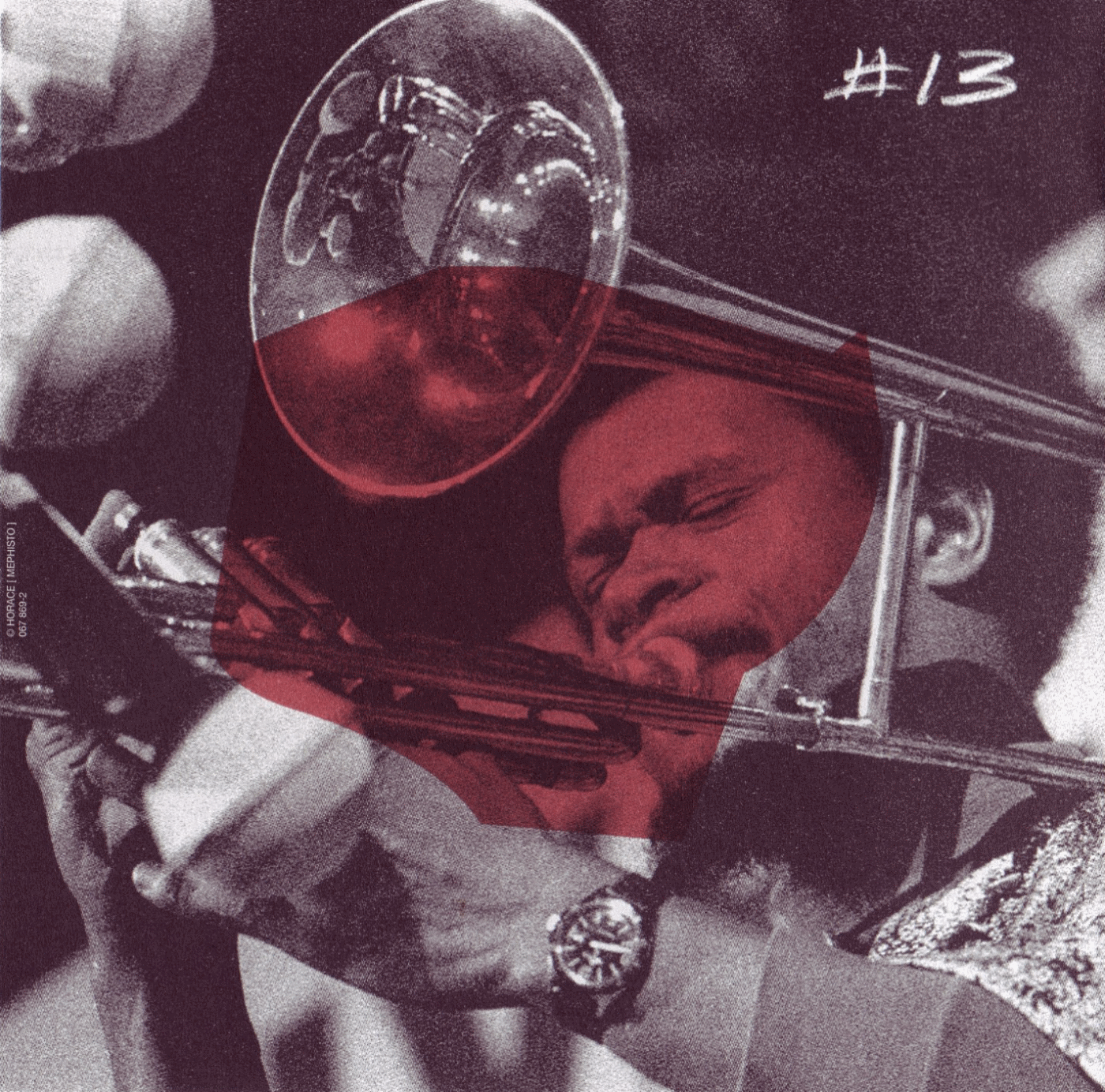
CLIFFORD THORNTON QUARTET – The Panther And The Lash (1970) - Re-2004


Label: America Records – 067 869-2
Series: Free America – #13
Format: CD, Album, Reissue, Remastered, Limited Edition
Country: France - Released: 2004
Style: Free Jazz, Free Improvisation
Live concert at "La Maison de la Radio" (ORTF) Paris on November 7, 1970
Art Direction, Design, Painting – Gilles Guerlet, Jérôme Witz
Liner Notes – Philippe Carles
Photography By [Paintings] – Fredéric Thomas
Producer – Pierre Berjot
Reissue Producer [Prepared For Reissue By] – Bruno Guermonprez
Supervised By [Reissue] – Daniel Richard
Transferred By [Transfers], Mastered By [Mastering] – Alexis Frenkel


The album title, referencing the first truly great anthology of poetry written by an African- American, Langston Hughes's 1926 book of the same name, nails Clifford Thornton's political colors firmly to the mast, and they're black. Described, with some justification, by Philippe Carles, the co-author of the seminal Free Jazz Black Power, as the quintessential free jazz performer, Thornton is in absolutely breathtaking form throughout this live set recorded in Paris on November 7, 1970, on which he plays not only the cornet but also trombone, piano, percussion, and shenai, accompanied by the cream of the crop of the local free music warriors, pianist François Tusques and bassist Beb Guérin, as well as the woefully under- recorded American expat drummer Noel McGhie. It's one of the highlights of the America back catalog and its reissue is cause for celebration. Thornton was able, in an all too brief career (he died in Geneva in relative obscurity in 1989), to sign three truly great free jazz albums under his own name. The Panther and the Lash fills the gap between Freedom & Unity (recorded on the day after Coltrane's funeral in 1967, reissued by Atavistic in 2001) and 1975's Jazz Composers Orchestra outing The Gardens of Harlem (JCOA), and is just as indispensable. _ (AMG)


Enjoy. This is one incredible recording.


Links in Comments!

Thursday, November 28, 2013

ARCHIE SHEPP / CLAUDE DELCLOO and the FULL MOON ENSEMBLE – Live In Antibes Vol.1 & Vol.2 (LPs-1971)


Label: BYG Records – 529.338  -  (vol. 1)
Series: Actuel – 38 Format: Vinyl, LP, Country: France/US - Released: 1971
Style: Free Jazz, Free Improvisation, Avant-garde Jazz
Recorded live at Antibes - Juan les Pins Jazz Festival, July 18, 1970, by O.R.T.F.
Producer – Jean Georgakarakos, Jean-Luc Young

Archie Shepp And The Full Moon Ensemble:
CLIFFORD THORNTON (trumpet, piano), ALAN SHORTER (flugelhorn), ARCHIE SHEPP (tenor saxophone, piano, recitation), JOSEPH DÉJAN (guitar), BEB GUÉRIN (bass) CLAUDE DELCLOO (drums)

A - The Early Bird (Part 1)  -  22:16
B - The Early Bird (Part 2)  -  26:31


Superb live recordings (dated July 18 and July 20, 1970) captured in France at the Antibes- Juan Le Pen Jazz Festival. Archie Shepp and the Full Moon Ensemble (featuring Clifford Thornton on piano and trumpet, Beb Guerin on bass and Claude Delcloo on drums) play through four long tracks with an intensity that still sounds fresh more than four decades later."


Label: BYG Records – 529.339  -  (vol. 2)
Series: Actuel – 39 Format: Vinyl, LP; Country: France/US - Released: 1971
Style: Free Jazz, Free Improvisation, Avant-garde Jazz
Recorded live at "Antibes - Juan-les-Pins" Jazz Festival, July 20, 1970, by O.R.T.F.
Producer – Jean Georgakarakos, Jean-Luc Young

Archie Shepp And The Full Moon Ensemble:
CLIFFORD THORNTON (trumpet, piano), ALAN SHORTER (flugelhorn), ARCHIE SHEPP (tenor saxophone, piano, recitation), JOSEPH DÉJAN (guitar), BEB GUÉRIN (bass) CLAUDE DELCLOO (drums)

A1 - Huru (Part 1)  -  26:15
B1 - Huru (Part 2)  -  22:40


Like many saxophonists and jazz musicians in general, Archie Shepp moved to New York City in 1959 in search of becoming a professional musician. Things moved slowly, but by 1965 he had performed with pianist Cecil Taylor and had made the acquaintance of several musicians in the burgeoning free jazz or "new thing" cadre. Most importantly was his relationship with the great saxophonist John Coltrane who recommended him for Impulse Records. Shepp recorded for about a decade with Impulse, but also for other labels like BYG/Actuel which released this concert featuring Shepp on tenor saxophone, piano and vocals, Clifford Thornton on trumpet and piano, Alan Shorter on flugelhorn, Joseph Dejean on guitar, Beb Guerin on bass and Claude Delcloo on drums. The album is taken from two concerts at the French jazz festival in 1970 with "The Early Bird: Parts 1 and 2" on the Vol. 1 and then "Huru: Parts 1 and 2" on the Vol. 2. The music is very wide open and seems use piano as its anchor, with either Shepp or Thornton laying down massive slabs of dark keyboards that lock in with the deeply percussive bass and drums to give the music a haunting and hypnotic effect. Shepp takes a lengthy saxophone solo on "Huru: Part One" where he ranges from deep guttural moans to high energy squalls and howls. "The Early Bird" he incorporates vocals and shouts from his composition "Mama Rose" into the overall fabric of the performance. This is a very interesting and freewheeling set of music. It is a fine example of the way that jazz had evolved in the early 1970's. Incorporating elements of African music as well as the past and present in jazz, it makes for compelling listening.

_ By Tim Niland (MusicandMore)
http://jazzandblues.blogspot.com/2013/07/archie-shepp-and-full-moon-ensemble.html


Links in Comments!

Monday, November 25, 2013

MUHAL RICHARD ABRAMS featuring MALACHI FAVORS – Sightsong (LP-1976)


Label: Black Saint – BSR 0003
Format: Vinyl, LP, Album; Country: Italy - Released: 1976
Style: Free Jazz, Free Improvisation
Recorded at Generation Sound Studios, New York on October 13-14, 1975.
Engineer – Tony May
Producer – Giacomo Pellicciotti
All songs written by Muhal Richard Abrams except "Way Way Way Down Yonder" (Malachi Favors).

A fantastic record – and one of the warmest, most soulful sets we've ever heard from Muhal Richard Abrams! The album features Muhal's piano alongside the bass of Malachi Favors – a really unique duo outing that unlocks a whole new side of both players, especially Favors, who really seems to have a presence here that's different than usual – a bubbling, effervescent sense of soul that really buoys up the whole record, and helps Abrams hit these beautifully lyrical tones on the piano. We can't recommend this one highly enough, and the tracks include "W.W. (Dedicated to Wilbur Ware)", "JG", "Way Way Way Down Yonder", "Unity", and "Two Over One". _(Dusty Groove, Inc.)


"The reputation of members of the AACM (Association for the Advancement of Creative Musicians), of which Abrams is a founding member, has long been one of adventurous, dangerous, and difficult music. But in fact, much of the music created out of this organization shows enormous appreciation of the blues and earlier jazz forms. Sightsong is a splendid case in point. The album opens with four duets (two dedicated to Chicago legends Wilbur Ware and Johnny Griffin) which have a swing, a groove, and a delicacy that no fan of "straight- ahead" jazz could ignore. Favors, always one of the great underrated bassists in the music, provides a thick, soulful pulse and solos with huge imagination while Abrams always stays within the song's parameters which provide ample room for his creativity. As fine as these more "traditional" numbers are, the standout piece is perhaps Favors' solo feature, the wonderfully titled "Way Way Way Down Yonder." Opening with what sounds like the riffled pages of a book, Favors then states the deep, bluesy theme with strutting authority and proceeds through one of the richest investigations of the string bass the listener is ever likely to hear. Sightsong is one of Abrams's finest recordings and is also perhaps the best showcase for Malachi Favors' talents outside of his seminal work with the Art Ensemble of Chicago."

_ By BRIAN OLEWNICK (AllMusic.com)


Links in Comments!

Saturday, November 23, 2013

ALAN SILVA and THE CELESTRIAL COMMUNICATION ORCHESTRA – Seasons (3LP-1970)


Label: BYG Records – 529.342-43-44
Series: Actuel – 42 / 43 / 44
Format: 3 × Vinyl, LP, Album; Country: France - Released: 1970
Style: Free Jazz, Free Improvisation
Recorded live at Studio 104, Maison de L'O.R.T.F. Paris, December 29, 1970.
Executive-Producer – Jacques Bisceglia, Pierre Lattes
Photography By – Jacques Bisceglia
Producer – Jean Georgakarakos, Jean-Luc Young
Recorded By – Guy Level
Supervised By – Pierre Lattes


Recorded live (three-LP set) at Studio 104/Maison De L'O.R.T.F., Paris, France on December 29, 1970, remarkable gargantuan effort by bassist and composer Alan Silva, for which the term "masterpiece" is not too far a stretch.
This is a magnificent, rambling, chaotic, lavish, and often meandering spectacle that should be heard in one sitting to be completely appreciated. It is a spectacular presentation, with snippets of melodies (or more precisely, riffs) interspersed among the soloists, who include Silva, Steve Lacy, Lester Bowie, Joseph Jarman, Roscoe Mitchell, Robin Kenyatta, Michel Portal, and Joachim Kühn, to cite the more recognizable names. The results are absolutely thrilling, if not always inspiring, and there are many high points. While individual improvisers are difficult to identify, the level of improvisation remains consistently at the highest levels. It is wild and free, and the listener receptive to free improvisation is likely to be held in rapturous attention. Destined to be a classic of its genre, Seasons offers a full-scale radical bombardment from many perspectives, resulting in a smorgasbord of delights. While listening to so much at once is a challenge, the patient listener willing to put in the effort should be fulfilled and rewarded amply.

_ By STEVEN LOEWY


Links in Comments!
 

Wednesday, November 20, 2013

EQUAL INTEREST: Joseph JARMAN, Leroy JENKINS, Myra MELFORD – Equal Interest (1999)


Label: OmniTone – 12001
Format: CD, Album; Country: US - Released: 1999
Style: Contemporary Jazz, Free Improvisation
Recorded live on 2-3 August 1999 at Sear Sound, New York.
Engineer – Tom Schick; Engineer [Assistant] – Todd Parker
Executive Producer – Frank Tafuri
Liner Notes – Frank Tafuri
Mastered By – Bob Ward
Producer – Equal Interest, Frank Tafuri

Midwest sensibilities and New York attitude converge in an energizing collective, fusing jazz, blues, classical and folk musics. Comprised of two veterans of Chicago's venerable AACM (saxophonist Joseph Jarman and violinist Leroy Jenkins) and "downtown" NY pianist Myra Melford, Equal Interest explodes with sensual, exotic, even mystical sounds, bridging the past, present and future. Pushing and groovin' new jazz for the new millennium.


At the vanguard of the past and present creative improvised jazz movement, these three brilliant musicians come together in continually surprising ways. The depth of their collective spirituality is most impressive, but the music virtually bursts with passion and vibrancy. There is also an equally shared compositional stance. Jenkins (on violin and viola) contributes "B'Pale Night," with swirling melodic improvs surrounding Jarman's alto sax and blue string counterpoint, Melford's piano circling around it all, plus some cartoonish unison lines. "In the Moment" emphasizes harder-edged, darker spontaneity, rich in counterpoint, demonstrating intense listening and responding. Jarman gives the trio another two pieces: "Rondo for Jenny" has Melford on harmonium as a South Indian-based flute-violin unison and Vietnamese oboe solo bring about an air of stark mysticism, while the 13-minute-plus "Poem Song" is one of the more beautiful pieces of music you will ever hear -- fanfare viola introducing serene, meditational flute and delicately constructed, flowing piano. Of Melford's three pieces, "Over This/Living Music" splits time between her 5/4 piano, which sets the pace for skittering violin and flute, and gently plucked strings which back Jarman's solo, with more pensive call and response at the end. "The Beauty We Love" has swelling harmonium under layered strings and alto, while "Everything Today" sports a 6/8 start-up, more free alto, repeated piano lines, and Jenkins' scattershot strings joining clever, spirited, uplifting writing. The finale is a traditional Armenian piece, "Apricots for Eden"; Jarman's tambourine-sounding Turkish hand drum and Melford's harmonium travel at a patient pace, then are inspired to dancing motifs. Following up the prelude to this recording, Out of the Mist (Ocean), this trio has exploded into a most impressive improvising unit that will hopefully continue to bring us miracles like this highly recommended CD.

_ By MICHAEL G. NASTOS (AMG)


Links in Comments!