Wednesday, September 12, 2012

PETER KOWALD and WILLIAM PARKER – The Victoriaville Tape (2003)


Label: Les Disques Victo – VICTO CD 088
Format: CD, Album; Country: Canada
Released: 10 Jun 2003
Style: Free Improvisation
Recorded on 19 May 2002 live at Festival International de Musique Actuelle de Victoriaville


Note:

On May 19, 2002, Peter Kowald and William Parker played a duo set at the Festival International de Musique Actuelle de Victoriaville .

JazzTimes (11/03, p.104) — "There is no doubt that Kowald and Parker generate an expansive sound together....The two men create a slowly shifting field of pure sound, sometimes out of which emerge small moments of furious walking bass or fragments of melody."


Review:

Both bassists had made regular appearances in Victo over the past two decades, but no one in the audience could have guessed that it would be Kowald's last. The German improviser died in New York City four months later. The French-Canadian radio was not recording this concert, but the mixing desk engineer kept a tape rolling, just in case, and negotiations toward the release of this performance were already in progress when fate struck. Now, as the listener, you can decide whether or not to "hear" this album as a normal performance or as a farewell, but it's suggested you choose the latter. Why? Because, all in all, The Victoriaville Tape is a rather ordinary offering from extraordinary musicians. There are moments in "Arrival" and "Conversation" when the sound of the two basses becomes overwhelmingly claustrophobic, each player trapped in his own world without stepping into the other guy's sphere. When Kowald starts singing 24 minutes into the 41-minute "Conversation," it sounds unnecessary. That said, there is magic on this record, especially in the last minutes. The two shorter tracks ending the set are nothing less than fabulous. "Departure" drones in a rapturing way, soothingly beautiful after the monolithically hyperactive monster that came before it. This refreshing dip opened new doors of communication between the bassists for the encore "Farewell." One wishes the concert had started just then, but as it is, The Victoriaville Tape makes a decent album and, circumstances considered, a worthy document.

~ François Couture, All Music Guide


Welcome to new prog-blog "Different Perspectives In My Room...!".
Enjoy the music, and please leave a comment. Thanks in advance.


Link in Comments!

Tuesday, September 11, 2012

AXEL DÖRNER, JOHN SCHRÖDER, CLAYTON THOMAS, OLIVER STEIDLE - Das Treffen (2009)


Axel Dörner, John Schröder, Clayton Thomas, Oliver Steidle - Das Treffen, 2009
Label: Jazzwerkstatt; Catalog#: jw059
Country: Germany
Recorded at Studio P4, Nalepastraße, Berlin, December 12 & 13, 2008
(avant-garde, free improvisation, Contemporary Jazz, Free Jazz)


Note:

The first time in Chicago was all settled yet by phone, then there was the end of the salary barely above what. With e-mail, it now costs almost nothing to organize contacts and concert performances, as well as the flights are cheaper. If the trumpeter Axel Dörner reported his concert tours - actually, he's the whole year in the wide world of improvised music on the go - then it is not surprising bad. Dörner does not have a web presence, and his phone is often turned off, but the influential American jazz magazine Down Beat him one of the handful of European musicians, who will be able to jazz of the 21st Century add important and visionary music. In June, he will meet with Alexander von Schlippenbach and the band go The big disappointment on tour of Canada in order to present the complete works of Thelonious Monk in a new and pleasurable cooked version. At the trade fair Jazz Ahead, held just in Bremen, the jazz festival director Ken Pickering from Vancouver already enthused by the great music of the Berlin band and told how long you've been working on her tour. Dörner aware of his importance in the scene, international awards confirm him as the great innovators and experts. About the precarious situation in the field of improvised music he makes still worried. That one on the jazz show in Bremen but everywhere got the feeling that the world is watching Berlin, even if the European capital of jazz really was the theme at any of the numerous panel discussions, is good. Whether the highly subsidized French and Danes: they afford to own all festivals in Berlin and want to benefit from the creative atmosphere of the city. Even Alex Dutilh, chief of Jazzman, the main French jazz magazine plans to later this year, a Berlin- based businesses. The current issue can be found ever a portrait of the Berlin bassist Clayton Thomas, who is one of the key drivers of the local scene. His presentation tool includes rods and strips of wood and metal, a battered Australian car license plate, Filzklöppel and bows. As he puts these things between the strings, pushes and hits, he elicits from his instrument sounds that act strange, defiant and sometimes quite funny. That the people that you talk so much elsewhere in Berlin now also appear together fits. On Saturday, 2 May, they celebrate on the big stage debut: Along with John Schroeder, piano, and Oliver Steidle, drums, and Thomas Dörner occur in the Babylon under the name "Das Treffen ” (The meeting) on (20 clock).

By Christian Broecking


Review:

Bassist Clayton Thomas is known to wedge a license plate between his strings and lists both Luigi Nono and Ghostface Killah as influences. A search for John Schröder's career shows that he's as respected a jazz guitarist as a drummer as a protege pianist. Downtown sound by way of Nirnberg Music Conservatory drummer / human metronome Oliver Steidle (currently on permanent tour with trio Der Rote Bereich, then Klima Kalima, et cetera) recently added a Korg Kaoss Pad to his kit. And, from Thelonious Monk tribute bands to interpretations of Cage-esque performance art works to classically trained pianist to adept trombonist to feedback tweaker to trumpeter, Axel Dörner also wears many hats. So you better hang on to yours (you know...your hat?)

Recorded in 2008, the quartet begins "Res Res" with an analog warble and frantic typewriter style metal pings, Schröder quickly adding to the mulch with high-pitched prepared arpeggiations (on this disc, he has a tendency to work towards a centered point as the others push away). As a gradually overwhelming siren-like pulse takes over, bass and drums give into the pianist's whim and move to a brief, speedy segment of polyglot gestures to match that of "Giant Steps"; Dцrner puts down the mixing board, picks up the trumpet and joins with a matching set of punctuating blasts. Like an intruding sunspot, the mood is ruptured for a moment with rattling metal (possibly by the license plate); they continue briefly before Schröder adopts a limited range staccato plunk (think toy piano) and Steidle moves to his own corner of contrapuntal minimalism. For the climax, Dörner and Steidle return to the original motif (Schröder advancing alone, now mixing two-part invention with romantic, lounging swagger), then spin a shrunken reduction — turntablist style — through the heart of a piece that travelled from Christian Marclay to Oscar Peterson to Xenakis in under eighteen minutes. Following suit on the looser "Baby Doll", the group wanders through a lugubrious series of extended techniques and puffing drones, all framed around Thomas's solo flight of texture, harmonics and resonance. Nine minutes in, something slips and on a lark they're back, sort of, bouncing between a tough swing, on-a-dime tempo shifts to a straighter, quicker groove and a mix of both — oh and here comes that swirling, hand-pushed turntable sound to introduce a scene change into even murkier musique concrete / electroacoustic improv. For "Nautic Walking", the quartet straddles their bi-polar approach while adding microbursts of rock and late '80s break-neck hardcore rhythms to the merry go round. Of course this union is rife with disparate agendas — it should be; but the surprise is how well this internal dissonance (working together by working apart, if you will) galvanizes global accordance and organic progression in the music; with Das Treffen (German for "The Meeting"), diverse individuality gives the album a portentous and distinct personality.

by Dave Madden


Welcome to new prog-blog "Different Perspectives In My Room...!".
Enjoy the music, and please leave a comment. Thanks in advance.


Link in Comments!
 

Sunday, September 9, 2012

Jazz Masters Clinical Archives – Promotional Poster – Vol.8


Graphic Design
Promotional Poster - Vol.8
JMRP.DVD/CD-2008
Jazz Masters Clinical Archives - Original Masters Series - PSYCHO / JAZZ
Artwork and Complete Design by Vitko Salvarica
ART&JAZZ Studio SALVARICA - 2008


Welcome to new prog-blog "Different Perspectives In My Room...!".
Enjoy the music, and please leave a comment. Thanks in advance.

Regards, Vitko


Friday, September 7, 2012

RESONANCE - Live At Alchemia 2007, Final Concert - Set 1 & Set 2 (2009)


Label: Not Two Records
Catalog ID: MW 830-2
Product Code: 12139
Recorded at Alchemia Manggha Hall (final concert) in Kraków, Poland by Marcin Chlebowski, Michal Cholewa, Jacek Laton - MAQ Records Studio. Records. Final concert mixing and mastering by Bob Weston and Ken Vandermark at Chicago Mastering Service.
All compositions by Ken Vandermark (Twenty First Mobile Music / ASCAP)


Note:

The Resonance Ensemble, an international New Jazz group, began as a co-presentation by American musician, Ken Vandermark, and Polish concert promoter and wonder of Not Two Records, Marek Winiarski. Vandermark has been performing in Poland since the mid 2000s, with a large number of groups (the Vandermark 5, duo with Paal Nilssen-Love, Sonore, Free Fall, Powerhouse Sound, the Frame Quartet and many more), and decided that is was time to organize a band that included musicians from that part of the world. After consulting with Winiarski, the two combined their resources and knowledge to organize a large unit of improvisers from the contemporary scene. In addition to Vandermark [reeds], the project included Magnus Broo [trumpet] and Per-Ake Holmlander [tuba] from Stockholm; Tim Daisy [drums], Dave Rempis [saxophones], and Michael Zerang [percussion] from Chicago; Steve Swell [trombone] from New York; Mark Tokar [bass] and Yuri Yarumchuk [reeds] from Lviv; and Mikolaj Trzaska [reeds] from Gdansk.

In November of 2007, Vandermark arrived in Krakow to complete four new compositions for this ten piece orchestra, all of the pieces loosely based on his impressions of time spent in Poland as a musician and traveler. After a week, that work was done and the other artists arrived. For five days the group rehearsed at the Alchemia club during the day, then played in small Improvised Music configurations at night. On November 17, the Resonance Ensemble traveled overnight by bus to perform for the first time, in Lviv, Ukraine. (This concert, which took place for an audience of over 800 people, was recorded, and the second set was released as an album by Not Two in the fall of 2008.) The next morning the band returned to Krakow for a concert at the Manghha Museum, playing to another sold out crowd. All of the performances in Krakow, by the small units and the full ensemble, were released in October of 2009 by Not Two as a 10cd box set; just in time for the band's first tour of Europe.

The Resonance Ensemble's music has advanced Vandermark's composing methods for large groups, work that started with the early music of Peter Brötzmann's Chicago Tentet, which then continued with his Territory Bands. Much of the first Resonance material combined his interest in “ suite forms ” (perhaps most influenced by Duke Ellington and Charles Mingus) and a collaging approach to improvising structures that he began with the Territory Band. The initial project by the group provided Vandermark with the first opportunity in his career to do nothing but compose for a week. In September of 2009, he began a new approach to writing for the project, a series of “ modular pieces, ” which could be reassembled for each performance, giving added spontaneity to both the improvising and the compositional structures. The results of these new compositional strategies, developed over a 10 day European tour, resulted with the album, "Kafka In Flight," which was recorded live in Gdansk, Poland, and is also part of the Not Two catalog.

Vandermark's creative activity has remained focused on the Resonance Ensemble and its innovations. During March of 2011 the band, and its association with Polish culture, was celebrated by the "Resonance Festival" held in both Chicago and Milwaukee; the group's latest recording for Not Two, "What Country Is This?" was made at the end of that period. In addition, the ensemble toured Europe for a second time in March of 2012, performing in Austria, Slovenia, Poland, and Belgium.

In November of 2007, Vandermark arrived in Krakow to complete four new compositions for this ten piece orchestra, all of the pieces loosely based on his impressions of time spent in Poland as a musician and traveler. After a week that work was done and the other artists arrived. For five days the group rehearsed at the Alchemia club during the day, then played in small Improvised Music configurations at night. On November 17, the Resonance Ensemble traveled overnight by bus to perform for the first time, in Lviv, Ukraine. (This concert, which took place for an audience of over 800 people, was recorded, the second set was released as an album by Not Two in the fall of 2008.) The next morning the band returned to Krakow for a concert at the Manghha Museum, playing to another sold out crowd. All of the performances in Krakow, by the small units and the full ensemble, were released in October of 2009 by Not Two as a 10cd box set; just in time for the band's first tour of Europe.

The Resonance Ensemble's music has advanced Vandermark's composing methods for large groups, work that started with the early music of Peter Brötzmann's Chicago Tentet, and then continued with his Territory Bands. Much of the new material combines his interest in “ suite forms ” (perhaps most influenced by Duke Ellington and Charles Mingus) and a collaging approach to improvising structures that he began with the Territory Band. The project provided Vandermark with the first opportunity in his career to do nothing but compose for a week. In September of 2009, he began a new approach to writing for the project, a series of “ modular pieces, ” which can be reassembled for each performance, giving added spontaneity to both the improvising and the compositional structure. The results of these new compositional strategies, coupled with a 10 day European tour, has resulted in the newest album by the band, "Kafka In Flight," which was recorded live in Gdansk, Poland, and is also part of the Not Two catalog. In March of 2011 the Resonance Ensemble, and its association with Polish culture, will be celebrated by the Resonance Festival held in both Chicago and Milwaukee, and a new recording for another album by the band on Not Two.


Band Members:
Ken Vandermark (USA) tenor & baritone saxes, clarinet Magnus Broo (Sweden) trumpet Tim Daisy (USA) drums Per-Âke Holmlander (Sweden) tuba Dave Rempis (USA) tenor & alto saxes Steve Swell (USA) trombone Mark Tokar (Ukraine) bass Mikołaj Trzaska (Poland) alto sax, bass clarinet Yuriy Yaremchuk (Ukraine) tenor & soprano saxes, bass clarinet Michael Zerang (USA) drums, percussion


Note from Ken Vandermark:

The first album I bought as a kid, with my own money was a Woody Herman album featuring his Thundering Herds from the 1945-47 period; where they played charts like "Woodchopper’s Ball", "Apple Honey", "The Good Earth", "Wild Root" and "Four Brothers". Though I didnt know it at the time, this was a document of a big band in transition, moving from the Swing era towards BeBop (with the help of people like Dizzy Gillespie, who wrote arrangements for the band in 1942). I grew up with the records of Duke Ellington, Gil Evans & Miles Davis, and Count Basic playing on my father ’ s stereo. I ’ m not sure if this is the reason why I am so attached to writing for larger ensembles, or if it ’ s just that composing for bigger groups is such a phenomenal experience; maybe it ’ s a bit of both. But the end result is the same— for me, there is something permanently important and interesting about composing for, and working with, a large group.

The first chance I had to really write for a big ensemble was given to me by Peter Brotzmann, for the initial version of his Chicago Tentet. The piece was called, “ Other Brothers, ” a nod to Jimmy Giuffre ’ s famous composition for Woody Herman ’ s Thundering Herd, “ Four Brothers, ” and an acknowledgement of the saxophone lineup in the band at that time: Peter Brotzmann, Mats Gustafsson, Mars Williams, myself. That was in 1997. Since then, I ’ ve continued to try and find more opportunities to keep writing for larger groups. The Territory Bands I put together throughout the start of this century were the first chances I had to organize my own ensembles of this type. There were two “ one off “ Chicago orchestras during this period as well— the Crisis Ensemble, which played at the 2003 Chicago Jazz Festival; and the Index Orkest, which played at the second anniversary of the Immediate Sound Series at the Hideout in Chicago during April of 2008 (another nod, this time to the Ex Orkest).

My next chance to write for an extended group came at the instigation of Marek Winiarski, of Not Two records. The first work we did on this project was released on the “ Live in Lviv ” LP, (released in 2008) and the “ Resonance Box Set. ” (released in 2009). One of the primary issues facing any band that deals with written material is having enough time to rehearse. In a larger ensemble this problem is compounded many times over. With the Territory Bands, and the Chicago groups mentioned above, it was possible to rehearse for several days due to MacArthur financing (in the case of the Territory Band) or the close proximity of the musicians involved (in the case of the Chicago based groups). The first music performed by the Resonance Ensemble in 2007 was possible because we had five days of rehearsals in Krakow before our initial concert together in Lviv, Ukraine. On the second occasion, before the European tour in 2009 when this album was recorded, there were only two days of rehearsal before the first show; and one of them was lost because almost half the band got stuck in transit (Tun Daisy, Per-Ake Holmlander, Steve Swell, and Mikolaj Trzaska, performed last on a bill of the opening night of concerts in Krakow at Alchemia, making it just in time to go on stage. Mikolaj formed a group out of this quartet because the music went so well that night, called Inner Ear, which went on tour in Poland a year later. Maybe that lineup is a bit cursed— half of the band showed up too late to play on the opening night of its December tour— Tim and Steve were stuck in transit again, this time for 13 hours at the Munich airport due to snow…).

So, like the Woody Herman album mentioned above, this recording documents the sound of a group in transition. The near lack of rehearsal time meant that my original approach to writing for the Resonance Ensemble, which was fairly complex and an extension of the work that I had done with the Territory Bands, needed to be thrown out the window. To solve time constraint problem, I developed a modular system of composition— specific thematic material that could be taught quickly, and that could be resequenced and intercut with different predetermined sonic environments and improvisational strategies before each performance; the set list became the tune— different orders of themes, different improvisers creating the links to the next areas of development. This kept the music spontaneous and easy to learn. The strategy was extremely successful, throughout the tour it was possible to try different soloists or collectives on different parts of the components at every performance. All of the musicians (what a band!) rose to both the challenge of the music and the insanity of being in a small bus together riding from Poland to Italy to Hungary to Poland to Ukraine to Poland… It was an amazing trip, seven concerts in eleven days by the full ensemble, which culminated with the show in Gdansk, documented on this album. That concert wasn ’ t definitive, no performance of music based on improvisation ever is, but it was a definite highlight in the Resonance Ensemble ’ s career so far—more than 600 enthusiastic people in attendance and a standing ovation that followed the conclusion of the music and the tour. When people ask me why Poland has had such a profound impact on my creative career, I think of nights like one in Gdansk— the music, the musicians, the audience, the experience shared. My sincere thanks must go to Marek Winiarski, who, once again, made it all possible.

Ken Vandermark, Chicago, January 10, 2011


 Link in Comments!

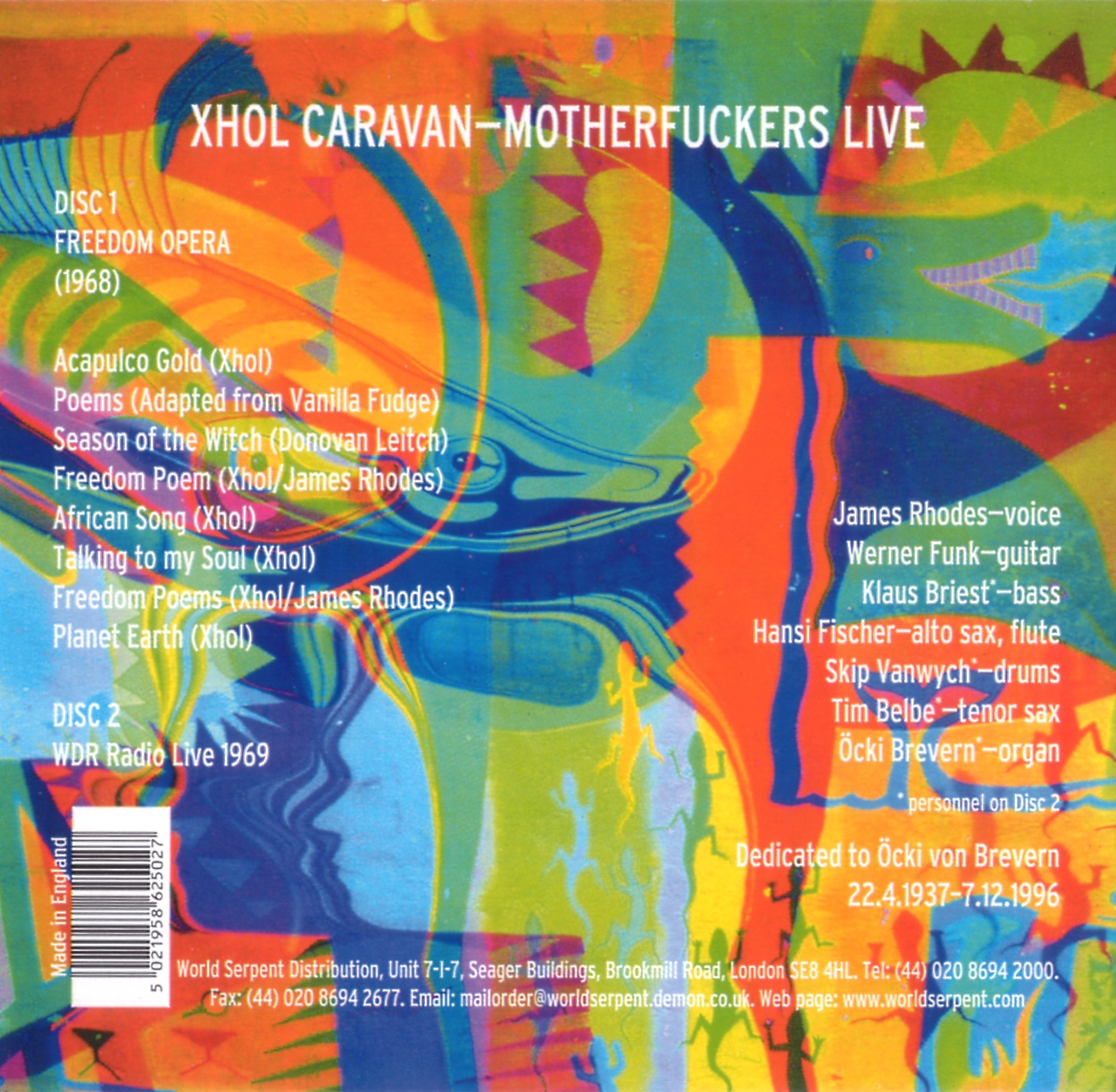
XHOL Caravan - Motherfuckers Live (1968-69, 2002)


Label: STREAMLINE 1022
Xhol Caravan Motherfuckers Live / WDR Radio Live
Free Jazz, Krautrock, Experimental
1968 - 1969 / Streamline 2002
Artworks by Babs Santini; Additional images and Layout: cg graphix and Christoph Heemann


Note:

Originally reissued on the United Dairies label as a double cd and sinlge cdep, motherfuckers live contains the first recordings to be released by krautrock pioneers Xhol Caravan since 1970. This double lp contains two entire concert performances from 1968 and 1969. The first lp features the only existing recording of the Xhol Caravan “ Freedom Opera ” , which was planned as an album release but never realized in the studio. The second lp, recorded for german radio in Cologne, shows a different side of the line up.

The short-lived Xhol Caravan was one of the earliest underground Krautrock groups, and their unique fusion of jazz and rock was a precursor to the direction that Embryo, Out of Focus, Missus Beastly, Thirst Moon, Ikarus, Kraan, Vita Nova, Manju and countless other German groups would take in the 1970s. Formed by saxophonists Tim Belbe and Hansi Fischer, the group started out in 1967 under the name "Soul Caravan". With a Motown- influenced bassist as well as two African-American vocalists, James Rhodes and Ronny Swinton, the group made competent but conventional R&B and soul music, even doing covers of Sam & Dave. Later that same year they released the record Get in High on CBS. By 1968, after several lineup changes, their sound began to develop into a more distinct blend of psychedelic and progressive rock and free jazz, with a wide range of influences, including the Soft Machine, Pink Floyd, Vanilla Fudge, Jimi Hendrix, Frank Zappa, Albert Ayler and Peter Brötzmann. Eventually the group coalesced with Belbe, Fischer, Rhodes, Klaus Briest on bass, Skip Vanwych on drums, and Ocki Brevert on organ. At a performance of Dave Brubeck's "Take Five" guitarist Werner Funk joined the group on-stage and stayed with them until the next year. Their live shows often consisted of long free-form jams, with a lot of experimentation and improvisation and a heavily drug-influenced vibe. In early 1969 they changed their name to Xhol Caravan to release a single "Planet Earth"/"So Down" on the Hansa label and then later that year, after both Funk and Rhodes had departed, they released the strange and excellent LP Electrip, one of the earliest Krautrock albums, also on Hansa. Xhol Caravan were a popular group at the time, constantly gigging and playing festivals, and even appeared live on WDR Radio that year as well as on television with Frank Zappa, Tangerine Dream, and Amon Düül II. Fischer left the group before the end of the year, and the band eventually shortened their name to Xhol to avoid confusion with the British group Caravan. More studio and live material was recorded that year, though the group was unable to release any of it until they signed on with the legendary Ohr Records. In 1971 Ohr released the LP Hau-Ruck, taken from a couple live jams in early July 1970. The following year the LP Motherfuckers GMBH & Co KG came out, with both live and studio tracks, also recorded in 1970 and also on the Ohr label. Xhol unfortunately disbanded at about this time. In 2001 United Dairies released Motherfuckers Live, a two-CD set of live Xhol material from 1968 (when they were still Soul Caravan with James Rhodes on vocals) and 1969 as an instrumental four-piece.

~ Rolf Semprebon, Rovi 


Link in Comments!

FUTTERMAN-JORDAN QUINTET - Nickelsdorf Konfrontation (1995)


The Joel Futterman - 'Kidd' Jordan Quintet
Nickelsdorf Konfrontation
SILKHEART - Cat. No.: SHCD143


Liner Notes

Nat Hentoff wrote the following in his liner notes for Joel Futterman's 1984 album, Inneraction, "True musicians have an irrepressible urge and a need to share their strongest, most delicate, most spontaneous feelings." In his fourth release for Silkheart Records, Futterman still displays that irrepressible urge. However, over the last decade the urge has been transformed and channeled into a highly focused, disciplined school of through-composed, what the Germans once called durchkomponiert, improvisational music. Thought of in less analytical terms, Futterman is continuing to define the once sole purview of Coltrane - that musical tradition of playing extended sets without repeating oneself. Long misunderstood though, Trane's vision, and now Futterman's, is not about playing 'free' or playing 'out'. And it is not about predetermined notions of what jazz is, or was, or should be. It is about musicians composing in the moment, resolving one phrase with the next, and through the process of continuous resolution, arriving at a place not yet discovered.

Just as Joel Futterman's vision has evolved over the past decade, so too have his musical associations. This CD features his strongest co- leader since Jimmy Lyons, Edward 'Kidd' Jordan on tenor saxophone. In fact, one reviewer termed their association, the 'Twin Axis of Power'. These two musical soul mates are finally delivering Trane's long sought promise for his music: that sense of being, derived from the compositional clarity of musicians truly interacting musically in the moment. Like Futterman, 'Kidd' Jordan has labored most of his professional life in relative obscurity to all but the most avid jazz fans. Living and working from New Orleans for more than 40 years, he has developed a very personal musical conception based on a fundamental philosophy. As 'Kidd' describes it, "Jazz is an improvised music. It is in constant change." This philosophy is in large part why he and Futterman have found such a complementary resonance in their musical concept of continuous movement and resolution within the context of the jazz tradition.

If resolving the dichotomy seemingly rested between improvisation and composition was not enough, this first release by Futterman and Jordan also displays a seamless resolution of two dissimilar jazz traditions: the European tradition steeped in atonality, and the American tradition steeped in the blues.

From the European jazz tradition, this recording features two of its most prominent proponents, veteran Barry Guy on bass and Mats Gustafsson on tenor and baritone saxophones. Guy, whose London Jazz Composers Orchestra recently marked its 25th anniversary, clearly not only understands the vision of his co-leaders, but is able to articulate that understanding in an extended musical context. In doing so, he brings to this music a highly refined concept of pulse, as opposed to time, within the framework of a virtuoso technique. Mats Gustafsson, one of Sweden's foremost new music performers is the enfant terrible of the group. Mats is always pushing and reaching for that next level of sound. In this recording, his continuous pursuit of the unknown provides a selective counterpoint to the cool refined sound of 'Kidd' Jordan that keeps the music's tonality continuously moving forward .

Rounding out the quintet is Alvin Leroy Fielder, Jr., on drums and percussion. Alvin, like the co-leaders, is a remarkably under-documented drummer in the finest American jazz tradition. A scholar of the Amencan jazz drumming tradition, especially that of Ed Blackwell, and one of the onginal members of the Association for the Advancement of Creative Musicians (AACM), Alvin has finally found a musical resting place in the Futterman - Jordan home. In this recording's first and umcharacteristically (for Futterman) short selection, Hear With You, the listener is treated to the whimsical side of Futterman and 'Kidd' as they run the quintet through its paces. The close interplay the co-leaders exhibit in this opening miniature - trading phrases on and off the beat with one another as well as with the rest of the group only serves to set up the listener for what is yet to come.

Futterman and Jordan have been performing together for about a year and Soul Mates personifies the closeness they have developed during this period. The piece also reflects the development of their compositional philosophies which are based on taking the best of the American jazz tradition and pushing the tradition beyond the paradigms that have bound it up since the late sixties. What seemingly begins as a harmonically interesting extended performance with 'Kidd' stretching the upper registers of his horn and Joel virtually using every inch of the piano, slowly but inexorably resolves to a beautiful ballad in the finest jazz tradition. It is this concept of continuous resolution in Soul Mates that provides a picture window view of not only where these two musicians have been, but more importantly, where they are going. While there is no question that the echoes of Trane, Shepp, Ayler, and Coleman are present in Jordan's compositional conceptions, the operative word is 'echoes'. Although there are few such 'echoes' in Futterman's playing, due largely in part to his self imposed isolation for the past two decades, this duet is clearly spawned from the finest mainstream of the American jazz tradition.

By contrast, Meeting Place, a trio with Futterman, Guy, and Gustafsson is squarely in the mainstream of the modern European jazz tradition. This piece showcases the very physical 'in your face' style that has become a trademark of Mats' playing, but done so in a sophisticated compositional structure. The five-part structure serves to both focus the strength of Mats' reedwork technique while providing a context for its development. Each of this piece's five parts are bridged by a duet of Barry performing some very subtle arco work with Joel working inside the piano with the precision of a harpist. On either side of the bridges, Mats explores every possible sonorous nook and cranny of his instruments. Behind Mats, Barry and Joel maintain a continuous current of compositional development that ultimately resolves itself in a most unexpected manner. Meeting places can be public or private, planned or unplanned; this piece describes each.

Building on the musical conceptions displayed in their duet, Futterman and Jordan bring all the members of the quintet together in the centerpiece of this recording, Nickelsdorf Summit. In almost 45 minutes, divided among seven continuous parts each with its own distinct personality, this composition explores the extreme reaches of the best each musician has to offer - within a unified whole. In this piece, Futterman continuously shifts from inside to outside the piano, while using his curved soprano and Indian flute for coloring, in a continual search for the next resolution and phrase. All the while, Jordan continuously changes the moods, colors, and melodic constructs of the music. In doing so, they not only continuously trade phrases with one another, but keep the music moving in a direction that fully integrates each of the other three members.

Fournier opens with an extended drum solo by Alvin Fielder, one of the rare instances that the spotlight has moved his way. This piece is based on another composition, Four For Fournier, that Alvin wrote for his longtime friend, Vernel Fournier, while Vernel was recovering from a stroke. Always the consummate sideman and gentleman, Fielder seeks to blend his style of playing with the musicians around him. Or, as Alvin says, "Similar conception in thought." In doing so, he brings no preconceived conceptions about the music's rhythms to the studio. As very aptly shown in this piece, Alvin is content to let the music flow, only seeking to be its rhythmic channel. With this recording, Joel Futterman and 'Kidd' Jordan have crafted a quintet performance that represents the purity of the jazz tradition - a purity that harkens back to another time. In its purity though, this music also holds the promise of the future. So, this recording closes with the bookend of its opener, Going With You. Just as Hear With You sets up the listener for the rest of this recording, Going With You, sets up the listener for what is to come.

Philip R. Egert, September 1995


 Link in Comments!

Monday, August 6, 2012

Re: MANERI ENSEMBLE – Going To Church (2002)


Label : Aum Fidelity; AUM024
Published by Personasound (BMI) ©+p 2002 AUM Fidelity
Recorded by Carl Seltzer on June 12, 2000 at Seltzer Sound, NYC
Produced by Mat Maneri, Mastered by FLAM at Mindswerve Studios, NYC
Design by Ming@409 from photographs by Edvard Vlanders

Note:

Going To Church is a once-in-our-lifetime meeting of three distinct and potent worlds of improv. One sunny Saturday afternoon in the studio with no preset ideas, save free communication through tone. The open form and fluid dynamics that day manifest themselves into this profound program, ranging from rarefied pastoral beauty to an intensity of psychedelic proportions. String prodigy Mat Maneri and his father, underground legend Joe Maneri – an innovator in the realm of elucidation through microtones. The legendary ex-pat bassist Barre Phillips (New Thing at Newport, Ornette Coleman, Naked Lunch soundtrack, ECM Records pivot) representing the finest that European improv has to offer. Legends in the making Matthew Shipp and Roy Campbell, bring to the party the African-American tradition; their gifts honed in the hardcore NYC of Now. Improvisation at the highest level knows no geographic or genealogical boundaries. Truth to tape, Going To Church is another divine offering from AUM Fidelity.

- SJ ( AUM Fidelity)


Review:

DUSTED REVIEW
date: Sep. 30, 2002

Going to Church is credited to the Maneri Ensemble, and right now, the Maneri with the highest profile among Dusted readers is certainly violist/violinist Mat. And sure enough, Mat Maneri does contribute his trademark twisting, sighing viola lines to this record, but the Maneri who features most prominently here is Mat ’ s father Joe.
Joe Maneri still isn ’ t especially well known in the U.S., even in free jazz circles, which may be partially due to the fact that he ’ s an older man who ’ s only been releasing recordings for about a dozen years. But it ’ s probably also because of his actual playing style, which is about as inaccessible as free jazz gets (despite Joe ’ s touching pleas to the contrary, available here: www.jazzweekly.com/interviews/maneri.htm). His work on saxophone and clarinet isn ’ t inaccessible in an Albert Ayler/Pharoah Sanders hide-the-children sort of way, and neither is it at all emotionally detached. But Joe ’ s playing is foot-draggingly slow, and it often sounds unsure—his phrases often expand and contract quickly, and he spends much of his time (intentionally) wobbling between the twelve equal-tempered tones to the octave used in most Western music. The first time I heard his playing, it sounded a little like a drunk person repeatedly trying to say something that would be easy to pronounce while sober. The more I listened, though, the more it sounded like Joe Maneri had found a new and beautiful way to play the blues.
Along with the two Maneris, Going to Church features pianist Matt Shipp, trumpeter Roy Campbell, veteran ECM bassist Barre Phillips and frequent Maneri family collaborator Randy Peterson on drums. Shipp ’ s presence is surprising, because his instrument doesn ’ t allow him to imitate Joe ’ s wavering approach to pitch. Shipp ’ s playing is effective, though, because he mostly stays out of the way, adding slow, unsure-sounding chords while allowing Joe to lead. Still, Shipp and Campbell ’ s contributions mean a lot—unlike some Joe Maneri recordings, Going to Church isn ’ t filled with tense pauses. Instead, the entire band seems to lumber like a drugged elephant, collectively lurching to and fro in tentative, yet weighty, steps. Both Joe and Mat Maneri are in especially fine form here, circling around each other with woozy, wounded lines.
The entire album feels both mournful and massive—listeners who haven ’ t heard Joe Maneri ’ s work before may find themselves focusing more on his microtonal approach to pitch than anything else. But after a few listens, the sadness in his playing becomes unmistakable. Going to Church would easily be among my favorite new jazz recordings if it hadn ’ t been recorded in June of 2000; the only downside to this album is that it ’ s taken so long to find release.

By Charlie Wilmoth


Welcome to new prog-blog "Different Perspectives In My Room...!".
Enjoy the music, and please leave a comment. Thanks in advance.


Link in Comments!