Monday, December 16, 2013

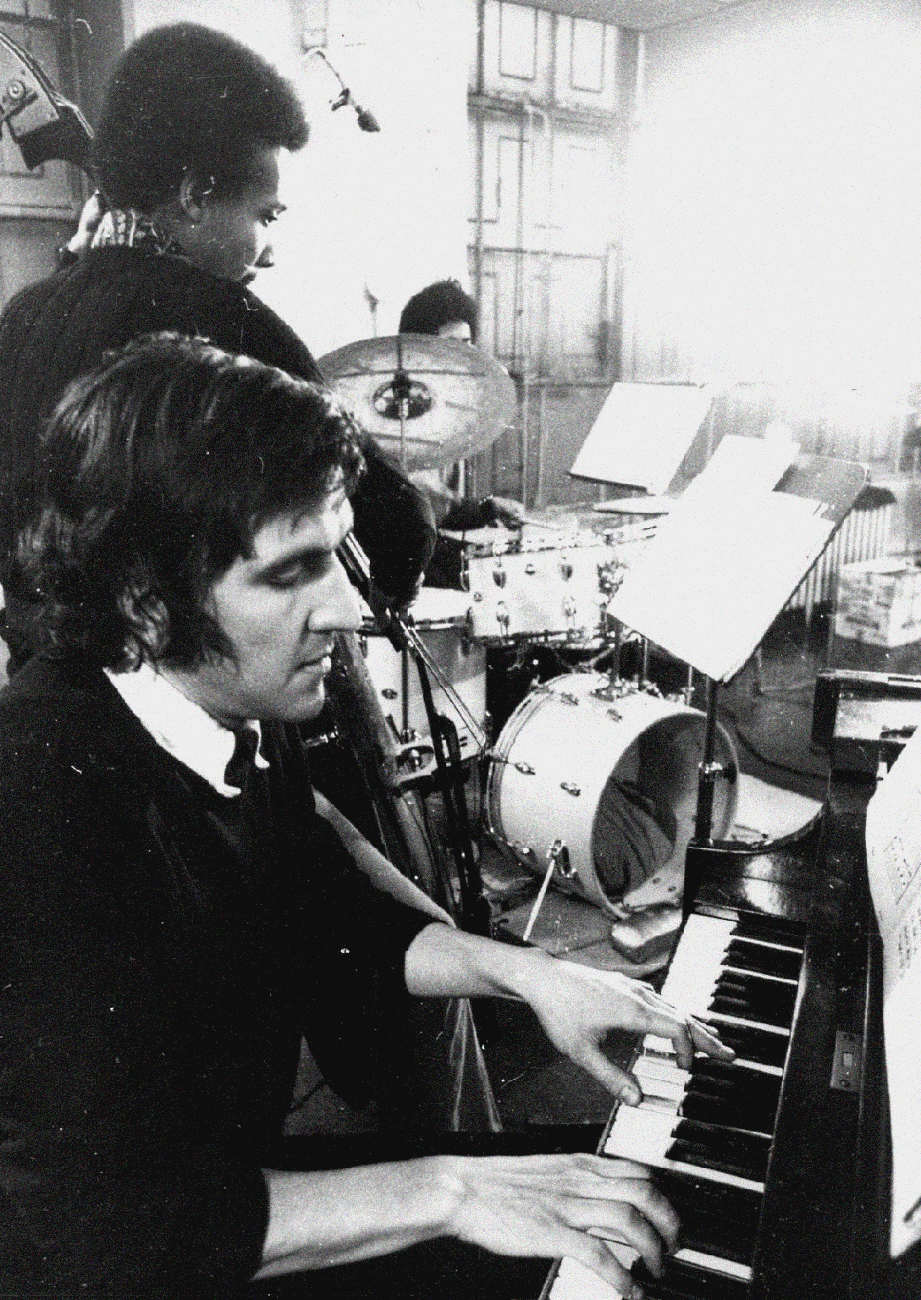
MIKE OSBORNE: TRIO / QUINTET – Border Crossing (1974) + Marcel's Muse (1977) – CD-2004


Label: Ogun – OGCD 015
Format: CD, Compilation, Digipack; Country: UK - Released: 2004
Style: Free Jazz, Free Improvisation
"Border Crossing" recorded live at the Peanuts Club, held at the "Kings Arms", Bishopsgate, London, E.C.2 on 28 September 1974.
"Marcel's Muse" recorded in London on 31 May 1977
Executive-Producer – Hazel Miller
Mastered By – Martin Davidson
Mixed By, Edited By – Keith Beal (tracks: 1 to 4)
Producer – Keith Beal (tracks: 1 to 4), Ron Barron (tracks: 5 to 8)
Recorded By – Ron Eve (tracks: 5 to 18)

The saxophonist Mike Osborne is pungent, sweet-and-sour, occasionally anguished tone might twinge some teeth, and almost all the material here represents a spiky, free-jazz exploration of idiosyncratic originals.


In his heyday from the late 1960s to the end of the 70s, alto saxophonist Mike Osborne was one of the most distinctive saxophone voices in Brit-jazz (and when you are talking about a school that included Elton Dean, Evan Parker, Dudu Pukwana, Alan Skidmore, etc., that is really saying something). This is two of his five albums as a leader for Ogun together and complete on one CD. "Although having retired from the music scene for well-documented health-related reasons over 20 years ago*, Osborne is still the greatest alto saxophonist ever to come out of Britain (that of course being separate and distinct from all the great alto players who came into Britain, such as Bertie King, Joe Harriott, Dudu Pukwana, Bernie Living, Ray Warleigh and Ntshuks Bonga) and this album of highlights from one of the trio ’ s many continuous performances at Stockwell ’ s Peanuts Club of the early-to-mid ‘ 70s is the unassailable proof of that assertion. He came out of Jackie McLean and Eric Dolphy via Ornette, but Osborne quickly found and established his own level of intensity, never better documented than here. As the three musicians move from tune to tune, the intensity of the music is stoked up to such a degree that side two of this album in particular is an emotionally exhausting adrenalin rush of music, easily up there with Ornette at the Golden Circle, Osborne, Miller and Moholo existing in absolute and blissful telepathy as they threaten to break all manner of sound and space barriers. This record, more than most in the Ogun catalogue, is urgently in need of reissue.
– (Text is from 2004)

*Note: Illness prevented him working from 1982. He died on 19 September 2007.

...Despite his illness and an increasing spiral of drinking and drug-taking, Ossie was able to hold things together for periods, largely due to the emotional, and financial, support of the ever-loyal Louise. Schizophrenia is perhaps the most destructive of any mental illness. Over time, the personality and the individual’s capacity to function deteriorates usually to the point where long-term care is required. That would prove the case with Mike Osborne. And yet, from 1975 even into the early-80s, Ossie produced some of his most remarkable work. Working with Hazel and Harry Miller and their Ogun record label resulted in Border Crossing with his trio with Harry and Louis and three years later in the quintet album, Marcel’s Muse, featuring Marc Charig on trumpet and the highly talented Jeff Green on guitar. There were also two albums with Stan Tracey, at the time in his most experimental phase. Both Tandem and Live at Bracknell are exceptional pieces of work and better yet are planned for reissue soon...
_ By Duncan Heining


Links in Comments!
  

Saturday, December 14, 2013

HARRY MILLER'S ISIPINGO – Which Way Now (1975, Re-2006)


Label: Cuneiform Records – Rune 233
Format: CD, Album; Country: US - Released: 2006
Style: Free Jazz,  Free Improvisation, Contemporary Jazz
Recorded at Post-Aula, Bremen, Germany on November 20, 1975.
Coordinator [Release Coordination] – Steven Feigenbaum
Design [Cd Package] – Bill Ellsworth
Painting [Cover Painting] – Ellie Payne; Photography By – Jak Kilby
Producer [Concert] – Gisela Steppat, Volker Steppat
Recorded By – Dietram Köster, Jürgen Kuntze, Klaus Schumacher, Peter Schulze
Remastered By [Tube] – Michael King, Miki Dandy
Technician [Transfer From The Original Tapes] – Christoph Romanowski

Which Way Now features over 70 minutes of music from a beautifully recorded radio concert from November 20, 1975; it sounds as if you are in the room right with the band!
Since Isipingo only released one album during their lifetime, this release dramatically extends their legacy and like Cuneiform's important and historical work with the Brotherhood of Breath, brings this important, hugely enjoyable, nearly-forgotten music to a new audience.


The remarkably large and intersecting jazz and progressive rock community of late-'60s and early-'70s England is enough to give any discographer nightmares. But within that group a few key players came together more often than most, including a contingent which had escaped South Africa's apartheid. Harry Miller was one such artist, an in-demand bassist who appeared on albums by King Crimson, saxophonist Elton Dean's Ninesence and pianist Chris McGregor's Brotherhood of Breath. Miller is underrepresented as a leader, so Which Way Now is a particularly welcome rescued archival live recording, highlighting Miller's considerable skills as composer and bandleader.

Recorded for Radio Bremen in 1975, Which Way Now features Miller's Isipingo sextet. It's a refreshingly vibrant acoustic jazz album, recorded at a time when most of his peers were pursuing the carrot of fusion. Combining traces of his African roots with a more open-ended improvisational aesthetic, it also strongly reflects the influence of jazz icon John Coltrane. Four extended pieces ranging from 15 to 21 minutes show Miller's ability to provide maximum freedom and avoid compromise. Pervasive rhythms that only occasionally dissolve into total freedom also keep them completely accessible.

The performance was recorded less than a month before another South African ex-pat, trumpeter Mongezi Feza, passed away in December, 1975 at only 30. A sharp-toned player who left a small but fine body of work, Feza is perhaps best known for his work on singer/songwriter Robert Wyatt's early records. Here he's at his best on the mid-tempo, modal "Eli's Song, where his own sense of construction combines with a certain abandon. He's matched by Mike Osborne, who may be an altoist, but is clearly informed by Coltrane's assertive stance.

The spirit of Coltrane may loom over this session, but the presence of pianist Keith Tippett takes it to a different place entirely. The best-known and certainly the most prolific player of the bunch, Tippett has always leaned towards more complete freedom. Here he isn't exactly reined in, but he remains within a sphere of smaller diameter, creating an outré space underneath the soloists that, oddly enough, meshes perfectly with Miller and South African drummer Louis Moholo's insistent pulse.

Trombonist Nick Evans' solo on the fiery title track interacts boldly with Tippett's sparse accompaniment, manifesting the kind of chemistry that's honed from years of working together. This shared chemistry amongst the entire sextet is, in fact, what makes Which Way Now so exciting from beginning to end. Whether acting as a tag-team rhythm section partner with Moholo and Tippett or delivering provocative solos, Miller clearly had the makings of a musical giant—which makes it all the more sad then that, like Feza, Miller's life was cut short prematurely in 1983 at the age of 42. Still, Which Way Now is a welcome reminder of just how vibrant the UK improvising scene was—and continues to be.

_ By JOHN KELMAN, Published: August 12, 2006


Links in Comments!

Thursday, December 12, 2013

JOEL FUTTERMAN / JIMMY LYONS / RICHARD DAVIS / ROBERT ADKINS – Inneraction (LP-1984)


Label: JDF – NDEJJ-3
Format: Vinyl, LP, Album; Country: US - Released: 1984 
Style: Free Jazz,  Free Improvisation
Recorded At – Mastersound, New York, release date: 1/1/1984
Engineer – Stephen Peppos
Painting – Joseph Schwarzbaum
Photography By – Linda Wood

Very rare vinyl record. Great free jazz musicians with the legendary alto of Jimmy Lyons.

A  -  Inneraction Part 1 ............................................................ 20:02
B1 - Inneraction Part 1 Cont. .................................................. 13:25
B2 - Inneraction Part 2 .............................................................. 6:32

JOEL FUTTERMAN - piano
JIMMY LYONS - alto sax
RICHARD DAVIS - bass
ROBERT ADKINS - drums


Futterman, a Chicago native who now resides in the East, is one of the few pianists who has the mental and physical equipment to be usefully influenced by Cecil Taylor.

His group here (alto saxophonist Jimmy Lyons, bassist Ricard Davis, drummer Robert Adkins) mirrors the basic sound of the many Taylor units that have had Lyons as their horn voice, and Futterman also strives for Taylor`s aura of near-unrelieved, breakneck intensity.

It`s much to the leader`s credit, though, that the results sound more personal than one might expect--perhaps because the challenge of playing in this manner is so extreme that, amid the blizzard of Taylor-esque patterns, Futterman`s own vision eventually has to emerge.


Completely new FLAC rip. I think you'll be satisfied.
Enjoy!


Link in Comments! 
If you find it, buy this album!

Tuesday, December 10, 2013

HEINER STADLER – Brains On Fire (2CD-2012) - [2LPs-1973/’74 + previously unreleased tapes]


Label: Labor Records – LAB 7069
Format: 2 × CD, Album - Released: 02/28/2012
Style: Free Jazz, Free Improvisation
Recorded at Nola Penthouse Sound Studio, NYC 1966 & recorded at O' Brien's Studio, Teaneck, NJ 1971/1973
Artwork [Illustration] By – Johann Feindt
Design By – Conni Lechner; Photography By – M. De Chiara
Engineer – Orville O'Brien / Tony May
Producer, Composed By – Heiner Stadler

Music that stretches boundaries and, yes, might sizzle the brain pan a bit.

ARTISTS:
Jimmy OWENS – trumpet (CD1: track 1; CD2: track 4); Tyrone WASHINGTON – tenor saxophone, flute (CD1: tracks 1-3; CD2: tracks 2-3); Garnett BROWN – trombone (CD1: track 1; CD2: track 4); Heiner STADLER – piano (CD1: tracks 1-3; CD2: tracks 2-3); Reggie WORKMAN – bass (CD1: tracks 1-3; CD2: track 1); Brian BRAKE – drums (CD1: track 1); The Big Band of the North German Radio Station: Manfred SCHOOF, Gerd DUDEK, Albert MANGELSDORFF, Wolfgang DAUNER, Lucas LINDHOLM, Tony INZALACO (CD1: track 4); Dee Dee BRIDGEWATER – vocals (CD2: track 1); Joe FARRELL – tenor saxophone (CD2: track 4); Don FRIEDMAN – piano (CD2: track 4); Barre PHILLIPS – bass (CD2: track 4); Joe CHAMBERS – drums (CD2: track 4)


Some recordings should come with a sticker which states: for those willing to be challenged. German-American composer, producer, pianist, arranger and bandleader Heiner Stadler’s reissued, remastered, restructured and expanded release, Brains on Fire (which initially came out as two separate vinyl volumes in 1967, which are often rare to find), certainly qualifies for such a caveat emptor. For some, Stadler is known as an interpreter of other musicians’ material, due in part to last year’s remixed reissue of his 1978 outing, A Tribute to Monk and Bird, which was also put out on Stadler’s Labor label. Stadler has also reissued other titles from his back catalog, including 1976’s Jazz Alchemy (which came out in 2000) and the 1996 compilation Retrospection (reissued in 2010). This year it is time to reevaluate one Stadler’s most original efforts, Brains on Fire. This CD version contains three tunes never before heard and marks the first CD presentation of five other works.

One reason to listen to the two-disc Brains on Fire is to hear then-current and up-and-coming jazz luminaries dig deeply into material which spans the perceived gap between avant-garde, post-bop, tone-row experiments and European serialist composition. The eight long pieces (four per disc) were recorded between 1966 and 1974 and feature 17 artists (as well as an orchestra), including trumpeter Jimmy Owens (who worked with Miles Davis in the '50s and was a founding member of the Thad Jones/Mel Lewis Orchestra), bassist Reggie Workman (notable for his work with John Coltrane, Art Blakey’s Jazz Messengers and Yusef Lateef), and future stars such as saxophonist/flutist Joe Farrell (who subsequently had crossover success on the CTI roster) and a young Dee Dee Bridgewater (a few years before fame found her, when she was still singing with the Thad Jones/Mel Lewis Orchestra).

Stadler uses several ensemble configurations ranging from a bass/vocals duet to a quartet (on four tracks) to a big band. The first CD’s opener, “ No Exercise ” (taken from a 1973 session but making its debut here) features a sextet with a three-horn frontline (Owens on trumpet, Tyrone Washington on tenor sax and Garnett Brown on trombone) with a three-piece rhythm section (Stadler on piano, Brian Brake on drums and Workman). The 12-minute workout starts with Workman’s arco bass, followed by Owens’ warm trumpet and then the rest of the group steps up to help present Stadler’s avant-garde blues which is shaped by a 12-tone row. Workman’s astute bass is a highlight during this spontaneously-surging piece, but so is Washington’s unfettered sax. Since Washington later left music because of a religious conversion, Brains on Fire is one of the few places listeners can hear the obscure sax player display the width of his skills. Washington is also heard to great effect on three other tracks. The post-Coltrane “ Three Problems ” (a 1971 performance never before released) crosses the lines between hard bop and free jazz, and is an often-chaotic construction with Washington’s lacerating sax leading the charge. Workman adds a transcendent bass solo, which temporarily ebbs the high-energy level, but for the most part “ Three Problems ” is almost 13 minutes of roaring density. “ Heidi ” has a slower, spiritual treatment and listeners initially may find this to be the most coherent cut, although “ Heidi ” also eventually edges to a tumultuous portion where written and improvised sections are fused to the point where it is impossible to tell where one ends and the other commences. The other quartet tunes, “ U.C.S ” and “ All Tones ” (both on CD2), are parallel explorative compositions which delve into variations on texture, phrasing and theme akin to Coltrane’s brilliant free recitations such as Interstellar Space or Ornette Coleman’s vitality-fueled Free Jazz, where the music is elaborately extemporized and not easily absorbed in a single listen. Howard Mandel’s liner notes advise listeners to let “ U.C.S ” and “ All Tones ” sweep the listener along and it’s a good recommendation.

Two of the longer compositions employ very different approaches. The 24-minute Russ Freeman-penned “ Bea’s Flat ” (a 1974 recording offered here for the first time) is a striking, customized blues given over entirely to The Big Band of the North German Radio Station, conducted by Dieter Glawischnig. Several band members are spotlighted as soloists (sax and piano in particular) and the full ensemble actually steps away at times, emphasizing single instruments. The result is somewhat like a meeting between Duke Ellington’s and Sun Ra’s groups. Reggie Workman and Dee Dee Bridgewater’s 20-minute bass/voice pairing, “ Love in the Middle of the Air ” (a shorter take can be found on Retrospection) is nearly as remarkable in a wholly dissimilar way. Bridgewater stretches, undulates and heightens beat poet Lenore Kandel’s minimal lines, phrases and words while Workman glides and rolls on his bass with perfect sympathy: his meticulous arco work in particular is an emotional standout.

Despite recordings from four studios and engineers, there is observable and high quality engineering and audio constancy over the course of the two-hour, eight-track project. Even during the most intense moments instruments rise out from the mix rather than getting washed aside, and when the heady musical concoction is confined to just a few instruments (like bass or vocals) the sound is wonderfully expressive.

_ By Doug Simpson 
 (February 22, 2012, AUDIOPHILE AUDITION)


Links in Comments!

Saturday, December 7, 2013

WILLEM BREUKER KOLLEKTIEF – In Holland (2LP-1981)


Label: BV Haast Records – BVHAAST 041/042
Format: 2 × Vinyl, LP, Album; Country: Netherlands - Released: 1981
Style: Free Jazz, Free Improvisation
Recorded at M.C.R. Studio Amersfoort, Holland, April 21th, 22th and May 6th 1981
Composed By – Henk de Jonge (tracks: C2), Unico Wilhelm graaf van Wassenaer (tracks: D1a-d), Willem Breuker (tracks: A1 to B5, D2), Willem van Manen (tracks: C1)
Cover Draving By – Ariane Gscheidle


Simply put, this is the finest album ever released by the Willem Breuker Kollektief as a jazz tentet (as opposed to the repertory ensemble they later became). In Holland contains the most creative orchestrations, and the most thrilling solo work by the Kollektief, and ranks among the best jazz albums of the '80s. Two of the songs here ("Tango Superior/Interruptie" and "To Be With Louis P.") were released on the compilation disk The Parrot, but the remainder were only available on vinyl as of 2001. 

The first record of this two-LP set is essentially designed as a suite, beginning with a powerful overture, and continuing on through an uproarious tango featuring a comically frustrated Breuker on alto, a drunkenly careening showcase for the brilliant trumpeter Boy Raaymakers, a loving homage to Prokofiev, and a fleeting reference to Wagner. Altoist Bob Driessen soloing never sounded better, and the driving bass work of the invaluable Arjen Gorter causes one's jaw to drop. Next comes "To Be With Louis P.," a surging R&B number with Breuker in the hilarious role of sleazy lounge singer who nonetheless matches Maarten van Norden's wondrous tenor sax shouting note for note. 

The second LP consists of four compositions, including a concertino by an obscure 17th century Swiss composer, and a ferocious reel called "Hopsa, Hopsa" that builds up, morphs, and goes bananas. It's an album highlight, featuring a breathtaking performance by WBK, and composed by the newcomer (who'd stick around) pianist Henk de Jonge. Also included is one of Breuker's most beautiful and moving compositions, "Marche Funèbre" (from his musical production De Vuyle Wasch, or 'Dirty Laundry'), whose themes are at once rich, somber, romantic, and inspired. Though the group lost quite a bit of freshness after the mid-'80s, In Holland qualifies as an extraordinary record by one of the most creative and enjoyable jazz ensembles to have emerged from Europe.

_ Review by BRIAN OLEWNICK


Links in Comments!

Thursday, December 5, 2013

The UNIT: CECIL TAYLOR in 1978 – "Cecil Taylor Unit" (LP-1978), "3 Phasis" and "Live In The Black Forest", LPs-1979


Label: New World Records – NW 201
Format: Vinyl, LP, Album; Country: US - Released: 1978
Style: Free Jazz, Avantgarde, Free Improvisation
Recorded in April 1978 at Columbia Recording Studios, 30th Street, New York, NY.
Artwork [Cover] – David X. Young; Design [Cover] – Elaine Sherer Cox
Engineer [Recording, Editing, Mixing] – Don Puluse
Mastered By – Ted Jensen

A1 - Idut  14:40
A2 - Serdab  14:13
B - Holiday En Masque  29:41

Cecil Taylor (piano) Jimmy Lyons (alto saxophone) Raphe Malik (trumpet) Ramsey Ameen (violin) Sirone (bass) Ronald Shannon Jackson (drums)

The Cecil Taylor Unit (band and album) announces itself with “ Idut, ” a piece running just under 15 minutes. The first sound we hear is Ameen’s violin, bolstered by Sirone’s bowed bass. The two men attack the strings in sharp and jagged fashion, reminiscent of an Elliott Carter string quartet. After a few seconds, Malik’s trumpet enters, a fountain of rich, full notes like a fanfare announcing a king. Lyons, for his part, offers boppish phrases full of life and joy. This is an erupting music.

Behind everything else, Taylor is there, striking the keyboard with great force, rumbling at the low end of a ninety-six key Bösendorfer, similar to the instrument he plays on the solo albums Air Above Mountains and The Willisau Concert, from 1975 and 2000 respectively. This is an imposing instrument, the ideal vehicle for a player of Taylor’s intensity and rigor. But it’s best heard by itself; surrounded by other sounds, its strength is diminished slightly. At the 90- second mark, when all the other instruments drop away, leaving only the piano, the purpose of all that hurtling exposition becomes clear—the band was setting the stage for Taylor, whose high-speed runs and teeth-rattling rumbles are accented by thunderous rolls from Ronald Shannon Jackson. The piece shifts again and again in this manner, offering solo piano passages, duos between Taylor and various other bandmembers, duos and trios, and explosive sections involving the entire band.

The album’s second track, “ Serdab, ” is much quieter. There are still moments of thrilling fire and fury, but Taylor’s solo passages are longer and more frequent, with Jackson pitter-patting behind him, creating rhythm (he ’ s a totally unique jazz drummer in that he plays marching-band and militaristic rhythms as often as he swings or grooves) without imposing it. It’s an interlude of gentle beauty, a bridge between the opening fanfare and thunder of “ Idut ” and the cataclysm that is the album’s second half.

“ Holiday en Masque ” is a half-hour, album-side-long avalanche of sound. The liner notes to the album, written by Spencer Richards , describe it as a “ masterful achievement in ensemble playing, ” and it truly is that and more. The dominant voices are Taylor’s and Ameen’s, with Jackson rattling and crashing in the back. At times the horns and strings and piano are so loud the drums can barely be discerned, even though they’re being played with as much energy as any other instrument in the studio. At other times, Jackson’s rhythms are quite clearly audible, his kit sounding more like one belonging to a hard rock drummer than a jazz player. He’s got a massive kick drum sound going on, and his toms slam like heavy wooden doors battered by a hurricane. Unison passages, arising out of the overall storm of sound like rainbows arcing between thunderclouds, reveal the scored nature of this music and the intense, focused rehearsals Taylor called before the recording began. As Ameen, who also contributed liner notes to The Cecil Taylor Unit (and was the only member of the band to do so), points out, “ Because in fact he has continued to make music of overwhelming originality, Cecil Taylor has been increasingly successful in exercising his right to determine the working conditions such music requires—in particular, pianos of the best quality, and extensive practice and rehearsal…This record was prepared under Taylor’s artistic direction and is a document not only of his power of musical expression but also of the success of the comprehensive working methods and the fierce independence he has developed and maintained during the past quarter of a century. ”


Label: New World Records – NW 303
Format: Vinyl, LP, Album; Country: US - Released: 1979
Style: Free Jazz, Avantgarde, Free Improvisation
Recorded in April 1978 at Columbia Recording Studios, 30th Street, New York, NY.
Artwork [Cover] – Paul Jenkins; Design [Cover] – Michael Sonino
Engineer – Don Puluse
Mastered By – Ted Jensen

A - 3 Phasis, Side One  28:22
B - 3 Phasis, Side Two  28:50

Cecil Taylor (piano) Jimmy Lyons (alto saxophone) Raphe Malik (trumpet) Ramsey Ameen (violin) Sirone (bass) Ronald Shannon Jackson (drums)

The second album by this group, 3 Phasis, was recorded on the final day of the sessions, and the issued take is the final one (of six), a performance that ran beyond the scheduled time and into overtime. According to the album notes by jazz critic Gary Giddins , the earlier versions all ran in the 20-30 minute range. The issued performance is a marathon, even an endurance test, at 57:17, but not a moment of that is wasted on vamping, casting about for inspiration, or anything but the most intense playing of which the group members are capable.

The piece begins with solo piano, but again the strings are the first instruments to join the fray. Ameen and Sirone come in bowing, with Lyons ’ alto saxophone keening romantic ballad melodies, Malik ’ s trumpet squalling in a less florid, more sardonic way than on the previous album…and Jackson announcing his arrival with tremendous, rolling-thunder assertiveness.

The horns keep dropping out, though, and the piece becomes chamber music with drums. Passages of violin and piano, or violin and bass, Ameen jabbing sharply into the airspace between himself and Taylor with shrieks of the bow not unlike Bernard Herrmann ’ s famous score for Alfred Hitchcock ’ s movie Psycho. Ameen adds more than classical filigree to this music, though. He ’ s also prepared to be a hillbilly fiddler when the occasion calls for it, conjuring the spirit of African-American string bands (violin, banjo, upright bass) with a single raucous phrase behind the horns.

Giddins was present at the recording, and wrote the liner notes to the album. He describes the recording engineer’s panic as the take that was eventually released runs longer and longer, finally coming to a halt just shy of the one-hour mark (and consequently nudging the limits of 33 1/3 rpm vinyl’s storage capacity).

“ Previous takes had averaged twenty to thirty minutes and seemed to get tighter each time,” Giddins writes. “ The fifth take produced a splendid array of dynamics and a rollicking dance exuberance, but saxophonist Jimmy Lyons was dissatisfied with his solo, and there was a general feeling that an earlier take had been more successful. Taylor decided to work on some of the other pieces, and it wasn’t until midnight that they returned to the suite. From the first notes, there was an excitement in the studio, an electricity, and after about twenty minutes producer Sam Parkins said, ‘ This is the best yet by far. If Jimmy Lyons holds up in the shuffle, I don’t care how long it goes. ’ Later Parkins noted, ‘ This is more of a piano concerto than the others.’ A significant difference between this and earlier versions was that Sirone, the bassist, who had previously played mostly against the rhythm, now fell into a steady 4/4 shuffle meter (heard in the second half). Taylor conducted the music from the piano without eye contact, as the others stood poised. Lyons, awaiting his entrance, lit a cigarette. Then the shuffle started: Taylor instigated a rocking stomp with chords in both hands; Sirone bore down on the time; drummer Ronald Shannon Jackson alternated between mallets and sticks; Lyons steamed through like a train. After about forty minutes, Parkins exulted, ‘ We’ve got a record now! ’ —but ten minutes later he was worried about whether Taylor would stop in time: ‘ I hope he stops pretty soon, because I’d hate to cut this. I ’ ve never been to anything like this before, have you? ’ Taylor punched out a riff, his hands leaping as fast and deft as a cheetah, his arms almost akimbo. Everyone was eyeing the clock nervously and with giddy excitement. And then, nearing fifty-seven minutes, just short of the maximum playing time for a long-playing album, Taylor began to wind down for a dramatic finish. Observers burst into the studio with excited praise, and the laconic Taylor was heard to say, ‘ Well, you know we knew it was good, too. ’”

Taylor didn’t typically go on the road with the same bands he recorded with. Throughout his career, studio sessions have been relatively rare; live recordings make up the bulk of his discography. But in 1978, he took this Unit on the road for several weeks of shows in Europe, at least three of which were documented, two of them on albums that are among his greatest work.


Label: MPS Records – 0068.220
Format: Vinyl, LP, Album; Country: Germany - Released: 1979
Style: Free Improvisation, Free Jazz
Recorded live on 3 June 1978 in SWF-Radio JazzConcert in Kirchzarten, Black Forest, West Germany.
Artwork – Müller & von Frankenberg
Engineer – Norbert Klövekorn; Producer – Joachim E. Berendt

A - The Eel Pot   24:57
B - Sperichill On Calling   25:08

Cecil Taylor (piano) Jimmy Lyons (alto saxophone) Raphe Malik (trumpet) Ramsey Ameen (violin) Sirone (bass) Ronald Shannon Jackson (drums)

Live in the Black Forest was the first to appear, on the unjustly obscure MPS label. Featuring two 25-minute pieces recorded on June 3 for broadcast on German radio, it’s a somewhat more “ crowd-pleasing ” and less abstruse set of music than the Unit ’ s self-titled debut or the crushing 3 Phasis. The first piece, “ The Eel Pot, ” begins with solo piano, followed quickly by the entry of Malik and Lyons (playing unison phrases) and then Ameen. Jackson hits huge thunderous tom rolls, and the band has become fully present. Then things can truly get started. Piano and trumpet exchanges, violin and alto saxophone tinkering at the margins. Martial drumming. There’s bass work, but it’s not particularly high in the mix at first; only later does Sirone’s forceful plucking assert itself, when the group becomes, of all things, a piano trio, albeit the most aggressive one I’ve ever heard. Jackson is playing something close to a death metal blast beat, as Taylor dances across the keyboard like a maniac and Sirone throbs between them. The next player to re-enter after this thunderous passage is Ameen, offering almost Bela Bartók -like stabs as though to pay tribute to the concert’s central European location. He and Taylor duet passionately, with Sirone still lingering in the background. Eventually, the full ensemble returns to roaring life, and the piece comes to a raucous close, celebrated by wild applause from what sounds like a large audience.

The disc’s second half, “ Sperichill On Calling, ” is more or less in the same spirit as its predecessor, but it’s less aggressive, a midtempo marathon with occasional eruptions. Around the 11-minute mark, Jackson bursts into a particularly aggressive drum solo, smashing the cymbals and battering the snare, as Malik’s trumpet unleashes a repeated, fanfare-like figure. Malik gets a lot of solo space during “ Sperichill, ” his rippling upper-register lines extraordinarily full and vibrant. When Taylor takes the lead, his playing is often quite delicate; during one quiet passage, he and Ameen duet totally unaccompanied, and it’s possibly the album’s high point. Again and again throughout this group’s discography, it becomes unmistakable that the violin is the most important instrument, besides the piano, to the whole project. Two decades later, on Algonquin (recorded 1999, released 2004), Taylor would explore this combination of sounds again, in a live duet with violinist Mat Maneri at the Library of Congress.

_ Story by PHIL FREEMAN

The fourth part see:
http://differentperspectivesinmyroom.blogspot.com/2013/11/cecil-taylor-one-too-many-salty-swift.html


Links in Comments!

Monday, December 2, 2013

VINNY GOLIA – Openhearted (LP-1979)


Label: Nine Winds Records – NW-0102
Format: Vinyl, LP; Country: US - Released: 1979
Style: Free Jazz, Avant-garde Jazz
Recorded Feb. 7, 1979 at U.C.L.A., Melnitz Hall, Los Angeles, CA.
Composed By, Arranged By  – Vinny Golia
Producer – Vinny Golia
Cover Design By – Vinny Golia and Alex Cline
Published By Nine Winds Music

A1 - Alone - A) ...At Nite B) Try Toane  -  11:18 
A2 - #14 - A "Conversation" Piece  -  6:15
A3 - The Happy... - For My Friends In L.A.  -  6:10

B1 - Pulse - ..Striving To Ascend...  -  6:13
B2 - The Presence - "..A Dedication To The All-seeing Eye..."  -  8:04
B3 - Dance For O.C. - ..Thanks For A Conversation In '69 And A "Special" Meeting A Remingtons..."  -  7:58

Vinny Golia – alto / bass clarinet, soprano / tenor / baritone saxophone, flute [C- / alto]
Baikida Carroll – trumpet, flugelhorn
Nels Cline – guitar
Roberto Miranda – bass
Alex Cline – drums, percussion


Vinny Golia / Alex Cline

The second LP from Nine Winds features the versatile avant-gardist Vinny Golia playing six originals that feature him on alto flute, soprano, clarinet, bass clarinet, tenor and baritone.
Golia is joined by trumpeter Baikida Carroll, bassist Roberto Miranda, drummer Alex Cline and (on three of the six numbers) guitarist Nels Cline. From sound explorations to free bop, the advanced music always holds one's interest and has plenty of unexpected tone colors.


Links in Comments!