Tuesday, January 14, 2014

ALEXANDER von SCHLIPPENBACH / SUNNY MURRAY – Smoke (1990)


Label: FMP – FMP CD 23
Format: CD, Album; Country: Germany - Released: 1990
Style: Free Jazz, Free Improvisation
Recorded on October 6th, 1989 at the FMP-Studio/Berlin
Mastered By – Jonas Bergler
Producer, Recorded By, Mixed By, Photography By, Layout – Jost Gebers


This duet between Dutch pianist Alexander von Schlippenbach and vanguard drummer Sunny Murray is one of those records that makes FMP such a necessary label. This impromptu meeting between two giants of that "other" jazz world, the avant-garde, reveals with startling clarity the inherent musical courage it takes to play freely with another musician you have never encountered. This nearly 80-minute recording was done in one day in 1989. Here, von Schlippenbach abdicates his normal responsibilities as a leader and becomes a collaborator. Murray, never really anybody's sideman, takes the reins and turns his rhythmic chops on in such a way that the pianist cannot help but to respond in a like manner. So listeners have a study in rhythmic improvisation. The colliding skeins of von Schlippenbach's notes are patterned after the rolling rim shots of Murray's left hand. His arpeggios land like punches in the heart of the tom-tom and bass drum fills, and together they create the rhythmic impulse to improvisation. With the exception of a truly bent -- that is, very innovative -- read of Monk's "Trinkle, Tinkle," the set is one of improvisations credited to one man or the other. Figures combine to make new structures, as bass notes are discarded in favor of side rolls and cymbal shimmers. Also, as middle-register tonal clusters are etched into the pulse of each track, Murray works to accent them, bringing them out from the drums so that they can become drums in and of themselves. And when it's over, in the silence, the listener will most assuredly sit for a while in disbelief at what just transpired.

_ Review by THOM JUREK


Links in Comments!

Sunday, January 12, 2014

MONGEZI FEZA and BERNT ROSENGREN QUARTET – Free Jam - 1972 (2004)


Label: Ayler Records – aylCD-048/49
Format: 2 × CD, Album; Country: Sweden - Released: 2004
Jazz Style: Free Jazz
Recorded on Nov 15/24, 1972, and Dec 15, 1972 at ASEA, Stockholm, Sweden
Cover, Design – Åke Bjurhamn
Edited By, Mastered By – Jan Hansson
Engineer – Göran Freese
Executive-producer – Jan Ström
Liner Notes – Keith Knox, Roger Bergner
Mastered By [Final Mastering] – Per Ruthström
Photography By – Gunnar Smoliansky, Rita Knox
Technician [Assembling Of Material To Dat], Mastered By [Assistant] – Keith Knox

An extraordinary recording, this two-CD set captures trumpeter Mongezi Feza fronting the remarkable Bernt Rosengren Quartet, with Okay Temiz added on percussion. Recorded in 1972, but not released until 2004 on the Swedish label, Ayler Records, the ten tracks constituting nearly two hours of music are a major find, despite the somewhat sub-par recording quality and the truncated nature of some of the pieces.
As is customary with this label, the production quality is first-rate, with meticulous notes contained in the 20-page booklet, superb packaging, and a serious effort to clean up the sound.
For those familiar only with Feza's work with the Blue Notes, his ability to create astonishing solos at lightening speed in a largely unfettered environment may come as a pleasant surprise...


Some music and musicians are linked irrevocably to a specific era, either because premature exits or enforced retirement have limited their contribution to those particular times or because their strongest work appeared then. Feza, of course, suffered an all too early exit while Windo kept on going until 1992. While it is impossible to predict what the trumpeter would have gone on to achieve, in Windo’s case I feel that the work done in the ferment of the 1970s was among his strongest and most intense.

Explosive South African trumpeter Feza was a guest with Bernt Rosengren’s quartet along with percussionist Okay Temiz, during November and December 1972 and Free Jam was recorded during this time in an old paint and glass-blowing factory in Stockholm. The location may not seem inspiring but the sound definitely is, being both raw and full of the energies of collective improvisation, with band members shouting encouragement while the rest respond with vigorous, ebullient solos and group blowing.

On the first cd the opening ‘ Theme Of The Day ’ is nearly forty minutes of this approach and features a typically buoyant solo from Feza as well as a freely ranging alto break by Rosengren and some muscular tenor from Tommy Koverhult. But much of the track is a high energy group interaction with players moving to the foreground then shifting back into the ensemble again. It is a truly exhilarating sound driven by the twin percussive assault of Temiz and quartet drummer, Leif Wennerstrom. It ends with Rosengren abstracting a melodic theme, apparently from a pop song, ‘ Sambabiten ’ , stretching it a little and bringing the piece to a joyously steady rhythmic conclusion.

From the same day ‘ Group Notes 1 ’ continues the mood of free improvisation and highlights Feza’s dynamic playing alongside Koverhult and Rosengren. ‘ Group Notes 2 ’ also finds the tenor man exploring though in slightly more restrained manner, holding notes then unleashing cascades of them. It reminded me of Coltrane momentarily. There is a more spacious feel to this track though the energy levels are still quite high.

The second cd also opens with ‘ Theme For The Day II ’ , in this case a spiralling motif that gradually mutates into a group improvisation led by Rosengren. The drumming is particularly fierce and it is a shame that the track seems to fade before it really gets started. Following on though, is the first of several tracks which prominently feature Feza. ‘ Mong’s Research I ’ allows him space to build a furious solo supported only by Wennerstrom and Temiz. He then carries this on at the start of ‘ Group Notes III ’ wrenching squirming metallic figures from his trumpet whilst again being powerfully driven by the force emanating from the twin percussion team. It is probably one of the longest solos I've heard him take and his energy and invention become quite staggering, cutting a swaggering path through the track. The other major force on this track is Rosengren who matches Feza in resourcefulness and power.

A further three sections of ‘ Mong’s Research ’ also contain stunning examples of his technique as he bursts out in barely contained melodic torrents over Rosengren on piano. He seems to want to explore every aspect of the improvisations, his tone shifting through a range of moods. Again, this is another one of the most sustained performances I’ve come across, possibly even surpassing work he laid down with Brotherhood Of Breath and The Blue Notes and reminding me what a terrible loss his early death was for the music.

Although this is ostensibly a guest session from the trumpeter he contributes much of the excitement and verve to the performances, sounding like a small musical tornado, aided crucially by the empathies of both drummers. For anyone, like me, who feels they’ve never heard enough of his work this is absolutely essential listening. Jan Strom’s team at Ayler deserve an award both for making it available in the first place and for presenting it in an informative and attractive package with distinctive cover artwork, as ever, by Ake Bjurhamn.

_ By PAUL DONNELLY, Stride Magazine


Links in Comments!

Friday, January 10, 2014

JORMA TAPIO and TERJE ISUNGSET – Aihki (2006)


Label: Ektro Records – EKTRO-039
Format: CD, Album; Country: Finland - Released: 2006
Style: Free Improvisation
Tracks 1, 2, 3, 4 and 7 recorded live at Telakka, Tampere 6.3.2005.
Tracks 2, 5 and 6 recorded at Kurvi Studio, 2005.
Mastered By [Mastermixing] – Max Latva
Mastermixing at Vapaa Palestiina Studio, spring 2006
Photography – A. O. Väisänen, E. Leskinen, H. Iffland, I.K. Inha, Pekka Kyytinen, Toivo Talvi
Producer – Jorma Tapio
Recorded By – Eero Savela

"All music is improvised."

1 Seita . . 4:06
2 Nocturnal Wind From The Lake . . 4:12
3 Alone In Public . . 3:09
4 Salainen Tuli / Secret Fire . . 21:33
5 Huh-Huh . . 1:17
6 Turja . . 5:42
7 Mana . . 11:35

JORMA TAPIO - Flute [Flutes], Bells [Bell], Voice, Kantele, Percussion
TERJE ISUNGSET - Drums, Jew's Harp, Voice, Percussion

Some particularly impressive shamanistic improv from the Norwegian/Finnish duo of Terje Isungset and Jorma Tapio. The boundless multi-instrumentalism of the two performers is something to behold, with Isungset’s percussion extending far beyond the realms of conventional drumming (apparently he fashions his own instruments from natural elements like arctic birch, granite, slate and ice), and similarly, Tapio’s woodwind playing seems to transcend the conventional language of the that family of instruments, especially on the appropriately titled ‘ Nocturnal Wind From The Lake ’ , which mimics the natural sounds suggested by the title. The closest Aihki comes to conventional jazz improvisation is on the extended jam, ‘ Salainen Tuli/Secret Fire ’ , which as the album’s centrepiece sees the duo running through their expansive repertoire. Beginning as a caterwauling free music workout, the piece eventually dissolves into the more esoteric, spiritual sounds that characterise this set of recordings, and make them so unique.


While the name Jorma Tapio may not be familiar to you, the name Terje Isungset sure as heck should. He's the man responsible for the Igloo record, a past record of the week, recorded entirely on instruments made from ice. We've been selling that like CRAZY, when all of a sudden we got an email from Jussi (Circle, Pharaoh Overlord, etc.) letting us know that his label Ektro was releasing a brand new record by Isungset, teamed up with some guy names Tapio. We were of course intrigued, but had no idea what to expect. And had we actually expected something, we probably never would have guessed how weird and wonderful this record would be. No ice instruments sad to say, but armed with flutes, bells, voices, kantele, percussion, Jew's harp and lots and lots of drums, these two whip up a super wild and wooly, ultra dense blast of what we can only describe as tribal forest folk free jazz. Or something like that.
Free jazz is probably the closest comparison, the first few tracks are dense psychedelic percussive freak outs, lots of splattery spastic free jazz drumming all over the place, deep bowed bass, steel string zings, and super creepy strangled and howled vocalizations.
Everything sounds very primal and tribal, thick swaths of rhythmic throb underpinned by shimmering washes of cymbal sizzle and warbly mumbled melodies. Isungset proves to be a pretty bad ass drummer, whipping up some seriously wild squalls of spastic skitter, and octopoidal crash and bang. The vocals grunt and chant, sort of yodel, and hoot and holler, very festive and just a little nuts sounding. When the drums recede a bit, the band sort of wonders through some ancient forest, fluttering flutes, simple subtle percussion, distant drones. A bit reminiscent of Avarus or Anaksimandros for sure. The 20+ minute centerpiece, the track "Selainin Tuli / Sacred Fire" lets the duo spread way out, and lay out an expansive tribal soundscape, like the earlier 'free jazz' tracks but stripped way down. Hints of No Neck Blues Band and Sunburned Hand definitely surface now and then, the track eventually building to a howling shrieking psych drone freakout before settling back to almost complete silence. then a gentle lilting smudge of soft flutes and abstract clatter. That smeared clatter sort of drifts into the next two songs, disembodied scrapes and creaks, random bits of percussion, thick washes of low end thrum, quite dark an lovely.
The final track is a flittering flutescape, a spare landscape of woodwinds and distant shimmer, which is soon joined by a buzzing Jew's harp, and the harp and flutes get all tangled up into a strangely propulsive groove, some sort of skeletal prog laced with primal psych rock primitivism and festive Renn Faire revelry, like stumbling into some clearing in the woods and finding some strange open air market, with a very strange duo performing before a crowd of rapt onlookers. Weird, but pretty darn cool as well. Finnish music obsessives need this no matter what. Lovers of that modern free folk new weird America thing might just find that this pushes all their buttons, and REALLY REALLY open minded jazz heads might also want to give this a try. Highly recommended!

_ Aquarius Records


Links in Comments!

TERUHISA FUKUDA – Shakuhachi - Kinko School (2003)


Label: Ocora – OCR560184 - 1
Format: CD, Album; Country: France - Released: 2003
Style: Ethnic, Shakuhachi
Recorded at Radio France, Paris, June 2003
Japon - Teruhisa Fukuda, Shakuhachi, Kinko School
Performed by : Fukuda, Teruhisa
Publisher : Editions Radio France

Teruhisa Fukuda performing six of the most representative pieces of Kinko School, developed in the 18th century from traditions of itinerant komusô zen monks for whom enlightenment could be reached through the sound of the shakuhachi flute.

Shakuhachi – TERUHISA FUKUDA

1. Hifumi Hachigaeshi no Shirabe . . 9:27
    (Hifumi introduction - Hachigaeshi. Introduction piece)
2. Mukaiji Reibo . . 12:03
    (Spiritual quest - Hazy sea. A metaphorical allusion to human existence)
3. Koku Reibo . . 13:52
    (Spiritual quest for vacuity. This piece is about the search for a convergence of
     spirituality and music)
4. Shin Kyorei / Banshiki . . 18:00
    (Soul - Vacuity with a Banshiki introduction. In a Zen-doctrine sense)
5. Sokaku Reibo . . 10:38
    (Spiritual quest - Nesting cranes. This piece is a symbol of parental love for one's
     offspring)
6. Yobikaeshi Shika no Tone . . 8:40
    (Stag-calls in the distance. This piece is a symbol of human love)


TERUHISA FUKUDA was born in 1949 in Nagano Prefecture. He studied shakuhachi with Baizan Nakamura and Miyata Kohachiro. He is a member of the Pro Musica Nipponia and master teacher working to free the shakuhachi from its strict traditional setting.

He has performed with numerous famous Japanese orchestras including the NHK Symphony Orchestra. He has also performed at prestigious performances sponsored by famous groups like the National Theater, New Nippon Steel Culture Foundation, and Musical Foundation for Modern Music, Japan Federation of Composers, Orchestra Project and NHK.

Fukuda-sensei is a member of the Pro Musica Nipponiais and director of La Voie du Bambou in Paris, France.


Relax and enjoy.


Link in Comments!

Wednesday, January 8, 2014

LOL COXHILL – Diverse (LP-1977)


Label: Ogun – OG 510
Format: Vinyl, LP; Country: UK - Released: 1977
Style: Free Jazz, Free Improvisation
Recorded in concert (but only just, as most of the audience were in the bar) at the Seven Dials, Shelton Street, London WC2, 1976.
Front cover illustration from Victorian Lantern Slide (Anon)
Producer, Recorded By – Lol Coxhill

A - Diver  . . 16:30
LOL COXHILL - duet for soprano saxophone and loose floorboard (unrelated)

B - Divers  . .  21:00
LOL COXHILL - soprano saxophone
DAVE GREEN - bass
COLIN WOOD - cello
JOHN MITCHELL - percussion

The two long pieces that make up the Diverse album, we get Coxhill as we know him best: as a quirky, complex improviser with a sense of humor and a flair for understatement. "Diver" is completely solo, a long, loping travail through Coxhill's tonal universe as expressed by his great love of balladry. It's an unusual timbral specter he reveals, but it's a welcome one in that his phrasing, sonorities, and tonal explorations are never off the mark and always expansive harmonically. On the quartet piece, we get chamber improvisation at its finest; various dialogues and languages assert themselves only to disappear before they can take themselves too seriously. The music circles round, and turns out and in on itself before breaking onto higher ground as sound itself.


At the time this album was cut, saxophonist Lol Coxhill seems to have had more of a sense of humor than the entire British improvising crowd combined. This much is evident from the amusing liner notes, at one point quoting someone as saying Coxhill's solo soprano saxophone playing is a highlight of western culture and at another admitting that most of the audience was too busy drinking at the bar to listen to the concert that is featured on this 1976 album. The first half is Coxhill on solo soprano. While that is a good idea, a comparison with some of his later recordings, such as the 1981 Dunois Solos, makes the 16-minute "Diver" a bit edgy and incoherent. One obvious distraction is a loose floorboard, and while there is always a certain amount of interest in phenomenon such as this getting captured on record, inevitably listeners will be able to find better example of this man's fine solo saxophone in the Coxhill discography. The floorboard gets in his way, he get in its way. Perhaps a solo recording of the floorboard is stashed in the Ogun vaults somewhere. A quartet convenes on the second side, placing the saxophonist in front of drums, bass, and cello for music that is slippery, surprising, and not entirely successful. It is admirable music, sure, never content to crawl into one extreme corner and stay there like so many groups on the British free improvisation scene. At times, it even seems like the playing might have been more inspired had the players not been relying totally on their improvised wits; Coxhill is certainly a player that can work magic with composed and arranged material, and aspects of his accompanists' playing suggests they share this similarity with him.

_ Review by EUGENE CHADBOURNE


Links in Comments!

Saturday, January 4, 2014

THE NUMBER – The Making Of Quiet Things (2006)


Label: Slam Productions – SLAMCD 269
Format: CD, Album; Country: UK - Released: 2006
Style: Free Improvisation
Recorded on 19 to 20 July 2005 at Vestry Hall, London College of Music, Thames Valley University
Artwork – Val Tevenson
Engineer – Paul Borg; Engineer [Assistant Engineer] – Andy Johnson
Mixed By – Justin Paterson, Paul Borg
Mixed on 28 Sept 2005 at Vestry Hall and on 1 & 8 May 2006 at Borglands
Photography By – Sue Cunningham
Producer – Justin Paterson

The Making of Quiet Things is the product of a collaboration between Gary Curson and producer Justin Paterson , senior lecturer at the London College of Music. The album was recorded at Vestry Hall Studios at the London College of Music as part of Paterson's research.

Technical challenges:
Paterson asked the musicians to perform free improv whilst separated, unable to communicate directly with each other, without rehearsing, in one take. Paterson's goal was the complete separation of sound for each instrument for a second spinoff album using the tracks from this recording session to produce a new, synthesised improvisational work. This environment was extremely challenging for the musicians. The recording and producing of this album itself was a technical feat. Some problems with the recording session, particularly pressures of time and budget, meant complete separation was not achieved. Paterson attempted to remove the microphone spillage on the tracks and devised an algorithm and built software to do this: The "One-T" . The results were presented it at the 2nd Art of Record Production (ARP) conference in Edinburgh last September to extremely warm reception from the academic and industrial community. Further development of this "One-T" project is continuing. Paterson hopes to complete the second album within the next year or two.

Gary Curson

Anyone who was fortunate enough to hear Dreamtime at the Vortex in December will already have experienced the power and passion of Gary Curson's alto playing. On this quartet album (other participants: Keith Tippett on piano, John Edwards on bass, Mark Sanders on drums) Curson is given even freer rein than he is in Dreamtime; the Number specialise in freely improvised music, full on, fiercely interactive interplay utilising the entire dynamic and textural range of each instrument. Tippett, whether performing in the ensembles, duos or the concluding solo piece, moves with his customary ease between full-blooded percussive playing and the most filigree-delicate contributions, interspersed with rustlings and tinklings produced by objects placed on the piano's strings; Edwards (his playing skills now finely honed by all his experience with the likes of Evan Parker) plunges, twangs and blurts his way through the more raucously vigorous passages and squeaks and drones through the quieter moments; Sanders (his playing as ever finding a middle path between the clattering roar of Tony Levin and the wonderfully sympathetic, quietly rapt patter of Tony Marsh) is the subtly discreet yet powerful heartbeat of the band. It is Curson, however, who most often sets the tone: urgent bordering on downright frenetic, his alto wails, screams and keens, rendering the Number's music raw and adventurous, intensely emotional. Free jazz at its most viscerally affecting.

_ By CHRIS PARKER, The Vortex


Producer Justin Paterson is sampling the recording to create new compositions, so the musicians were isolated to get acoustic separation, listening over headphones without visual cues. This makes their achievement all the more remarkable.


Links in Comments!
 

Thursday, January 2, 2014

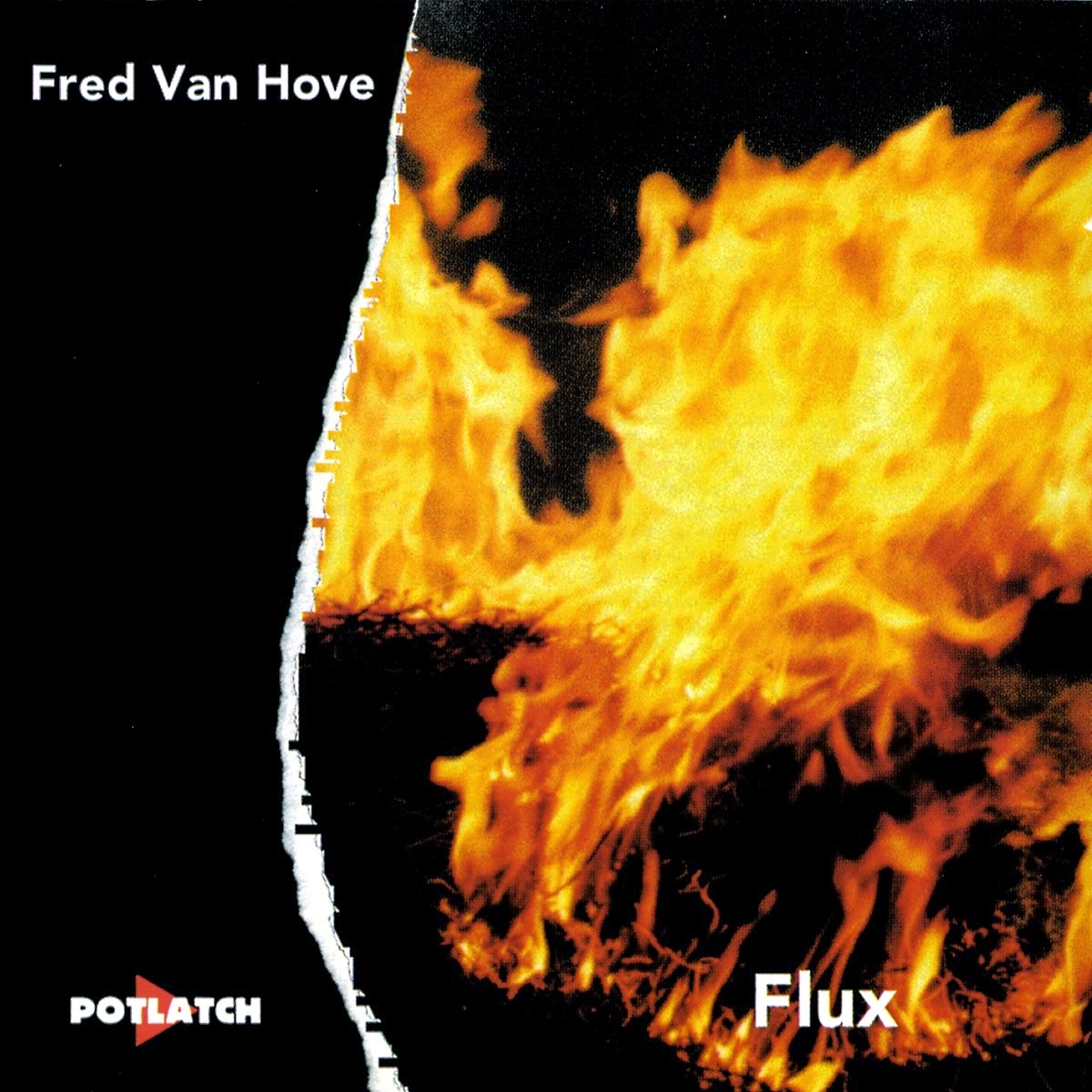
FRED VAN HOVE – Flux (piano solo) - [2CD-1998]


Label: Potlatch – P2398
Format: 2 × CD; Country: France - Released: 1998
Style: Free Improvisation
Recorded live in January 15 and 16, 1998, at Les Instants Chavirés.
Liner Notes – Gérard Rouy, John Corbett
Photography By – Fabio Pastorelli, Gérard Rouy
Piano, Music By – Fred Van Hove
Recorded By – Jean-Marc Foussat

Recorded live in January 1998 at Les Instants Charires Montreuil, France, Van Hove performs two pieces of 52 and 43 minutes length. His ceaseless creative pounding lines, working right hand runs while his left hammers, are both acts of endurance and one of a fertile imagination. His musical thoughts develop from his physical movements, like Jackson Pollock painting in the airspace above his canvas laid out on the floor. Like Pollock, Van Hove's thoughts are anything but random drippings. He passes intensity on, builds to a climax, releases tension with gentler cycles and opens the piano for some dulcimer sounds and wood thumping. The music heard is easy to relate to on several levels. Physically, the workout is impressive, emotionally or spiritually, his playing pulls you into the action before leaving you with a cathartic sigh, and intellectually (and maybe socially) you grasp the commitment he has to creative music. A satisfying and exhausting experience.


John Corbett's sleeve notes claim an analogy between solo improvisation and shadow-boxing. That's as may be, but Van Hove feels very much like he's landing every heavyweight punch he throws on these two marathon outings. Frequently occupying the bass register with his high-impact, staccato ostinati, his music can often be bludgeoningly loud and irritably angular.

Yet that's only half the story. If Van Hove can pound you into submission, he can also find a sweet, rhythmically ambiguous place among the higher notes. His right hand seems to dance across the keys, so intense is the illusion of movement in his playing, yet there's no hint of gestural sketchiness. Like Crispell, who he can quite strongly resemble at times, he has an ability to weld rhythmic and melodic shapes to logical harmonies. This can sometimes give his playing the air of Messiaen's more complex solo keyboard works.

It also completely side-steps the Cecil Taylorisms to which many avant garde pianists are prone. For all his whizz-bang technical fireworks, Van Hove's connections with Taylor are not his high-definition runs or the occasional cluster, but the impression that, at the centre of the whirlwind, careful thought is being put into the form of the piece and the development of its ideas.

Van Hove's playing may be closer to Modernism than to anything else, but there's a strong jazz connection here too. In particular, his left-hand strategies are often of the bass-line variety, while a hint of boogie woogie even surfaces now and again. His right hand can sometimes recall the great rock 'n' roll players, while a rhythmical reference to ragtime can occasionally be discerned within the tempestuous world he creates.

There's not much to separate these two long pieces -- each follows a similar path in its own fashion. Each has a ferocity which is all the more intimidating for its being so apparently casual, and each proceeds by generating and then transforming fairly simple materials, creating an organic flow of music with a surface which bristles with detail. One is reminded of Salieri in Schaeffer's Amadeus: if there really are only so many notes one can listen to in one evening, the audience at Les Instants Chavires must have gone home with hemi-demi- semiquavers dropping out of their ears. Like Mozart, though (and there's a comparison Van Hove can't have had too often), his superficial complexity compliments a formal elegance.

This double CD represents a technical, creative and athletic tour de force. Those who thrive on this level of intensity will find their ears very pleasingly crammed. It's also worth noting that, for a live document of such astonishingly loud music, the recording is very clear and not at all muddy. Highly Recommended.

_ By RICHARD COCHRANE


Links in Comments!