Thursday, January 15, 2015

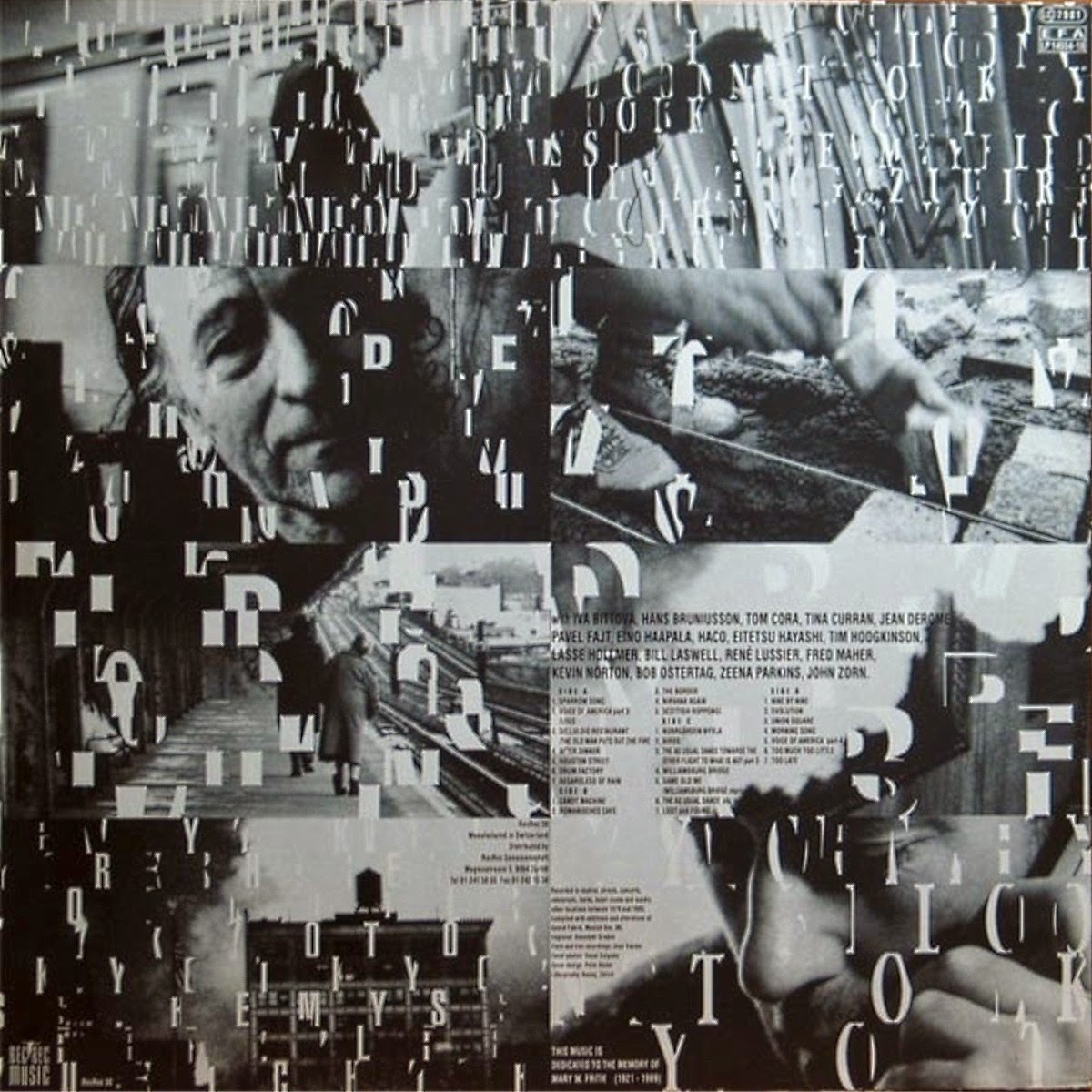
FRED FRITH – Step Across The Border (2LP-1990)


Label: RecRec Music – RecRec 30
Format: 2 × Vinyl, LP, Compilation / Country: Switzerland / Released: 1990
Style: Avantgarde, Experimental, Jazz-Rock
Music for the film by Nicolas Humbert and Werner Penzel, Recorded between 1979 and 1989.
Artwork [Lithography] – Busag, Zürich
Design [Cover] – Peter Bäder
Engineer – Benedykt Grodon
Photography By – Oscar Salgado
Recorded By – Jean Vapeur
Compiled with additons and alterations at Sound Fabrik, Munich Dec. 89.

A1 - Sparrow Song ........... (1:31)
A2 - Voice of America, Part III .......... (4:26)
A3 - Selluloid Restaurant ........... (3:12)
A4 - After Dinner .......... (1:49)
A5 - Houston Street .......... (2:56)
A6 - Drum Factory .......... (2:04)
A7 - Regardless of Rain ............ (3:07)
B1 - Candy Machine ............ (3:02)
B2 - Romanisches Café .......... (6:22)
B3 - The Border ........... (3:31)
B4 - Nirvana Again ............ (1:55)
B5 - Scottish Roppongi ........... (1:50)
C1 - Norrgarden Nyvla ............ (2:59)
C2 - Birds ........... (2:21)
C3 - The As Usual Dance towards the Other Flight to What Is Not, Part 3 ........... (1:50)
C4 - Williamsburg Bridge ........... (1:56)
C5 - Same Old Me .......... (4:13)
C6 - The As Usual Dance towards the Other Flight to What Is Not, Part 7 ........... (2:28)
C7 - Lost and Found .......... (3:20)
D1 - Nine by Nine .......... (5:54)
D2 - Evolution ........... (3:23)
D3 - Union Square .......... (1:44)
D4 - Morning Song .......... (2:03)
D5 - Voice of America, Part IV .......... (2:05)
D6 - Too Much Too Little ........... (2:09)
D7 - Too Late ........... (2:25)

Line-up / Musicians:
- Fred Frith / guitar, violin, bass, home-mades, DX7, Casio, voice, percussion, bottles, trumpet
- Tom Cora / cello, drum, voice
- Zeena Parkins / keyboards, drum, voice
- Bob Ostertag / Serge synthesizer, tapes, samples
- Bill Laswell / bass
- Fred Maher / drums
- John Zorn / alto saxophone
- Daihachi Oguchi / factory sound
- Jean Derome / alto saxophone
- René Lussier / bass
- Kevin Norton / drums
- Eino Haapala / guitar
- Marc Hollander / alto saxophone
- Lars Hollmer / keyboards
- Hans Bruniusson / drums
- Tim Hodgkinson / bass clarinet
- Iva Bittová / violin
- Pavel Fajt / beer cans, guitar, voice
- Eitetsu Hayashi / taiko
- Tina Curran / bass
- Haco / piano, voice

Step Across the Border is a 1990 avant-garde documentary film on English guitarist, composer and improviser Fred Frith. It was written and directed by Nicolas Humbert and Werner Penzel and released in Germany and Switzerland. The film was screened in cinemas in North America, South America, Europe and Japan, and on television in the United States, Germany, Switzerland, Austria and France. It was also released on VHS by RecRec Music (Switzerland) in 1990, and was later released on DVD by Winter & Winter (Germany) in 2003.

Shot in black and white, the 35mm documentary was filmed between 1988 and 1990 in Japan, Italy, France, Germany, England, the United States and Switzerland, and shows Frith rehearsing, performing, giving interviews and relaxing. Other musicians featured include René Lussier, Iva Bittová, Tom Cora, Tim Hodgkinson, Bob Ostertag and John Zorn.

The film won "Best Documentary" at the European Film Awards in 1990. A companion soundtrack album, Step Across the Border was also released by RecRec Music in 1990.


A ninety minute celluloid improvisation by Nicolas Humbert and Werner Penzel.
"Improvisation" here refers not only to the music, but also to the film itself. Humbert and Penzel state in the 2003 DVD release of the film:

“In Step Across the Border two forms of artistic expression, improvised music and cinema direct, are interrelated. In both forms it is the moment that counts, the intuitive sense of what is happening in a space. Music and film come into existence out of an intense perception of the moment, not from the transformation of a preordained plan.”

The film is not narrated, and the musicians, the music and the locations are not identified. Instead it is a sequence of "snapshots' taken of Frith and musicians he has worked with, rehearsing and performing, interspersed with apparent random images of movement (trains, cars, people, grass) that blend in with the music. The improvised nature of the film and its Direct Cinema approach make it more of an art film than simply a documentary on a musician.
The music in the film is performed by Frith on his own, with others, and by others on their own. Some of the music is improvised, some is composed material performed "live", and some is previously recorded material played as accompaniment to many of the "movement" sequences in the film.
The recording of the film coincided with the formation and activity of Frith's review band Keep the Dog (1989–1991), and many of the participants of the band appear in the film. There are even a few rare glimpses of the band rehearsing. René Lussier in particular, features prominently and "interviews" Frith about his musical upbringing and approach to music.

The title of the film comes from the lyrics of the song "The Border", recorded by Skeleton Crew on their album, The Country of Blinds (1986). A brief "video" of this song also appears in the film.


Although this is technically the soundtrack to a film of the same name by Nicolas Humbert and Werner Penzel, Step Across the Border actually serves as an excellent overview of Fred Frith's groundbreaking work as a soloist, bandleader, and collaborator. There's an example of his "guitars on the table" approach ("Romanisches Cafe"), and a couple of excellent duos with tape manipulation whiz Bob Ostertag ("Voice of America, Pt. 3," from the lost and lamented Voice of America album they made for the defunct Metalanguage label). There are also scraps of material from his work with Skeleton Crew as well as numerous other well-chosen miniatures that vary from tuneful and charming to stark and forbidding. Perhaps the best thing this album accomplishes is that it puts some of the material from the astounding (but, sadly, long out of print) album of avant-garde power trio compositions and improvisations Frith recorded with Bill Laswell and Fred Maher under the name Massacre back into circulation: the very fine "Legs" is included here, as is a previously unreleased live track from 1983. Very highly recommended.

_ Review by Rick Anderson


The collection itself is wonderful, showing all sides of Frith's skillful and innovative playing and composition. The songs range from sounds similar to The Residents, whose Commercial Album featured Frith as a sideman, to early Zappa, and even one song Evolution, with high pitched vocals and a reggae influenced beat, that sounds sort of like a deranged version of The Police.

This is a gem in my collection. Highly recommended for the RIO fan.


If you find it, buy this album!

Monday, January 12, 2015

DEBILE MENTHOL – Emile Au Jardin Patrologique (LP-1981)


Label: RecRec Music – REC REC 01
Format: Vinyl, LP, Album / Country: Switzerland / Released: 1981
Style: Avantgarde, Prog Rock, Contemporary Jazz
Recorded in October 1981 at Sunrise Studio, Kirchberg, Switzerland
Artwork – Peter Bäder
Engineer – Bubu Steiner, Etienne Gonod, Roebel Vogel
Producer – Débile Menthole, Rec Rec Zürich
Printed By – Printoset, Zürich

Débile Menthol comes as the Swiss response to the Belgian Aksak Maboul with a Nutty side probably even more pronounced and from here and there, some specific to the time influences (very Talking Heads "A Nos Mamans'' and "Crash Que Peut").

        Ici Derrière
A1 - Stamoï De Cousu . . . . . . . . . . 1:04
A2 - Très Amusant, Major . . . . . . .  8:05
A3 - Tante Agathe . . . . . . . .  . . . . . 1:57
A4 - Coupe-Rose . . . . . . . . . . . . . .  1:56
A5 - Spacio Cib.   . . . . .  . . . . . . . .  7:18
A6 - Rien . . . . . . . . . . . . . . . . . . . .  1:54
        Là-Bas Devant
B1 - A Nos Mamans . . . .  . . . .  . . . 4:43
B2 - Mort Aux Dahus . . . . . . . . . . .  3:04
B3 - La Jupe . . . . . . . . . . . . . . . . . . 5:49
B4 - Je Regarde Par La Fenêtre . . . 3:41
B5 - Crash Que Peut . . . . . . . . . . . .4:21

François Liègme - (drums, percussion)
Patrice Dupasquier - (saxophones)
Cedric P.Vuille - (clarinette, guitar, drums)
Ivan G.Chkolnix - (bass, guitar)
Marie C.Schwab - (violon, chant)
Christian G.Addor - (keyboards, basse, chant)
Gilles Vincent Rieder - (drums, percussion, bass, voice)
Jean-Maurice Rossel - (bass, guitare)
Jean-Vincent Huguenin - (guitar, percussion, voice)

Essential RIO band, this group uses sophisticated rock based compositions and a very strange sense of humour to make some of the greatest pieces of complex rock music imaginable. Chris Cutler states that, while many bands are thrown around as belonging to RIO, this is one of the bands that would have been invited had the timing been possible.


Once upon a time in Neuchatel, Switzerland there was this band called Debile Menthol who played Rock In Opposition in the vein of Samla Mammas Manna, Etron Fou and Henry Cow and with a sort of minimalistic approach that reminds Massacre (Fred Frith).
Founded in 1979, this band managed to record only two albums - Emile Au Jardin Patrologique (1981) and Battre Campagne (1984).
The first album is rather cheerful sounding (with occasional darker parts), jazzier and has a large lineup consisting of 9 members (playing on violin, sax and clarinet among others). This album can appeal to Samla Mammas Manna and Miriodor fans.
Overall this is a weird sounding band, which created a mix of quirky rock, punk, fusion, free jazz and plain eccentricity. The lyrics (when there are any) are being spoken (sometimes at high tone) in a non-melodic style (not sung and to me reminds of Massacre and The Clash) in French and filled with satire and humour (as their name might suggests). During their tours the band was under financial and personal stresses which lead to its disbanding and the creation of two other bands.

Discography:
Emile Au Jardin Patrologique, studio album (1981)
Battre Campagne, studio album (1984)

Debile Menthol ‎second album

Recorded in the Fall of 81, Debile Menthol's debut album is very much in advance of its time and was obviously very influential for many group that are developing the Avant Prog genre (whatever that may be) today. From the Quebecois Miriodor, Rouge Ciel and Interference Sardine, to Finland's Alamaailman Vasarat or Uzva, to Belgium's Julverne, X- Legged Sally Hardscore or Cro Magnon etc.: all of these groups owe IMHO a big debt to Debile Menthol's works. Debile Menthol is a 9-man formation (most are multi- instrumentalists), from which will emerge Rossel and Huguenin.

While Debile Menthol's music is a rather crazy pot-pourri of musical influences and borrowings, they often remain fairly accessible, fun, often going into the bombastic and grotesque folkloric fair music (like the Oktoberfest beer-bingeing music or circus music for example). The album is fairly acoustic (just some synths and electric guitars) and mainly instrumental, with only a few weird French rather-funny vocals in off-voices, but they can get demented as well. In the album highlight A Nos Mamans (To Our Mothers), they sound for a small minute like the Sranglers, if you can believe it. Other tracks can sound like some crazy Devo or Talking Heads (Regarde Par La Fenêtre and Crash Que Peut), but the whole thing being much more complex and as much fun.

Most likely one of the most influential album in the "Avant Prog" genre, given its early release date, and a fun one too. Only for progressive nutheads with a few loosened bolts above the neck level.
_ Review by Sean Trane


Note:
I have listened to this album at least 20 times through, and it never ceases to amaze me. The instrumentation on this album akin to the virtuoso lunacy to be found on Begnagrad's eponymous album. Strange melodies and song structures dominate this LP, from the folksy, classically-influenced musings of Tres Amusant, Major to the haunting industrial vortex of Rien. I speak very sparse French, so I have no idea what these people are saying, and that is probably for the better. This album, as a whole, exhibits a slightly unhinged quality, as one would experience in a conversation with a seemingly normal person who nevertheless seems barely able to conceal his/her insanity. Bubbling beneath the surface of this album is a kind of demented-circus-quality of madness that seems at once both endearingly amusing and subtly dangerous. 
A must-have album for those who enjoy like their prog waaayy out there.    
_ jglowe77


If you find it, buy this album!

Sunday, January 11, 2015

AQSAK MABOUL – Un Peu De L'Âme Des Bandits (LP-1980)


Label: Crammed Discs – Atem/Crammed 002
Format: Vinyl, LP, Album / Country: Belgium / Released: Jan. 1980
Style: Avantgarde, Jazz, Experimental, Prog Rock
Recorded February and August 1979 at Sunrise Studio, Kirchberg, Switzerland
Mixed by Etienne Conod and Fred Frith, assisted by Aqsak Maboul
Front cover by – Pat Andrea
Back cover and layout by – M.M.C. Octave

Un Peu de l'Âme des Bandits (English: A Little of the Bandit Spirit) is the second album by Belgian avant-rock band Aksak Maboul. It was recorded at Sunrise Studio in Kirchberg, Switzerland in February and August 1979, and released on LP in January 1980 on founding member Marc Hollander's Belgian independent record label, Crammed Discs. At the time the band had changed the spelling of their name to "Aqsak Maboul", and this is reflected on the album's record sleeve. When the album was re-issued on CD in 1995 (also on Crammed Discs) the spelling of their name reverted to "Aksak Maboul".

In addition to the Aksak Maboul line-up at the time, the album also featured ex-Henry Cow musicians Fred Frith and Chris Cutler whose contribution and names helped bring the album to the attention of a wider audience. Aksak Maboul's co-founder, Vincent Kenis did not play on this album, although he did arrange two of the tracks.


A1 - Bo Diddley / Modern Lesson . . . . . 4:58
            bassoon, oboe, choir – Michel Berckmans
            cello [violoncellos] – Denis Van Hecke
            drums [part I], performer [flipper], recorder, choir – Frank Wuyts
            drums [part II] – Chris Cutler
            electric guitar, acoustic guitar, violin, viola, bass – Fred Frith
            organ, piano, clarinet [Bb], bass clarinet, saxophone  – Marc Hollander
            voice, performer [flipper] – Catherine Jauniaux
            written-by – Hollander
A2 - Trio-Tango / Palmiers En Pots . . . . . 3:24
            alto aaxophone – Hollander
            bassoon – Berckmans
            cello – Van Hecke
            drums – Cutler
            piano – Wuyts
            violin – Frith
            written-by – Wuyts, Hollander
            written-by [Trio] – André Verchuren
A3 - Rondo / Geistige Nacht . . . . . 5:18
            bass – Frith
            bassoon, oboe – Berckmans
            cello – Van Hecke
            drums – Cutler
            piano, synthesizer [Oberheim] – Wuyts
            soprano saxophone – Hollander
            written-by – Frith
A4 - Truc Turc / I Viaggi Formano La Gioventù . . . . . 5:15
            cello [acoustic & electric cellos] – Van Hecke
            goblet drum [dumbeg], soprano saxophone, organ, – Hollander
            guitar [Guitars] – Frith
            oboe – Berckmans
            synthesizer [Oberheim], Piano – Wuyts
            written-by – traditional
A5 - Pogo / Inoculating Rabies . . . . . 1:50
            bass clarinet – Hollander
            bass, lead guitar – Frith
            bassoon – Berckmans
            drums – Cutler
            rhythm guitar, electric cello, voice – Van Hecke
            written-by – Van Hecke, Wuyts

B  -  Knokke  / Cinema . . . . . . . . . . . . . . . . . . . . . . . . . . . . . . . (22:45)
   a - Ce Qu' On Peut Voir Avec Un Bon Microscope . . . . . 7:25
            bass, guitar, guitar [prepared] – Frith
            cello [acoustic & electric cellos], voice – Van Hecke
            composed by – Wuyts, Hollander
            composed by [part of] – Jauniaux, Cutler, Van Hecke, Frith, Berckmans
            drums, percussion, performer [radio] – Cutler
            oboe, bassoon – Berckmans
            organ, alto saxophone, bass clarinet, xylophone, piano  – Hollander
            piano, synthesizer [Óberheim], percussion – Wuyts
            voice – Jauniaux
   b - Alluvions . . . . . 5:27
            bass, guitar, guitar [prepared] – Frith
            cello [acoustic & electric cellos], voice – Van Hecke
            composed by – Frank Wuyts, Hollander
            drums, percussion, performer [radio] – Cutler
            oboe, bassoon – Berckmans
            organ, alto sax, bass clarinet, xylophone, percussion – Hollander
            piano, synthesizer [Óberheim] – Wuyts
            voice – Jauniaux
   c - Azinou Crapules . . . . . 7:05
            bass, guitar, guitar [prepared] – Frith
            cello [acoustic & electric cellos], voice – Van Hecke
            composed by – Wuyts, Hollander
            drums, percussion, performer [radio] – Cutler
            oboe, bassoon – Berckmans
            organ, alto saxophone, bass clarinet, xylophone – Hollander
            piano, synthesizer [Óberheim], percussion – Wuyts
            voice – Jauniaux
   d - Age Route Brra! (Radio Sofia) . . . . . 2:48
            bass, guitar, guitar [prepared] – Frith
            cello [acoustic & electric cellos], voice – Van Hecke
            composed by – Aqsak Maboul
            drums, percussion, performer [radio] – Cutler
            oboe, bassoon – Berckmans
            organ, alto saxophone, bass clarinet, xylophone – Hollander
            piano, synthesizer [Óberheim], percussion – Wuyts
            voice – Jauniaux

Marc Hollander – organ, piano, clarinet, bass clarinet, saxophone , drum machine, alto  
                            saxophone, soprano saxophone, dumbeg, samples, xylophone, percussion
Frank Wuyts – drums, pinball machine flipper, recorder, piano, synthesizer, percussion, choir
Michel Berckmans – bassoon, oboe, choir
Denis van Hecke – acoustic cello, electric cello, voice, rhythm guitar
Catherine Jauniaux – voice, pinball machine flipper
Fred Frith – guitar, violin, viola, bass guitar, prepared guitar
Chris Cutler – drums, percussion, radio


_1.     Aksak Maboul (also spelled Aqsak Maboul for a while) were a Belgian avant-rock band founded in 1977 by Marc Hollander and Vincent Kenis. They made two studio albums, Onze Danses Pour Combattre la Migraine (1977) and Un Peu de l'Âme des Bandits (1980), the last one with ex-Henry Cow members Chris Cutler and Fred Frith. They were also active in the Rock in Opposition movement Maboul began in 1977 as a duo of Marc Hollander (keyboards, reeds, percussion) and Vincent Kenis (guitar, bass guitar, keyboards). Marc Moulin (keyboards) and Chris Joris (percussion, keyboards) joined later, and with this line-up, plus guests Catherine Jauniaux (voice) and others, they recorded their first album, Onze Danses Pour Combattre la Migraine (French for “Eleven Dances for Fighting Migraine”).

It was released in 1977 under the name Marc Hollander / Aksak Maboul on an independent record label, Kamikaze Records.Onze Danses Pour Combattre la Migraine was a playful mix of musical forms, cultures and genres. With drum machines and looping organ lines, it shuffled between improvised jazz, ethnic music, electronics and classical music. It was largely an instrumental album with snatches of singing and voices.In late 1977 Aksak Maboul started performing live, during which time Frank Wuyts (percussion, keyboards) replaced Joris and Moulin, and Denis van Hecke (cello) and Michel Berckmans (bassoon, oboe) of Univers Zéro joined. In early 1979, Hollander invited Chris Cutler and Fred Frith of the recently defunct avant-rock group Henry Cow to join Aksak Maboul on their next record.

They rehearsed together, performed in a few concerts and then went to Sunrise Studio, Kirchberg in Switzerland to record their second album, Un Peu de l'Âme des Bandits (French for “A Little of the Bandit Spirit”).This was released in 1980 on Crammed Discs, a new independent record label Hollander had created to release the album.Un Peu de l'Ame des Bandits was more intense and experimental than their first album. It contained complex written sections as well as improvised ambient pieces. It used sampling before samplers were invented and was a mixture of jazz, tangos, traditionals from the eastern Balkans, chamber rock, noisy punk rock and pseudo-Varèse music. Like the first album, it was instrumental with a little singing and voices.Back on the road again, Aksak Maboul joined the Rock in Opposition (RIO) movement and in April 1979 they performed at an RIO festival at the Teatro dell'Elfo in Milano, Italy.

Aksak Maboul were one of the last of the original RIO bands.In early 1980, Hollander founded the Crammed Discs independent record label. A few months later the original nucleus of Aksak Maboul (Hollander and Kenis) and the core of a Brussels band Les Tueurs de la Lune de Miel joined forces to become The Honeymoon Killers. They toured Europe between 1980 and 1981, although still under the name Aksak Maboul. 


They later recorded an album Tueurs de la Lune de Miel / Honeymoon Killers and toured for a few months under that name. The last recorded work by Aksak Maboul appeared on a 1984 compilation album, Made to Measure Vol. 1, where the original duo of Hollander and Kenis contributed seven tracks of new material composed for a play by Michel Gheude based on the life of Maïakovsky.The music here has been described as “minimalist rock” and is very different from their two studio albums.By the mid-1980s Aksak Maboul ceased to exist as a group, but Hollander and Kenis continued to play an active role in Crammed Discs' musical policies.


_2.     Aksak Maboul - Un peu de l'ame des bandits Aksak Maboul (a.k.a. Aqsak Maboul) was one of the original Rock-In-Opposition (RIO) groups. They were one of three that were officially elected into the movement after Henry Cow’s original selection of bands (Univers Zero, Etron Fou Leloublan, Samla Mammas Manna and Stormy Six) had explored the style and ideology. “Un peu de l’ame des bandits,” Aksak Maboul’s 1980 effort, is more or less quintessential to the RIO genre, and one that set the stage for many of the Avant-Prog groups that have followed since...

The late '70s were a heady time in European progressive rock circles. Chris Cutler, drummer 
of the leading group Henry Cow and unrepentant leftist seeking to distance himself from both major label and American rock influences, found similarly minded groups in France, Sweden, Belgium, and Italy, and brought them together for a British tour under the banner of Rock in Opposition (RIO). New musical influences and adventures gave rise to more short term formations for Cutler and Fred Frith (Cow's guitarist), including this venture with a Belgian duo, Aksak Maboul, comprised at the time of Marc Hollander and Vincent Kenis. This group had recorded an album in 1977, Onze Danses Pour Combattre le Migraine, which became a cult album in its own right. As Aksak toured, their paths crossed with the various RIO groups, which led to this album in 1980. Cutler and Frith brought a solid rhythm section, but ready to make terrific noise when appropriate (as on the backing tracks of Inoculating Rabies). Michel Berckmans, wind player from Univers Zero (one of the Belgian RIO groups), and Hollander were the wind and reed section. Frank Wuyts and Denis Van Hecke rounded out the group on keyboards and strings. Stylistically the album is all over the board. For example, the opening track, featuring Catherine Jauniaux on vocals, launches into a twisted blues number, with the singer freely improvising and trading licks with Van Hecke's cello and Hollander's sax. The second part of Modern Lesson features extremely intricate horn writing, with different players rapidly trading different elements of the lines. "I Viaggi" uses a Middle Eastern scale, with cello and voice doubling the melody line. "Palmiersen Pots is a classical piece for string trio, followed by a tango composed from several popular pieces cut up with scissors and reassembled at random. The album culminates with a long suite (originally all of side two on the vinyl release) based on a shorter peggiated figure, composed sections alternating with solos on bass, cello, electric cello, and synthesizer. On top of all of the great musicianship, Frith and lead engineer Etienne Conod performed significant studio wizardry after the sessions. Modern Lesson contains sounds from a pinball machine as well as bits from every other track (and this is well before the age of samplers). The lead bassoon/oboe lines of Inoculating Rabies would be inaudible over the guitar and percussion noise in a live situation, but the contrast makes the piece.  
This Aksak Maboul lineup and this album, is remains a pinnacle of the RIO movement.

_Review by Caleb Deupree


If you find it, buy this album!

Tuesday, January 6, 2015

YOCHK'O SEFFER NEFFESH MUSIC – Délire (LP1-1976) and Ima (LP2-1976)


Label: Moshé-Naïm – MN 12 008
Format: Vinyl, LP, Album / Country: France / Released: 1976
Style: Free Jazz, Abstract
Recorded at Studio Aquarius (Genève) from 22 to 27 March 1976.
Artwork By [Maquette] – MN Studio (A. Appere)
Composed By – Yochk'o Seffer
Engineer – Roger Delongeas
Photography By – Michel Adda

A1 - Heart . . . . . 6:30
A2 - Jonetsu (For Judith) . . . . . 5:53
A3 - Orkana . . . . . 6:25
B1 - Estreledzia (For Winni) . . . . . 2:40
B2 - Délire . . . . . 13:20
B3 - Ima . . . . . . . . . . 4:02

Yochk'o Seffer – soprano sax, saxophone [soprano B Flat], tenor saxophone, vocals, 
                            bass clarinet, piano, synthesizer [Mini Moog & Arp Odc-solo], kamuka*
Jean-My Truong – drums, percussion
Claudine Lasserre – cello
Françoise Douchet – viola
Michèle Margand – violin [1st]
Marie-Françoise Viaud – violin [2nd]
Quatuor Margand – ensemble [string quartet]:
(Michèle Margand, Anne Méhat, Françoise Douchet and Claudine Lasserre)

* The 'Kamuka' is an instrument designed and built by Yoshk'o Seffer.


Although Delire was not Hungarian-born Parisian multi-instrumentalist Yochk'o Seffer's first solo album, it was nonetheless the first from his project Neffesh Music (music of the soul), consisting of him as the composer and the instrumentalist along with a revolving cast of other musicians. On this album he's backed by fellow Zao cohort Jean-My Truong on drums as well as a string quartet led by Michele Margand, who also were members of Zao at the time when this album was recorded (March 1976). All other instruments are played by Yochk'o.

What sets this album apart from his previous work with Zao, as well as his future Neffesh Music projects, was the lack of electric bassist. Therefore, this album includes less fusion/jazz-rock tinge, the dominant presence of acoustic piano and strings along with saxophones clearly hints at an avant-garde chamber rock sound reminiscent of Univers Zero, Henry Cow or possibly even late sixties Frank Zappa. Even within Seffer's varied discography this album is sonically unique, but unfortunately it's overlooked in favor of his other recordings, including Ghilgoul. Nowadays one can hope to buy this record via Ebay and this can incur more-than-average expenses for one vinyl copy. It's that rare!

"Heart" opens with a staccato piano-drums-sax riff, followed by ominous and rigid strings, the atmosphere is very tense and almost Stravinsky like. The main melodic theme is established after a minute with tenor sax carrying the melody, including a bassline that sounds like rendered on fuzz-bass, but is more likely a distorted bass synth that sounds heavy and sinister nonetheless. The same theme is then repeated on strings and Seffer's unique falsetto vocalize. Halfway in the piece switches to a funky drum break backing a tenor sax solo, with interjections from synth and piano.

"Jonetsu For Judith" ("jonetsu" is Japanese for "passion") starts with lush string arrangements and beautiful chord progression, as the prominent tenor sax solos over the chords with passionate agitation. Layers like piano, synthesizer and even overdubbed harmony vocals are added. The piece moves through some tense and dissonant chords that are contrasted by freeform tenor sax. The piece concludes with a moderately fast tempo carried by strings aided with synth bass and some percussion and Seffer's tenor sax gets more intense until the piece stops.

"Orkana" begins with a rubato synthesizer solo backed by sparse piano. First hint at the main melodic themes comes with overdubbed saxophones (sopranino, soprano and tenor). Drums and piano then come in and the same theme gets a beat-heavy basis, with Seffer adding vocalize to the mix as well. This is clearly the most Henry Cowish track on the entire album, as the interplay between drums and piano is pure kinetic chamber rock bliss, with overdubbed saxophones having the lushness comparable to a wind quartet, composed themes contrast with short solos on synthesizer, tenor and sopranino saxophones and Seffer showcasing more of his unique high voice. Halfway the piece switches to a relentless synth solo over a fast drum beat that goes on for a while until the piece concludes with the instrumentation of drums, piano and soprano sax.

"Streledzia" is a short, lush piece for electric piano, vocalize, strings and includes more freeform tenor sax outing. As a modern classical piece it sounds unique with its lush, empathic chord clusters, instrumentation and Coltrane-influenced tenor sax.

While other tracks confirm that Yochk'o Seffer is capable of composing warm, empathic and highly personal forms of avant-garde music combining modern classicism, free jazz and progressive influences, on the title track he pulls all the stops and creates a fusion of atonal classicism and unstructured free-jazz that at times sounds ominous, at times rigid and at other times shows that Seffer as a pianist had a bit of a Cecil Taylor influence. Not a palatable listening, unless you love later period Coltrane and/or Zappa's least accessible classical writing.

"Ima (1ere partie)" is a prelude to his next solo album, combining the low buzzing droning noises of his self-invented sonic sculptures, out-of-control bass clarinets rattling at the background, and haunting melodies carried by Seffer's vocalize, first doubled on a Moog synth and then on tenor sax. This is a mourning piece of proto-ambient music and as a precursor to the 2o minute title track of Ima, it shows that Yochk'o Seffer could also make electronic avant-garde music very well.

Delire is a rare and forgotten record that is unjustly overlooked. Nonetheless, it shows Yochk'o Seffer's boundless creativity as a composer, instrumentalist and improviser. This work transcends the usual trappings of jazz-fusion or progressive rock.

_ Review by Edmund


Label: Moshé-Naïm – MN 12 010
Format: Vinyl, LP, Album / Country: France / Released: 1976
Style: Free Jazz, Abstract
Recorded At – Studio Adam, 1976 / Production et réalisation : Moshé-Naïm
Artwork By [Maquette] – MN Studio (A. Appere)
Composed By – Yochk'o Seffer
Engineer – Philippe Beaucamp
Photography By [Back] – Alain Appéré
Photography By [Photos Of Yochk'o Seffer] – Michel Adda

A  -  Ima . . . . . . . . . . . . . . 22:50
B1 - Ofek . . . . . . .  . . . . . . . 8:12
B2 - Noce Chimique . . . . . 12:18

Yochk'o Seffer – soprano sax, saxophone [soprano B Flat], tenor saxophone, vocals, 
                            bass clarinet, piano, synthesizer [Mini Moog & Arp Odc-solo], kamuka
Dominique Bertram – bass guitar
Manu Katche – drums, percussion
Claudine Lasserre – cello
Françoise Douchet – viola
Michèle Margand – violin [1st]
Marie-Françoise Viaud – violin [2nd]
Quatuor Margand – ensemble [string quartet]:
(Michèle Margand, Anne Méhat, Françoise Douchet and Claudine Lasserre)


This LP is the 2nd part of a work named Neffesh Music.

Excellent complex compositions in the most experimental vein, with dark, evocative, sometimes oppressing feeling. Ethnic chanting and hard jazz passages creating a unique sound!

Listen to him. What to say? Just a masterpiece!


YOCHK’O SEFFER - Biography

French sax player and composer born in Miskolc (Hungary) on 10.7.1939, Seffer starts studying music at the age of 6. He moves to France in 1956 where he studies reeds, piano and composition at the Conservatoire de Paris, mainly with Nadia Boulanger but also as an occasional student with Olivier Messiaen. In 1959, at the Bohème, he performs with Mal Waldron, the first one in an endless list of partners (amongst others, Charlie Rouse, Phil Woods, Steve Lacy, Ornette Coleman, Pharoah Sanders, Dave Liebman, Kenny Barron, Joachim Kühn, Daniel Humair, Henri Texier)… In 1969 he creates Perception together with Siefried Kessler, Didier Levallet and drummer Jean-My Truong. The following year, he appears in Magma's line up. In 1973, he associates with pianist François "Faton" Cahen to create ZAO. In 1976, he initiates Neffesh Music, a musical ensemble including jazz improvisers and solists from Pierre Boulez' Ensemble Intercontemporain. Between 1983 and 1985, Jean-François Jenny-Clark, Kessler, Michel Godard and drummer Peter Gritz will be part of Chromophonie, a big band that will be followed by a saxophone septet (1986). In 1988, he adopts a quartet formula (with Kessler, François Méchali and Gritz) that plays Monk's compositions; that first tribute will be followed by another tribute, to Coltrane this time and with eighteen musicians. He is also a painter and a sculptor and the father of cellist Debora Seffer.
Coloured spots, smelting masses, nuances and violent patchworks, he plays music as he paints and sculpts, putting together the dancing lyrism of his compatriot and fellow musician Bartok, the colatranian fire and the sense of evidence of Monk, connecting all these various elements as a multi-instrumentist virtuoso(from soprano to bass saxophone) led by an inexhaustible passion.


Enjoy!

Saturday, January 3, 2015

JOHN GREAVES / PETER BLEGVAD / LISA HERMAN – Kew. Rhone. (LP-1977)


Label: Virgin Records – V 2082
Format: Vinyl, LP, Album / Country: UK / Released: 1977
Style: Avantgarde, Contemporary Jazz, Fusion
Recorded at Grog Kill Studio, Woodstock, New York, October '76.
Engineering by Michael Mantler
Interactive multimedia track "Kew. Rom." produced by Les Corsaires and Voiceprint
Coordination and concept by François Ducat
Programming by Denis Thiriar
Artistic contributions from Peter Blegvad

A1 - Good Evening . . . . . . . . . . 0:33
A2 - Twenty-Two Proverbs . . . . . . . . . . 4:08
A3 - Seven Scenes From the Painting "Exhuming the First American Mastodon" By C.W.  
        Peale . . . . . . . . . . 3:32
A4 - Kew. Rhone.  . . . . . . . . . . 3:04
A5 - Pipeline . . . . . . . . . . 3:41
A6 - Catalogue of Fifteen Objects and Their Titles . . . . . . . . . . 3:36
B1 - One Footnote (To Kew. Rhone.) . . . . . . . . . . 1:29
B2 - Three Tenses Onanism . . . . . . . . . . 4:07
B3 - Nine Mineral Emblems . . . . . . . . . . 5:51
B4 - Apricot . . . . . . . . . . 3:05
B5 - Gegenstand . . . . . . . . . . 3:34

LISA HERMAN – vocals
JOHN GREAVES – piano, organ, bass, vocals, percussion on 'Footnote'
PETER BLEGVAD – vocals, guitars, tenor sax on 'Pipeline'
ANDREW CYRILLE – drums, percussion
MIKE MANTLER – trumpet, trombone
CARLE BLEY – vocals, tenor sax on 'Good Evening' and 'Footnote'
MICHAEL LEVINE – violin, viola, vocals on 'Minerals'
VITO RENDACE – alto & tenor saxes, flute
APRIL LANG – vocals on 'Pipeline' and 'Three Tenses'
DANA JOHNSON – vocals on 'Proverbs'
BORIS KINBERG – clave on 'Pipeline'

Kew. Rhone. is a concept album by British bass guitarist and composer John Greaves, and American singer-songwriter and guitarist Peter Blegvad. It is a song cycle composed by Greaves with lyrics by Blegvad, and was performed by Greaves and Blegvad with vocalist Lisa Herman and others. The album was recorded in Woodstock, New York in October 1976, and was released in the United Kingdom in March 1977 by Virgin Records, credited on the front cover to "John Greaves, Peter Blegvad and Lisa Herman", but on the record label as "John Greaves and Peter Blegvad". It was issued in the United States in 1978 by Europa Records.


Kew.Rhone is an often overlooked masterpiece from the 1970s, a multilayered concept album that combines the complexity of RIO with the melodic sensibilities of the best Canterbury bands and which features perhaps the most erudite lyrics in the history of progressive rock.

John Greaves (music) and Peter Blegvad (lyrics) began their creative partnership when Henry Cow and Slapp Happy joined forces for Desperate Straits - their song 'Bad Alchemy' was one of that album's highlights, and they have continued to write and perform together on an occasional basis ever since. Following the recording of 'In Praise Of Learning' Henry Cow and Slapp Happy split, and John Greaves left Henry Cow at about the same time. He and Peter Blegvad went to New York, where they wrote this album and then recorded it with the assistance and participation of jazz greats Carla Bley and Mike Mantler. Vocalist extraordinaire Lisa Hermann was rightly given joint billing with the two songwriters; like Dagmar in Slapp Happy and Art Bears, it is her interpretation of the material that brings it to life. Robert Wyatt was so impressed that he bought two copies, in case one got damaged or worn out, and later sang a version of the title track on John Greaves' 'Songs' album.

Side 1 of the vinyl original opened with "Good Evening", which functioned like the opening tune of a Broadway musical - some of the main musical themes of the album are played in a short but highly effective big band arrangement. This leads straight into "Twenty Two Proverbs", which is just that - a collection of proverbs from a variety of sources set to music and sung by Lisa Herman with occasional interjections from other voices - John Greaves' delivery of 'What have I to do with Bradshaw's windmill?' is one of the album's early highlights. The proverbs sometimes seem to relate to each other; 'A cat may look at a king' is juxtaposed with 'By night all cats are grey', while 'Names are not the pledge for things but things for names' flags up one of the album's main lyrical concerns. "7 Scenes From 'Exhuming The First American Mastodon' By CW Peale" follows, the lyrics based on the cover painting, itself based on CW Peale's painting of his own scientific project. This track has some remarkable brass by Mike Mantler, which plays off Lisa Herman's lead vocal to stunning effect. "Pipeline" follows, which pulls off the rare feat of having a line such as 'Figure b. illustrates the assertion 'Ambiguity can't be measured like a change in temperature' and making it melodic and catchy. The lyrics refer back to "7 Scenes"; objects mentioned in that song reappear here in a different guise (Names are not the pledge for things...). Again, despite the apparent complexity this a breezy, melodic song which will linger in the mind for a long time. The title track is the album's centrepiece, another hummable gem with opaque lyrics. The first part of the song is written solely using the letters in Kew.Rhone, for example 'We who knew no woe', and the second features a lengthy palindrome: 'Peel's foe, not a set animal, laminates a tone of sleep'. Once again all this is sung to some extremely memorable music, with some wonderful strings by Michael Levine and a superb vocal arrangement with another sterling contribution from John Greaves' pleasing Welsh tenor. The first half of the album culminated with Catalogue of Fifteen Objects and their Titles (Names again...), which is also referred to obliquely on 'Squarer for Maud' by National Health.

Side 2 kicked off with another short track, "One Footnote", which suggests further anagrams from the title and invites the listener to think of some more. "Three Tenses Onanism" is a highly poetic paen to the pleasures of self gratification and sees the music move more towards RIO/Avant prog territory, each of the three tenses being represented by a different musical idea. Peter Blegvad is the main vocalist here, his knowing New York drawl adding an extra dimension to the lyrics. 'Nine Mineral Emblems' returns to the jazz tinged Canterbury stylings of the first half of the album, and contains some accurate information about mineralogy given an unlikely but effective erotic subtext: 'When heated, SCOLECITE lengthens, squirms - not unlike the worm that looks for lodgings in a pearly urn'. "Apricot" feature's Blegvad's second lead vocal, and is probably the closest the album comes to a straightforward rocker (not very close, admittedly, but there's something of Lou Reed in the vocals and it has the album's most prominent electric guitar)."Gegenstand" brought the album to a subdued close - this track has the sparsest arrangement on the album, dominated by John Greaves' bass playing.

The instrumental performances are all superb throughout the album. John Greaves plays some beautiful piano as well as anchoring the arrangements with his ever inventive bass work. Peter Blegvad is not a great guitarist (as he admits himself) but acquits himself creditably on some extremely tricky guitar parts, while the supporting players all turn in splendid performances - this is very much an album of tightly focussed, carefully arranged ensemble playing, the arrangements allowing the individual players to shine without dominating the proceedings. It also functions well as a whole package - Blegvad was responsible for the sleeve design, which informs some of the lyrics, and some CD versions have an enhanced feature which takes you deeper into the album's concept. Music, lyrics and visuals all complement each other to perfection.

Greaves and Blegvad have both had long and distinguished careers, and they have written a wealth of good material together and individually, but nothing since has quite equallled this gem of an album. This is a genuine masterpiece, and no collection is complete without it.

_ Review by Syzygy


NOTE:
The album cover is a reproduction of a painting by Charles Willson Peale entitled Exhuming the First American Mastodon (1806–1808). The song it illustrates, "Seven Scenes from the Painting 'Exhuming the First American Mastodon' by C. W. Peale" interprets the painting with, according to Peter Blegvad, "a brazen disregard for the painter's original intent." It is a song about "the perils of being named or defined" and describes a world in which "definition is acquired as liberty is lost". This "naming" is referred to again in the Romanian proverb, "Names are not the pledge for things, but the things for names" that appears in the song "Twenty-Two Proverbs".


Buy the book: PETER BLEGVAD – Kew. Rhone. (Uniformbooks, 2014)

First released in 1977, Kew. Rhone. is an album with lyrics about unlikely subjects and unlikelier objects, lyrics which refer to diagrams or function as footnotes, or are based on anagrams and palindromes.
Kew. Rhone. would never trouble the charts, it aspired to higher things, and yet, re-released in various formats over the decades, curiosity about this categorically elusive work has grown. Now its authors and some of its connoisseurs have broken silence to discuss the record and to reflect upon the times in which it and they themselves were forged.

http://www.colinsackett.co.uk/kewrhone.php
http://www.colinsackett.co.uk/uniformbooks.php


Definitely see:
(—by Franklin Bruno) PETER BLEGVAD Interview:
http://www.believermag.com/issues/200911/?read=interview_blegvad

Peter Blegvad, Angel Trap (Blue), 1977.
Ink and watercolor impregnated with Suze (liquor made from blue gentian).


Happy New Year everyone!

Enjoy.


If you find it, buy this album!