Showing posts with label Keith Tippett. Show all posts

Saturday, December 10, 2016

KEITH TIPPETT – Blueprint (LP-1972 / RCA – SF 8290)


Label: RCA – SF 8290
Format: Vinyl, LP, Album / Country: UK / Released: 1972
Style: Free Improvisation, Free Jazz, Experimental
Recorded at Studio Command, London, England, 1972. Cutting: RCA
Graphics [Reprographics] – CLE Print
Engineer – Andy Hendrickson
Recorded By – Ray Hendrickson
Lacquer Cut By – Arun Chakraverty
Producer – Robert Fripp
Composed By – Frank Perry, Julie Tippetts, Keith Bailey, Keith Tippett, Roy Babbington

A1 - Song ....................................................................................... 9:05
A2 - Dance ..................................................................................... 5:10
A3 - Glimpse .................................................................................. 4:40
B1 - Blues I .................................................................................... 4:05
B2 - Woodcut ............................................................................... 12:40
B3 - Blues II ................................................................................... 3:15

Line-up / Musicians:
Keith Tippett – piano
Roy Babbington – bass
Julie Tippetts – guitar, vocals , recorder , mandolin
Frank Perry – percussion (tracks: A2, A3, B2)
Keith Bailey – percussion (track: A1)

The sounds are acoustic - no electronics are involved (Robert Fripp)
All music on this album is improvised (Keith Tippett)


Coming straight after the gigantic "Septober Energy" as it did, Blueprint must have come as a bit of a surprise for many of Keith Tippett's fans. The music is minimal - both in scale and sound - but whereas the Centipede recording leaves its impression by its overwhelming force, Blueprint makes it mark with much more subtlety.

At the session, supervised by Robert Fripp, the collective ensemble consists of Keith Tippett (piano) Roy Babbington (bass) Keith Bailey and Frank Perry (percussion) and Julie Tippetts (voice/guitar/mandolin/recorder) but the groups on each track never go above quartet and four of the tracks being trio numbers.

With a few rushes of blood aside (for example on the quartet numbers "Dance" and "Woodcut", much of the album is dominated by quiet, with zen-like bells and percussion drifting into Tippett's piano and Babbington's ethereal bowed bass, while at the beginning of "Blues ll" Julie Tippetts coaxes the mandolin into sounding like a Japanese koto.

As someone who often veers away from anything that even suggests a "jazz" vocalist, I was very much taken by Julie Tippett's abstract use of her voice and the way she blends it with the rest of the instruments, making a much more textural balance between herself and the others.
_ By Alfie Cooke


This is a magical album that takes time and quiet to listen to.


If you find it, buy this album!

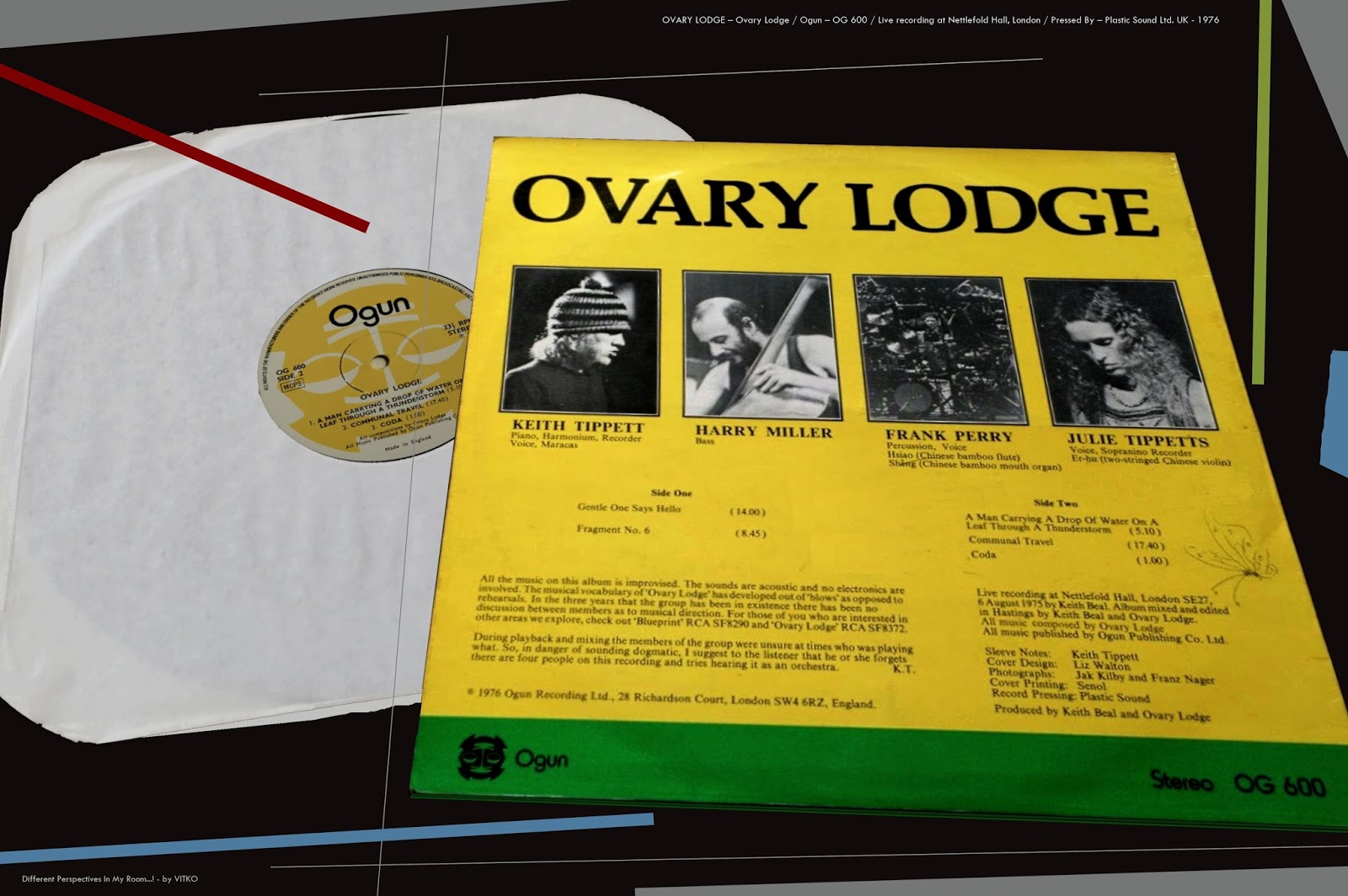
OVARY LODGE – Ovary Lodge (LP-1976 / Ogun – OG 600)


Label: Ogun – OG 600
Format: Vinyl, LP, Album / Country: UK / Released: 1976
Style: Free Improvisation, Free Jazz, Experimental
Live recording at Nettlefold Hall, London SE27, 6 August 1975.
Composed By – Ovary Lodge
Design [Cover] – Liz Walton
Photography By – Franz Nager, Jak Kilby
Lacquer Cut By – DB
Recorded By – Keith Beal
Mixed By, Edited By – Keith Beal, Ovary Lodge
Producer – Keith Beal, Ovary Lodge
Sleeve Notes – Keith Tippett
Matrix / Runout (Runout A, etched): OG 600 A₁-2 D
Matrix / Runout (Runout B, etched): OG 600 B₁-2 B

A1 - Gentle One Says Hello ..................................................................................... 14:00
A2 - Fragment No. 6 ................................................................................................... 8:50
B1 - A Man Carrying A Drop Of Water On A Leaf Through A Thunderstorm ............... 5:10
B2 - Communal Travel .............................................................................................. 17:40
B3 - Coda ................................................................................................................... 1:10

Keith Tippett – piano, harmonium, recorder, voice, maracas
Harry Miller – bass
Julie Tippetts – voice, recorder [sopranino], erhu
Frank Perry – percussion, voice, flute [hsiao], sheng

Album mixed and edited in Hastings by Keith Beal and Ovary Lodge. All music composed by Ovary Lodge.

Note:
All the music on this album is improvised. The sounds are acoustic and no electrics are involved. The music vocabulary of 'Ovary Lodge' has developed out of 'blows' as opposed to rehearsals. In the three years that the group has been in existence there has been no discussion between members as to musical direction. For those of you who are interested in other areas we explore, check out 'Blueprint' RCA SF8290 and 'Ovary Lodge' RCA SF8372.

During playback and mixing the members of the group were unsure at times who was playing what. So, in danger of sounding dogmatic, I suggest to the listener that he or she forgets there are four people on this recording and tries hearing it as an orchestra. K.T.


One of the almost mythical bands of early British free jazz history, Ovary Lodge was led by pianist Keith Tippett, although he would definitely stress that he was a figurehead-organizer rather than authoritarian boss. This is, after all, a collective that's dedicated to the most extreme form of improvising and abstraction, with no prior discussions allowed over the direction of each new piece. At the time, this was something of a departure for Tippett, but over subsequent decades, such hardcore improvisation has become the foundation of his work.

Beginning as a trio, in 1971, with percussionist Frank Perry and bassist Roy Babbington, they released an eponymous titled album in 1973. Ovary Lodge lost Babbington to Soft Machine, and he was replaced by South African exile Harry Miller. This is, confusingly, the band's second self-titled album, recorded in 1975, live at Nettlefield Hall, London. By this time, singer Julie Tippetts was becoming a regular guest, whilst Miller and Perry still remained with Keith.

There's absolutely no compromise with the opening 14 minutes of "Gentle One Says Hello," which certainly makes no attempt at being an easy path inwards to the group's minimalist sonic sphere. It has as much in common with Stockhausen territory as it has with any distant jazz memories, particularly when hearing Julie's high vocal acrobatics. Perry is singing too, up in a similar range. Much is made of drones and lashed cymbals, with the Lodge's chief influence being Far Eastern ritual music (...Buddhism...)

The next piece, "Fragment No. 6," is the one with which most bands would have opened the album, a jazzier pulse ensuing, with Miller's walking figures and Keith's rippling up and down the keyboard's entire spread. Julie's sopranino recorder sounds trillingly Chinese, but later, Perry whips out the real deal, with his sheng mouth organ. "Communal Travel" is another extended rumination, at nearly 18 minutes, and has the strongest Oriental sound, with Perry exploring his full spread of gongs.

It's possible to see how this album is very much of its time, and that some cynics might dismiss it as an aimless hippy happening. Even this reviewer, an avowed admirer of this band, and all music Tippettian, had such thoughts flitting past during some stretches, but the Lodge's high level of musicianship, careful listening abilities and philosophical bent, tend to overcome most of these uncertainties.
_ By Martin Longley


It’s hard to believe there are only four musicians at work here such is the density, richness and diversity of their sound. Ovary Lodge is without doubt a difficult, rigorous and demanding album. It’s also an exciting, dramatic rollercoaster ride in the company of some of the 70s UK jazz scene’s brightest players.


If you find it, buy this album!

Sunday, October 18, 2015

ELTON DEAN QUARTET – They All Be On This Old Road (LP-1977) + another


Label: Ogun – OG 410
Format: Vinyl, LP / Country: UK / Released: 1977
Style: Free Jazz, Contemporary Jazz, Free Improvisation
Recorded at the Seven Dials, Shelton Street, London WC2 on 18 November 1976.
Artwork By [Front Cover Painting] – John Christopherson
Engineer – Keith Beal
Liner Notes – Elton Dean
Mixed By, Edited By – Elton Dean, Keith Beal
Photography – Yuka
Producer – Elton Dean, Keith Beal
Recorded By – Ron Barron

A  -  Naima .................................................................................. 20:30
        (Composed By – Coltrane)
B1 - Dede Bup Bup ....................................................................... 8:50
        (Composed By – Dean)
B2 - Nancy (With The Laughing Face) ......................................... 3:12
        (Composed By – Van-Heusen, Silvers)
B3 – a) Easy Living ....................................................................... 8:40
         (Composed By – Robin, Rainger)
         b) Overdoing It
         (Composed By – Lawrence, Moholo)
         c) Not Too Much
         (Composed By – Dean, Tippett)

Elton Dean – saxophone [saxello]
Keith Tippett – piano
Chris Lawrence – bass
Louis Moholo – drums, percussion

Elton Dean, period 1975/1978 was very tumultuous and resulted in a series of good performances and albums for the label Ogun. This is one of them.

Elton Dean was a totally unique musician : at times lyrical and moving, at others explosive and unsettling, his approach of saxophone playing was totally his own, besides the fact that he favoured a little-used member of the sax family : the saxello, an hybrid between alto and soprano, with an instantly recognizable sound. Over the years, Dean lent his immense talents to bands like Soft Machine, Soft Heap, In Cahoots and L'Equip'Out, as well as many jazz ensembles featuring Keith Tippett, Hugh Hopper, Pip Pyle, Mark Hewins and John Etheridge.

 Elton Dean / Louis Moholo


In January 1975, Elton Dean launched his most ambitious project to date, the large ensemble Ninesense, which included many of the British jazz scene's most talented musicians, including Keith Tippett, Mark Charig, Nick Evans, Harry Miller and Louis Moholo. He also formed his own quartet, EDQ, with Tippett, Moholo and bassist Chris Laurence, recording They All Be On This Old Road (1977) for Ogun Records; around the same time he also formed El Skid with fellow saxophone player Alan Skidmore. In the autumn of 1975, he also joined forces with Tippett, Jim Richardson (bass) and Pip Pyle (drums) as the Weightwatchers, whose brief existence culminated in September 1976 with an epic tour of the Netherlands, The following month, Dean and Tippett formed yet another quartet, this time with Hugh Hopper and Joe Gallivan (drums and synthesizer), which recorded the album Cruel But Fair for Compendium.

1977 was another busy year, with more Ninesense activities, a tour of France and Germany with Tippett/Hopper/Gallivan, an album and European tour with Carla Bley's band (alongside Hugh Hopper and Gary Windo), and a trio album with Gallivan and Kenny Wheeler, The Cheque Is In The Mail. In 1978, he formed Soft Heap with Pip Pyle, Hugh Hopper and Alan Gowen. An inaugural French tour with Dave Sheen replacing Pyle resulted in the Soft Head album Rogue Element, and later that year the band went in the studio to record its eponymous debut, with Pyle back on the drum stool. Around the same time El Skid finally made its recording debut...

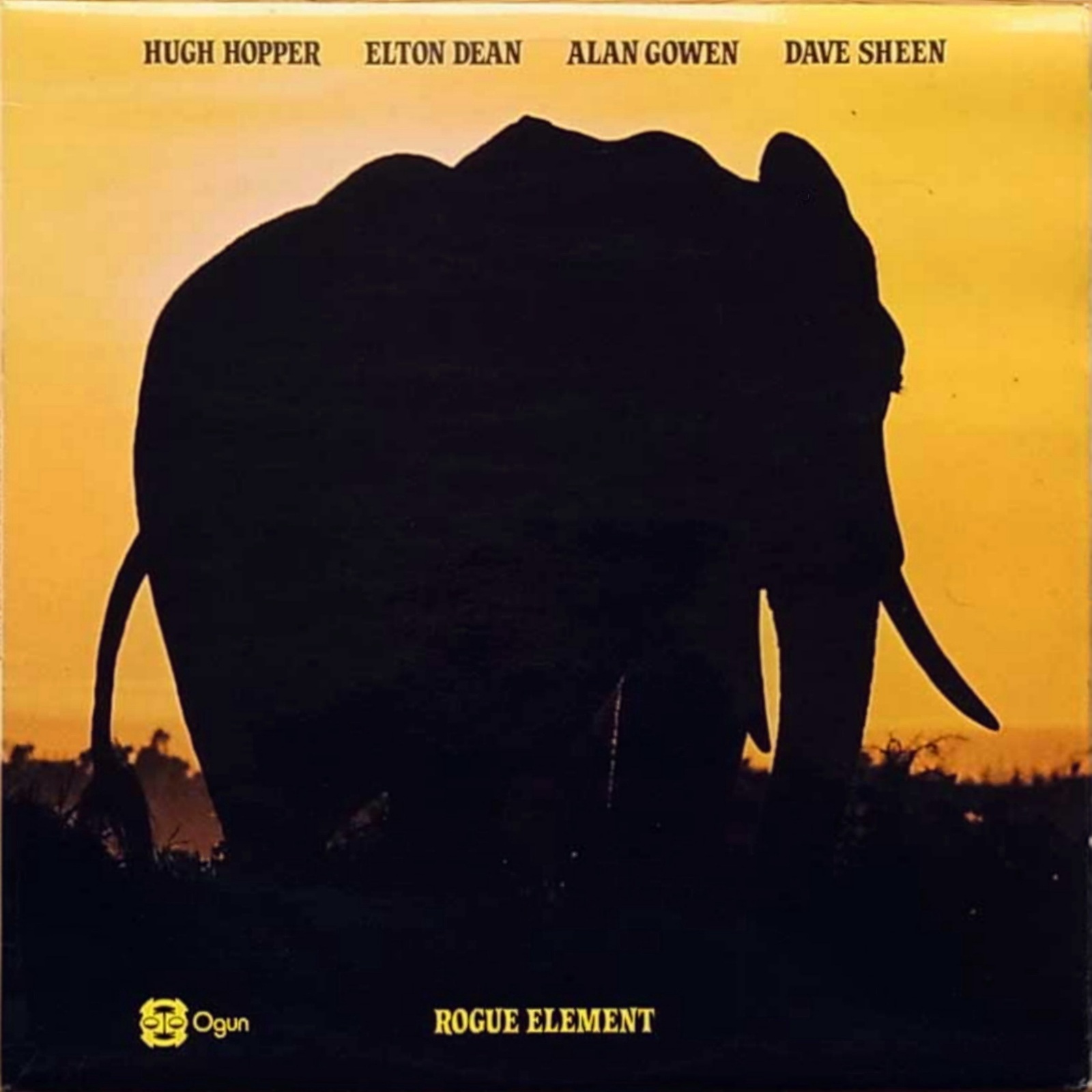
HUGH HOPPER / ELTON DEAN / ALAN GOWEN / DAVE SHEEN – Rogue Element (LP-1978)


Label: Ogun – OG 527
Format: Vinyl, LP, Album / Country: UK / Released: 1978
Style: Free Jazz, Jazz-Rock, Experimental
Recorded May 1978 at Chez Jacky "A L'Ouest de la Grosne" Bresse sur Grosne, on the Van Acker Mobile.
Design [Sleeve] – Liz Walton
Engineer – Jean-Pierre Weiller, Pierre Richard
Mixed By, Edited By – Keith Beal
Photography By [Front Cover] – David Graham
Photography By [Back Cover] – Jean-Pierre Duplan
Producer – Ron Barron
Matrix / Runout (Side 1): OG 527 A C 2929
Matrix / Runout (Side 2): OG 527 B C 2929

A1 - Seven For Lee ..................................................................... 8:40
         (Written-By – Dean)
A2 - Seven Drones ...................................................................... 4:20
         (Written-By – Hopper)
A3 - Remain So ........................................................................... 5:05
         (Written-By – Gowen)
B1 - C.R.R.C. ............................................................................. 14:01
         (Written-By – Gowen)
B2 - One Three Nine ................................................................... 6:17
         (Written-By – Dean)

Hugh Hopper – bass guitar
Elton Dean – alto saxophone, saxello
Alan Gowen – electric piano, synthesizer
Dave Sheen – drums, percussion

_1     This band was supposed to call themselves Soft Heap and include drummer Pip Pyle, but though a tour was booked, he found himself otherwise engaged, and Dave Sheen was hired to accompany fellow Canterbury scenesters Alan Gowen, Hugh Hopper, and Elton Dean on a tour of Europe. Calling themselves Soft Head, they hoped to draw in those frustrated fans of Soft Machine and Gilgamesh. And perhaps they did on this night in France in 1978. But make no mistake, even though Hopper and Dean are present here, this is no pure fusion date with a bunch of knotty harmonics and angular changes riffing around all over the place. This is an electric jazz date, period. Largely this is due to Gowen's compositions and arrangements that walk a tense line between strictly composed elements and improvisation, and the fire of the band themselves, who are -- on this night anyway -- inspired beyond belief. Thank God somebody recorded it. Even at the risk of overstatement, Elton Dean has never played like this on a record. His legato phrasing is lightning-quick and moves through harmonic figures against Gowen's keyboards like a knife cutting through butter. Counterpoint battles are pitched and waged in these tracks, coming down to riding the steady yet flailing rhythm section of Hopper's modally expansive bassing and the avant-swing of Sheen's drumming. While everyone but Sheen contributes originals to the mix here, the arrangement signature is all Gowen, even on Dean classics such as "Seven for Lee", or Hopper's signature "Seven Drones." The spaces for movement between members are held tightly by Gowen, who underlies everything with a chromaticism that is inclusive yet modally and dynamically driven. This is killer stuff that makes one long for the good old days of electric jazz that was still jazz.  
_ (Review by Thom Jurek)

 Hugh Hopper / Alan Gowen


_ 2     This is a live album recorded in a club in France in 1978. Alan Gowen, Hugh Hopper, Elton Dean and Dave Sheen make up this band.The first three are all gone now sadly. It's hard to believe when looking at the pictures of Alan Gowen in the liner notes that just three years from this recording he died of cancer while still in his thirties. In the liner notes it describes Alan as "a jazzer by nature, but his writing was dominated by elaborate and expansive themes. His playing had litheness and lightness which blurred what was scored and what was improvised. Running parallel jaunts with Elton's bitter-sweet saxello, Alan could wail in a way that stretched tonality to it's limit".
"Seven For Lee" opens with bass as light drums join in then keys. Sax before a minute. Great sound here. A calm arrives around 6 1/2 minutes then it builds with bass and drums. Sax before 8 minutes then keys. "Seven Drones" is a Hopper composition. Drums and dissonant keys lead the way as sax comes and goes. Bass before 1 1/2 minutes as the sax starts to play over top. The sax and keys become dissonant. Crazy stuff. It figures that this is a Hopper tune. "Remain So" picks up quickly with piano but the tempo changes often on this one. Bass takes over before 3 minutes. Sax is back late.
"C.R.R.C" is the long thing and takes whole 14 minutes. I like the sound here as keys and sax lead while the bass and drums are also prominant. The tempo picks up after 5 1/2 minutes. It calms right down a minute later with piano, bass and drums. "One Three Nine" is a jazzy little number with sax and keys leading. A bass solo after 5 1/2 minutes.
A very important document really of these talented men playing live. The electric piano, sax, bass and drums are played as only these men could play them.
_ (Review by Mellotron Storm)

Enjoy!


If you find them, buy these albums!

Thursday, July 9, 2015

KING CRIMSON – Lizard (LP-1970)


Label: Atlantic – SD 8278
Format: Vinyl, LP, Album / Country: US / Released: 1970
Style: Prog Rock, Free Jazz
Recorded at Wessex Sound Studios, London, 1970.
Artwork [Inside Marbling] – Koraz Wallpapers
Concept By [Sleeve] – Peter Sinfield
Engineer – Robin Thompson
Mastered By – GP
Painting [Outside] – Gini Barris
Producer, Written-By – Peter Sinfield, Robert Fripp

A1 - Cirkus Including Entry Of The Chameleons ......................................... 6:28
A2 - Indoor Games ....................................................................................... 5:38
A3 - Happy Family ........................................................................................ 4:15
A4 - Lady Of The Dancing Water ................................................................. 2:43
LIZARD       
B1 - Prince Rupert Awakes ......................................................................... 4:34
B2 - Bolero - The Peacok's Tale .................................................................. 6:30
B3 - a) The Battle Of Glass Tears Including Dawn Song –
        b) Last Skirmish –
        c) Prince Rupert's Lament .................................................................. 10:55
B4 - Big Top ................................................................................................. 1:05

Words By – Peter Sinfield

Line-up / Musicians
- Robert Fripp / guitar, mellotron, electric keyboards & devices
- Mel Collins / flute & saxes
- Gordon Haskell / bass guitar & vocals
- Andy McCulloch / drums
- Peter Sinfield / words & pictures

with:
- Keith Tippett / piano & electric piano
- Mark Charig / cornet
- Nick Evans / trombone
- Robin Miller / oboe & cor anglais
- Jon Anderson of YES / vocals on "Prince Rupert Awakes"

_1         LIZARD is perhaps the most "difficult" of the early King Crimson albums, yet, for that very reason, it is also ultimately one of the most rewarding. The third release from Robert Fripp and company sees the band moving in a new and radical direction. The classically-inspired sweeping grandeur and controlled cacophony that typified the first two Crimson LPs has been here largely (but not entirely) replaced by a sound that has its roots much more deeply embedded in jazz.


LIZARD was highly avant-garde and demanding of its audience when it was released in 1970, and it remains a powerfully unique, almost disquieting listening experience today. While IN THE WAKE OF POSEIDON's sardonic "Cat Food" may have hinted at the path about to be explored, nothing could have fully prepared fans for the truly bizarre, almost eerie colours of abstract sound paintings like LIZARD's first three songs: "Cirkus," "Indoor Games," and "Happy Family." Much of the credit for the feel of these tracks must be accorded to new vocalist Gordon Haskell, who had supplied the almost ethereal vocals for Poseidon's lovely "Cadence and Cascade." With Greg Lake departed for ELP, Haskell gets the space to reveal a voice of power and depth, which is by turns intimate, theatrical, scornful, fey and raving. The end of "Indoor Games" finds him cackling like a madman, but the delicately pretty "Lady of the Dancing Water" (the disc's most immediately accessible song) sees him don the guise of a sensitive poet-troubadour, paying court to his lady-love on the bank of a laughing stream.

The second half of the vinyl is given to the title suite. The first section of this masterful three-part song cycle features Jon Anderson of Yes on vocals, providing yet another savory flavour for LIZARD's exotic musical mélange. There is less of the jazzy experimentation which was heard on previous tracks; the direction here is more conventionally "progressive rock," with grandiose mellotrons, courtly subject-matter, and classically-oriented arrangements -- at this point almost a welcome respite from (or counter-balance to) the overt strangeness of the first half. The final installment, "Big Top," fades up to repeat the "Cirkus" theme, before diminishing hauntingly away, thus neatly framing this unique work of art. (Indeed, as art, this album is the total package -- the cover artwork is breathtaking, and the Pete Sinfield lyrics, with lines such as "Night, her sable dome scattered with diamonds," are some of the best poetry he has ever written.)

LIZARD may be an acquired taste, but it has stood the test of time as a lustrous example of early progressive rock at its most inventive. It is decidedly not for the faint-of-heart, but it is well worth taking the time to appreciate!
(Review by Peter)

 Ian McDonald, Michael Giles, Peter Sinfield, Greg Lake & Robert Fripp - King Crimson 1969

 King Crimson 1970 – Lizard

_2         In 1970, King Crimson was an unstable band, that surprisingly managed to produce excellent albums, landmarks in progressive rock. At this point, much of the original band had departed, with the exception of band leader Robert Fripp and lyricist Peter Sinfield. Luckily, they bring in many talented musicians in to round out the band. This lineup only lasted for the recording of LIZARD and never toured. Gordon Haskell is brought on as vocalist/bassist to replace Greg Lake, and does an admirable job. His raspy, brooding vocals fit the material perfectly. Andy McCulloch is competent as drummer, and his presence is felt, giving pace to the often chaotic jazz interludes. The addition of many woodwind and brass players gave King Crimson a much richer, jazzier sound. Keith Tippett's strongly Jazz flavored keys are an added plus (Keith was asked to join the band, but passed). The material found on LIZARD also has a much jazzier edge than its two predecessors, and is also much darker and complex. While it does mark a step towards Jazz-Fusion, that's not to say this is The Soft Machine style free- Jazz; LIZARD is much more composed, and it is still very much in the Progressive Rock camp, with prominent guitars and stereotypical 'epic' progressive lyrics. One gets the feeling Robert Fripp and Sinfield carefully orchestrated this whole album, and it successfully builds a certain (creepy-demented) theme throughout.
LIZARD opens strongly with Cirkus, a frightening track featuring Crimson at their most insane. This track features excellent acoustic guitar from Fripp, as well as dramatic vocals by the underrated Haskell, and wonderfully arranged horns and keyboard flourishes. It alternates perfectly between soft vocal segments, and cacophonous jazz flavored instrumental bridges, creating a true circus atmosphere, with a sinister twist. This is a near perfect early-Crimson track, and shows just how scary these guys could be. The next piece lightens up a bit, featuring a wonderful jazz introduction from the brass section. Haskell's distinctive vocals give the song it's Crimson touch. Overall, it is quite good, but not nearly as interesting as the other tracks found here, and follows a more straight-jazz approach, with occasional Fripp Guitar breaks. Happy Family resumes the dark feel of Cirkus, with eerie distorted vocals, and more guitar and keyboards than on the previous tracks. It also has great flute touches. (note: It is rumored that this track was written by Sinfield about the Beatles' breakup, and many further contend that the figures found on the elaborate record sleeve under the 'I' are the Beatles...This is also one of the best cover's ever on a Crimson album, designed by Sinfield). Side One closes with Lady of the Dancing Water. This represents the obligatory, light acoustic piece on a King Crimson album, and is much in the vein of Cadence and Cascade and I Talk to the Wind. It is very enjoyable and light, providing a brief respite from the insanity surrounding it, but by this point, the formula was getting old for this sort of song. Side Two features the side- long epic, Lizard. The title track is a twenty-three minute suite, with four distinct movements. This piece is one of the most ambitious songs ever attempted by Fripp and Co. It opens with Prince Rupert Awakens. Surprisingly, Jon Anderson of Yes sings vocals on this piece, as Gordon Haskell never finished. This is an excellent touch. Anderson's light, ethereal vocals give the folksy-traditional prog song a definite boost. This song has beautiful melodies, and it is nice to hear Anderson sing semi-coherent lyrics, as oppose to his Yes work. The next two sections, Bolero and The Battle... are Jazz pieces, and feature impressive playing from all members. McCulloch's drums are especially good, giving The Battle... a warlike feel. The horn section is also excellent. These pieces are well done, but a bit drawn out and longwinded. Lizard closes with Big Top, a short reprise of Cirkus, giving the album a fitting close and a cyclical feel.

Many fans do not like this album, and it is not easy to define. LIZARD is King Crimson's darkest, and least accessible album. It is also their farthest removed from traditional rock. It is a progression over their last album, IN THE WAKE OF POSEIDON (1970), and it is a shame that this potent lineup didn't last.
This is one of those albums that rewards repeated listens, a definite essential for fans of King Crimson or Jazzier Rock.


Note:
All the tracks on the album are connected, there is no break in between, so I decided not to spoil well blended whole. Now you only have two tracks, the first and second side of the vinyl.

Enjoy, my friends!


If you find it, buy this album!

Saturday, January 4, 2014

THE NUMBER – The Making Of Quiet Things (2006)


Label: Slam Productions – SLAMCD 269
Format: CD, Album; Country: UK - Released: 2006
Style: Free Improvisation
Recorded on 19 to 20 July 2005 at Vestry Hall, London College of Music, Thames Valley University
Artwork – Val Tevenson
Engineer – Paul Borg; Engineer [Assistant Engineer] – Andy Johnson
Mixed By – Justin Paterson, Paul Borg
Mixed on 28 Sept 2005 at Vestry Hall and on 1 & 8 May 2006 at Borglands
Photography By – Sue Cunningham
Producer – Justin Paterson

The Making of Quiet Things is the product of a collaboration between Gary Curson and producer Justin Paterson , senior lecturer at the London College of Music. The album was recorded at Vestry Hall Studios at the London College of Music as part of Paterson's research.

Technical challenges:
Paterson asked the musicians to perform free improv whilst separated, unable to communicate directly with each other, without rehearsing, in one take. Paterson's goal was the complete separation of sound for each instrument for a second spinoff album using the tracks from this recording session to produce a new, synthesised improvisational work. This environment was extremely challenging for the musicians. The recording and producing of this album itself was a technical feat. Some problems with the recording session, particularly pressures of time and budget, meant complete separation was not achieved. Paterson attempted to remove the microphone spillage on the tracks and devised an algorithm and built software to do this: The "One-T" . The results were presented it at the 2nd Art of Record Production (ARP) conference in Edinburgh last September to extremely warm reception from the academic and industrial community. Further development of this "One-T" project is continuing. Paterson hopes to complete the second album within the next year or two.

Gary Curson

Anyone who was fortunate enough to hear Dreamtime at the Vortex in December will already have experienced the power and passion of Gary Curson's alto playing. On this quartet album (other participants: Keith Tippett on piano, John Edwards on bass, Mark Sanders on drums) Curson is given even freer rein than he is in Dreamtime; the Number specialise in freely improvised music, full on, fiercely interactive interplay utilising the entire dynamic and textural range of each instrument. Tippett, whether performing in the ensembles, duos or the concluding solo piece, moves with his customary ease between full-blooded percussive playing and the most filigree-delicate contributions, interspersed with rustlings and tinklings produced by objects placed on the piano's strings; Edwards (his playing skills now finely honed by all his experience with the likes of Evan Parker) plunges, twangs and blurts his way through the more raucously vigorous passages and squeaks and drones through the quieter moments; Sanders (his playing as ever finding a middle path between the clattering roar of Tony Levin and the wonderfully sympathetic, quietly rapt patter of Tony Marsh) is the subtly discreet yet powerful heartbeat of the band. It is Curson, however, who most often sets the tone: urgent bordering on downright frenetic, his alto wails, screams and keens, rendering the Number's music raw and adventurous, intensely emotional. Free jazz at its most viscerally affecting.

_ By CHRIS PARKER, The Vortex


Producer Justin Paterson is sampling the recording to create new compositions, so the musicians were isolated to get acoustic separation, listening over headphones without visual cues. This makes their achievement all the more remarkable.


Links in Comments!
 

Tuesday, December 31, 2013

SLAMFEST 1999 - Live At The Premises, London - (2CD-2000)


Label: Slam Productions – SLAMCD 405
Format: 2 × CD, Album; Country: UK - Released: 2000
Style: Free Jazz, Contemporary Jazz, Free Improvisation
Recorded live at the Premises, London, England, 10 and 11 July 1999.
Design, Producer – George Haslam
Recorded By, Edited By, Mastered By – Dill Katz

This first SLAM CD release for 2000 is a live recording of the two nights of music played at The Premises, London, July 1999 to celebrate the tenth year of SLAM CDs. The line up presents an impressive array of musicians prominent on the British improvising scene - most of which have appeared on previous SLAM releases. The recording is another example of the impressive abilities of soundman Dill Katz. The music by five different groups fills two CDs; the double CD package is offered at the same price as a SLAM single CD.

ARTISTS: Brian Abrahams, Roberto Bellatalla, Jeremy Brown, Lol Coxhill, Gary Curson, Elton Dean, Jim Dvorak, Nick Evans, George Haslam, Jim LeBaigue, Phil Minton, Liam Noble, Howard Riley, Paul Rutherford, Harrison Smith, Keith Tippett.


The artists who participate on this two-CD set, recorded live at the Premises, London July 10 and 11, 1999, read like a who's who of British modern jazz/improvising superstars. Here, legendary saxophonists Elton Dean and Lol Coxhill, trombonist Paul Rutherford, pianist Keith Tippett, vocalist Phil Minton, and others of note perform within various aggregations or subgroups on this rather multifarious affair. Basically, these performances should whet one's musical appetite, whether they are Tippett's sweeping arpeggios and fervent right-hand leads on the piece titled "Careful Driver," or Coxhill, Rutherford, and baritone saxophonist George Haslam's frisky interplay and converging statements on the 19-minute work "CHAR I." Other highlights include: a spirited duet, marked by counterbalancing themes between pianist Howard Riley and alto saxophonist Elton Dean, while "Tuna Up" features trumpeter Jim Dvorak and Phil Minton embarking upon an often humorous journey, thanks in part to Minton's frantic, scat-like vocalise and the twosome's altogether enticing exchanges. Ultimately, there's quite a bit to digest here, as the musicians toggle between modern jazz- style interplay and cunning improvisational tactics, atop richly thematic lyricism and blues- drenched choruses.

_  Review by GLENN ASTARITA


Links in Comments!

Wednesday, December 25, 2013

KEITH TIPPETT and LOUIS MOHOLO – No Gossip (1982)


Label: FMP – SAJ-28
Format: Vinyl, LP; Country: Germany - Released: 1982
Style: Free Jazz, Free Improvisation
Recorded by Thomas Funk on March 20th & 23rd, 1980, during the Workshop Freie Musik at the Akademie der Künste in Berlin.
Music edited by – Harry Millerand and Jost Gebers
Produced by – Jost Gebers
Cover photographs and cover design by – Dagmar and Jost Gebers

"No Gossip"... An outstanding pairing of percussion and melody from the British pianist Tippett and South African drummer Moholo. What’s surprising is that Moholo provides much of the melodic material, while Tippett handles the beat. An intense record that demands attention.

This LP was originally released in 1982 (and recorded in 1980); it has never been on CD. The pair have continued to perform as No Gossip, most recently 2010 in London, on the occasion of Moholo’s 70th birthday. The last surviving member of the Blue Notes, Moholo is a towering figure of the music, a bridge that links South Africa to the European scene, and beyond. Tippett brings a huge imagination and aggressively heterodox approach to his instrument. Together, they form a timeless couple.


This is simply one of the best free improvisation jazz albums around. Tippett is a woefully overlooked pianist whose technical abilities and musical sensibilities are vast. Coupled with the energetic drummer Louis Moholo, these two have created a fiery, frenetic, but thoroughly captivating music. Rather than being simply a flurry of notes, this music is exciting, invigorating and demands attention. “ Black and White Unite ” is a nearly continuous onslaught of sound that leaves the listener drained, but blissfully so. “ Dedicated to Mandela, Biko, Sobukwe ” is a more varied work. Over Moholo’s perpetual motion drumming, Tippett works with a variety of textures and ideas, with passages that make reference to more conventional jazz, some lyrical and beautiful arpeggios, as well as some pull out all the stops jamming. Side two begins with the most extreme piece, which includes bird calls, guttural utterances, Tippett damping the strings with his hand inside the piano, and other unidentified sounds, not to mention some absolutely stunning playing by Tippett. Finally, “ All People…God’s People…Don’t Worry ” is a very interesting piece which finds Tippett exploring the lower, oft neglected, register of the piano. This is an album that must be heard.


...and
Happy Holidays to everyone.


Links in Comments!

Saturday, December 14, 2013

HARRY MILLER'S ISIPINGO – Which Way Now (1975, Re-2006)


Label: Cuneiform Records – Rune 233
Format: CD, Album; Country: US - Released: 2006
Style: Free Jazz,  Free Improvisation, Contemporary Jazz
Recorded at Post-Aula, Bremen, Germany on November 20, 1975.
Coordinator [Release Coordination] – Steven Feigenbaum
Design [Cd Package] – Bill Ellsworth
Painting [Cover Painting] – Ellie Payne; Photography By – Jak Kilby
Producer [Concert] – Gisela Steppat, Volker Steppat
Recorded By – Dietram Köster, Jürgen Kuntze, Klaus Schumacher, Peter Schulze
Remastered By [Tube] – Michael King, Miki Dandy
Technician [Transfer From The Original Tapes] – Christoph Romanowski

Which Way Now features over 70 minutes of music from a beautifully recorded radio concert from November 20, 1975; it sounds as if you are in the room right with the band!
Since Isipingo only released one album during their lifetime, this release dramatically extends their legacy and like Cuneiform's important and historical work with the Brotherhood of Breath, brings this important, hugely enjoyable, nearly-forgotten music to a new audience.


The remarkably large and intersecting jazz and progressive rock community of late-'60s and early-'70s England is enough to give any discographer nightmares. But within that group a few key players came together more often than most, including a contingent which had escaped South Africa's apartheid. Harry Miller was one such artist, an in-demand bassist who appeared on albums by King Crimson, saxophonist Elton Dean's Ninesence and pianist Chris McGregor's Brotherhood of Breath. Miller is underrepresented as a leader, so Which Way Now is a particularly welcome rescued archival live recording, highlighting Miller's considerable skills as composer and bandleader.

Recorded for Radio Bremen in 1975, Which Way Now features Miller's Isipingo sextet. It's a refreshingly vibrant acoustic jazz album, recorded at a time when most of his peers were pursuing the carrot of fusion. Combining traces of his African roots with a more open-ended improvisational aesthetic, it also strongly reflects the influence of jazz icon John Coltrane. Four extended pieces ranging from 15 to 21 minutes show Miller's ability to provide maximum freedom and avoid compromise. Pervasive rhythms that only occasionally dissolve into total freedom also keep them completely accessible.

The performance was recorded less than a month before another South African ex-pat, trumpeter Mongezi Feza, passed away in December, 1975 at only 30. A sharp-toned player who left a small but fine body of work, Feza is perhaps best known for his work on singer/songwriter Robert Wyatt's early records. Here he's at his best on the mid-tempo, modal "Eli's Song, where his own sense of construction combines with a certain abandon. He's matched by Mike Osborne, who may be an altoist, but is clearly informed by Coltrane's assertive stance.

The spirit of Coltrane may loom over this session, but the presence of pianist Keith Tippett takes it to a different place entirely. The best-known and certainly the most prolific player of the bunch, Tippett has always leaned towards more complete freedom. Here he isn't exactly reined in, but he remains within a sphere of smaller diameter, creating an outré space underneath the soloists that, oddly enough, meshes perfectly with Miller and South African drummer Louis Moholo's insistent pulse.

Trombonist Nick Evans' solo on the fiery title track interacts boldly with Tippett's sparse accompaniment, manifesting the kind of chemistry that's honed from years of working together. This shared chemistry amongst the entire sextet is, in fact, what makes Which Way Now so exciting from beginning to end. Whether acting as a tag-team rhythm section partner with Moholo and Tippett or delivering provocative solos, Miller clearly had the makings of a musical giant—which makes it all the more sad then that, like Feza, Miller's life was cut short prematurely in 1983 at the age of 42. Still, Which Way Now is a welcome reminder of just how vibrant the UK improvising scene was—and continues to be.

_ By JOHN KELMAN, Published: August 12, 2006


Links in Comments!

Wednesday, November 13, 2013

KEITH TIPPETT – Mujician I and II - Live At Berlin 1981/1986 (CD-1998)


Label: FMP – FMP CD 95
Format: CD, Compilation; Country: Germany - Released: 1998
Style: Free Improvisation
Tracks 1, 2 and 5 - 3/4 December 1981 in Berlin 
Tracks 3 and 4 - 13 June 1986 in Berlin 
New CD edition/compilation of the LPs SAJ-37 & SAJ-55, on basis of the original recording tapes.
Composed By, Piano – Keith Tippett
Mastered By – Jonas Bergler
Photography By – Dagmar Gebers
Recorded By, Producer, Design, Layout – Jost Gebers

Given that there are so many recordings of pianist Keith Tippett with his partner, vocalist extraordinaire (some would say superhuman) Julie Tippett and his many large ensemble projects, it's easy to let slip what a truly amazing improvising soloist he is. These first two volumes, recorded in 1981 and 1986, respectively, in Berlin and issued as separate LPs are seemingly the work of one man as an orchestra. The nearly 11-minute "All Time, All Time" begins in the middle registers and, ostinato, goes for the depth of the pianos reaches, as if looking for notes that lie somewhere not between the keys on the piano, but the resonances they make together in the air. The playing is so fast and so dense one has to wonder how many fingers he has and where he comes up with so many ideas so quickly, especially playing with whole tones. While many would be tempted to compare Tippett's playing to Cecil Taylor's, they would be wrong. Tippett is not so much interested in bending the reason for the piano's existence as an instrument as in turning it in on itself and using its sonic possibilities to create new ones from the limitations imposed on it by physical structure. It's not about questing for Tippett, it's about listening and creation. The guy will put blocks of wood inside the instrument and let the vibrations move them around; he'll pick up the lid and blow on the strings. And yet, it's not about extremes; all of this, all of these shamanic elements that Tippett employs are very musical. The speed, the intensity, the singing and bowing, the extended beyond comprehension chord voicings, and harmonic adventures all serve music, not soloist. This is playing on an ego-less level, where musician becomes magician because of the thing he serves, not how it serves him. And what the listener gets is an encounter with music as spoken through one who embodies what it actually is, which is something rare and beautiful. Having these two recordings on one CD, and its final part on another, is a gift. These solo sessions are essential not only for those all-too-few Tippett fans, but for anyone interested in either the piano or music as magical endeavor. And for those curious about Tippett, this is the very best place to start.

_ Review by THOM JUREK


Links in Comments!