Showing posts with label Derek Bailey. Show all posts

Sunday, June 12, 2016

DEREK BAILEY / HAN BENNINK - Derek Bailey / Han Bennink (LP-1972-Incus–9)


Label: Incus Records – 9
Format: Vinyl, LP, Album, Stereo / Country: UK / Released: 1977
Style: Free Jazz, Free Improvisation
Selections from live performances at Verity's Place, June 16-17, 1972.
Cover drawing, Artwork – Mal Dean
Composed By – Bailey, Bennink
Engineer – Bob Woolford
Matrix / Runout (Side A Runout stamped): INCUS 9 A-3△6
Matrix / Runout (Side B Runout stamped): INCUS 9 B-3△6

A1 - Call That a Balance ........................................................................... 2:07
A2 - Misty .................................................................................................. 7:18
A3 - The Title ............................................................................................ 2:17
A4 - Who Is That ....................................................................................... 4:02
A5 - The Girl with the Concrete Tongue ................................................... 4:35
B1 - Din Din Teo ........................................................................................ 9:31
B2 - On a Clear Day .................................................................................. 4:07
B3 - Barb ................................................................................................... 1:36
B4 - Shake Your Arse White Man ............................................................. 1:32
B5 - Whiling ............................................................................................... 2:19
B6 - When Day Is Done and Shadows Fall I Think of You ....................... 4:10

DEREK BAILEY – guitar
HAN BENNINK – drums, percussion

Derek Bailey & Han Bennink (subtitled Selections from Live Performances at Verity's Place) is a live album by guitarist Derek Bailey and percussionist Han Bennink which was recorded 1972 and released on the Incus label.


This selection of live duet performances from 1972 is a wonder to listen to almost forty-four years after the original performances. The guitar's greatest improviser bantering musically with the Netherlands' greatest drummer is, no doubt, a point of interest for those interested in the extremes of Western music. Before Bailey had recorded the infamous and now legendary Incus Taps disc, he had perfected his view of the atonal world (at least up until that time), undoing it with spiritual guidance from the ghost of Webern at his side. These two live dates reflect that direction, having been recorded less than a year before. Given that Bailey is investigating his undoing of the ritual tonal space, Bennink's woolly percussions are the perfect foil: Who better to stretch the perceptions of guitar music to its limit and beyond than a man for whom the drums are the only instrument in any band? Thus, the chase is on, moving from one dynamic range to the next in search of the perfect tonal space where things completely fall apart, only to be picked up in rather grotesquely fascinating order. This music asks no questions; it only shouts obscenities while laughing hysterically because it knows exactly what it's not doing. Great album.
(Review by Thom Jurek)


If you find it, buy this album!

Saturday, May 21, 2016

DAVID HOLLAND / DEREK BAILEY – Improvisations For Cello And Guitar (LP-ECM-1971)


Label: ECM Records ‎– ECM 1013 ST
Format: Vinyl, LP, Album / Country: Germany / Released: 1971
Style: Free Jazz, Free Improvisation
Recorded live at the Little Theater Club, London, January 1971.
Cover Design by – Dave Holland
Layout – B & B Wojirsch
Liner Notes [Poem] – E. E. Cummings
Music published by ECM-Verlag
Matrix / Runout (Side A Runout): ST-ECM 1013-A
Matrix / Runout (Side B Runout): ST-ECM 1013-B

A  -  Improvised Piece III ........................................................... 20:04
B1 - Improvised Piece IV ............................................................. 8:16
B2 - Improvised Piece V ............................................................ 10:08

All compositions by Dave Holland and Derek Bailey

David Holland — cello
Derek Bailey — guitar

Improvisations for Cello and Guitar is an album by cellist David Holland and guitarist Derek Bailey recorded in 1971 and released on the ECM label.

''One’s not half two. Its two are halves of one… All lose, whole find.''
(by–E. E. Cummings)


If you’ve ever picked up a guitar and played those short strings between the end of the neck and the pegs and wondered if one could make viable music with that kind of sound, then look no further, for that is precisely the pinpoint aesthetic captured on this rare recording. These improvisations are miniscule and entomological, whispering with the nocturnal regularity of a cricket. Holland and Bailey shift from pops and plucks to more sustained tones at the drop of a hat, but always with an ear keenly tuned to the other player. The two take full advantage of extended techniques to create a wide palette of sounds. These are delicate pieces, but no less full of verve and character for their utter precision. Sometimes the music is incredibly expansive. Other times it seems to implode, by turns galactic and subterranean. Because both musicians are so skillful at what they do, one can truly appreciate the spontaneous dynamics of their playing, the ways in which they react and prompt each other into action. They are never afraid to take separate paths, for they always seem to rejoin, and in doing so they add seemingly endless variety as the energy flows and ebbs. It’s always fascinating to hear Dave Holland’s earlier work, and this meeting with Bailey is certainly an archival treat.

Todd S. Jenkins called the album "a dark resonant masterwork".


If you find it, buy this album!

Friday, February 26, 2016

TONY OXLEY – 4 Compositions For Sextet (LP-1970)


Label: CBS – 64071
Format: Vinyl, LP / Country: UK / Released: 1970
Style: Free Jazz, Free Improvisation
Recorded on February 7, 1970 and released on LP by CBS that year.
Liner Notes – Michael Walters
Engineer by – Mike FitzHenry
All compositions by Tony Oxley

A1 - Saturnalia ............................................................................. 10:09
A2 - Scintilla ................................................................................... 8:56
B1 - Amass ................................................................................... 13:00
B2 - Megaera ................................................................................. 6:09

Personnel:
Tony Oxley – drums
Evan Parker – tenor sax
Kenny Wheeler – trumpet, flugelhorn
Paul Rutherford – trombone
Derek Bailey – guitar
Jeff Clyne – bass

Released in 1970, 4 Compositions for Sextet was one of a pair of records drummer Tony Oxley recorded for CBS, which, at that time, seemed to be very interested in British free jazz -- the label also recorded at least three LPs by avant guitarist Ray Russell and a pair by Evan Parker.


Oxley's band for this outing was a dream group of Brit outsiders: Derek Bailey on guitars, Kenny Wheeler on trumpet and flügelhorn, Evan Parker on saxophones, Oxley on drums of course (the only British drummer besides Robert Wyatt who could play pop or free jazz with equal enthusiasm), Paul Rutherford on trombone, and Jeff Clyne on bass. The four tunes are all outer-limits numbers; all methadrine takes on what were happening improvisations. It's true that there are loose structures imposed on all four tracks, but they quickly dissolve under the barrage of sonic whackery. At times, dynamic tensions present themselves, such as on the beautiful "Scintilla," where Bailey shows what made him Derek Bailey in the first place: his willingness to take even preconceived notions of free improvisation apart. There are also puzzling questions that the sextet cannot resolve (e.g., how far to take harmonic investigation). It's clear not even Parker wants it to completely disintegrate into the ether; he holds forth with Wheeler that some semblance of order, no matter how tenuous, be kept. And while it's true these selections all sound dated by today's standards, and by how far each man has come in terms of musical growth, there is still something compelling here in the chopped-out framework of "Amass" or Parker's attempt to blow Oxley from the room with outrageously long lines that seem to come from the mouthpiece of the horn rather than its bell in "Megaera." There is also a stalwart "anti-Americanism in all of it," an anger directed at the Yankee jazzers who were now moving toward fusion or even the avant cats who relied too heavily on tradition. In any case, this is a fine record historically, for seeing where the Brit free music movement came from. 
_ Review by Thom Jurek


A year on from The Baptised Traveller, Tony Oxley's debut recording as a composer, this LP from 1970 is perhaps even more indicative of how the experimental music of the time ended up in the jazz bin seemingly by default. That said, all the essential attributes which are needed to add to the impetus of jazz are still here in abundance--the extraordinary empathy between the players, the clarity of thinking as to where the music needs to go and the continuing search for fresh and revitalising ideas to help it get there--but Oxley's diverse musical background (which even by this time had ranged from duties as housedrummer at Ronnie Scott's club to military band drumming, classical studies, working with John McLaughlin and forging an increasing commitment to freely improvised music) and natural self-discipline invests these compositions with a more wide-ranging sensibility. Oxley's lucid notes guide the listener through the structural bones of the compositions to which the musicians add improvised flesh and, while the results are no more likely to appeal to staunch traditionalists than they were all those years ago, the sheer vision of these works makes them compulsive listening. 
_ Review by Roger Thomas


If you find it, buy this album!

Sunday, August 2, 2015

STEVE LACY – Dreams (LP-1975 / Saravah – SH 10058)


Label: Saravah – SH 10058
Format: Vinyl, LP, Album / Country: France / Released: 1975
Style: Free Jazz
Recorded at Saravah Studios Paris, May 12-15-1975
Artwork [Cover Art] – Claude Bellegarde
Engineer – Christian Jence
Photography By [Photos] – Bunny Brissett
Producer – Pierre Barouh
Technician [Assistant] – Larry Martin

A1 - The Uh Uh Uh .............................................................. 7:20
A2 - Dreams ......................................................................... 3:05
A3 - The Oil ......................................................................... 9:10
B1 - The Wane ................................................................... 10:00
B2 - Crops ............................................................................ 7:00

Steve Lacy – soprano saxophone, composed
Steve Potts – alto saxophone, soprano saxophone
Derek Bailey – guitar
Jean-Jacques Avenel – bass
Kent Carter – bass
Irene Aebi – voice, cello
Kenneth Tyler – drums, percussion
featuring:
guitar – Boulou Ferré (tracks: A2, B2), Jack Treese (tracks: A2, B2)

Dreams is easily Lacy's greatest moment from the 70s, and the one that sounds, simultaneously, most and least like him.


Recorded at Saravah's studios in Paris in May 1975, Dreams is the fourth of five albums cut for the label by Steve Lacy between 1969 (Roba) and 1977 (The Owl) -- the intervening pair being 1971's Lapis and 1974's Scraps -- and features the soprano saxophonist in the company of his favorite playing partners, altoist Steve Potts, bassists Kent Carter and Jean-Jacques Avenel, guitarist Derek Bailey, drummer Ken Tyler, and not forgetting the composer's partner, Irene Aebi on cello and vocals on the dreamy, almost Debussyesque setting of Brion Gysin's permutational poem "Dreams." For the occasion, the group is joined by Saravah regulars guitarists Boulou Ferre and Jack Treese, who also contributes some spindly banjo to the closing "Crops." It's quintessential Lacy, all relentless harmonic cycles with saxophones locked together a whole- or half-tone apart, but extraordinarily varied in scope nevertheless, running the gamut from the twisted psychedelic funk of "The Uh Uh Uh" to the rolling free folk of "Crops," via the tense, claustrophobic weave of "The Oil." On this, the tough nut of the set, Bailey's pinched Webernian splutters are the perfect foil for the rigorous saxophone dirge, and his volleys of harmonics complement Treese's fingerpicking to perfection in "Crops." And anyone who still doubts Lacy's consummate mastery of his instrument needs only to check out the ease with which he negotiates the ferociously difficult theme in "The Wane."

As the story unfolds one small piece at a time over this LP, the vision of the man comes clearly into view and his true genius is revealed. Lacy saw jazz in the 70s as a way to make sense of the entire world -- a world in transition and fragmentation. His musical view was all-inclusive (Bailey's rock and funk moves on the Dreams album) and sought order using a musical language that would open the doors to dialogue: first with musicians and then with other artists everywhere. The amazing thing is that -- at least in the avant-garde music world -- he succeeded: because everyone there cites him as an influence...........

Enjoy!


If you find it, buy this album!

Sunday, August 24, 2014

THE MUSIC IMPROVISATION COMPANY – 1968-1971 (LP-1976)


Label: Incus Records – 17
Format: Vinyl, LP, Album - Country: UK / Released: 1976
Style: Free Improvisation
Side A recorded in mono in London on 4 July 1969.
Side B recorded in stereo in London on 18 June 1970.
Painting – Jamie Muir
Producer [Post Production] – John Hadden
Recorded By – Bob Woolford (tracks: 5, 6)

The back cover features a quote from 'The Wellsprings of Music' by Curt Sachs.

A1 - Pointing . . . 7:10
A2 - Untitled 3 . . . 6:32
A3 - Untitled 4 . . . 4:10
A4 - Bedrest . . . 7:38
B1 - Its Tongue Trapped To The Rock By A Limpet, The Water Rat Succumbed To The Incoming Tide . . . 8:55
B2 - In The Victim's Absence . . . 10:35

Derek Bailey – guitar
Evan Parker – soprano saxophone, autoharp [amplified]
Hugh Davies – electronics [live], organ
Jamie Muir – percussion, painting

This LP covers the historic beginnings of the British free music scene and its founding fathers: Derek Bailey, Evan Parker, Hugh Davies, and future King Crimson drummer Jamie Muir. These recordings come off amazingly well, considering the first four were recorded in mono. And while there are six pieces here, it's almost impossible to talk about them as separate entities, since what was at work in the group consciousness was to create a free jazz music in the U.K. that was distinct from what was happening in America and elsewhere in Europe at the time. Therefore in the brave spirit of rabid experimentation and oh so serious creative spirit, we have an amalgam of recordings that suggest the future of a free music that turned out very differently than its origins suggest. This collective is exactly that; none of these players -- especially not Parker or Bailey -- had developed into the kinds of soloists that they are today, not only in terms of technical expertise, but in terms of vision. What one can hear in the bravado here is indecision, misdirection, and wrongheaded musical obfuscation that proved to be liberating obstacles in the long run. The one constant here, the thread, if you will, is the sense of dynamics that became the trademark of the new music and has remained ever since. This is a document that does sound dated, but only in a way that tells a story. It's is a necessary addition to anyone's library who is interested in improvised music.

_ By THOM JUREK  


If you find it, buy this album!

Wednesday, May 14, 2014

BRUISE: T. Bevan / J. Edwards / A. Wales / M. Sanders / O. Robinson – Bruise With Derek Bailey (2006)


Label: Foghorn Records – FOGCD006
Format: CD, Album; Released: 01 Apr 2006
Style: Free Jazz, Free Improvisation
Recorded live at the 291 Gallery, Hackney Road, London E2, on Tuesday August 17th 2004.
Post-production and Mastering: Asa Bennett at sonic studios.
Engineer by – Ashley Wales
Design by Paul Dunn @ diablo based on original artwork by Ashley Wales

Gig of the year – Derek Bailey’s return in triumph from Barcelona to East London. – Phillip Clark, Jazz Review

01. Search . . . 20:50             
02. Locate . . . 16:01 
03. Destroy . . . 34:02

BRUISE is:
Tony Bevan – bass saxophone
Ashley Wales – soundscapes, electronics
Orphy Robinson – electronics, marimba, percussion, steel drums, trumpet
John Edwards – double bass
Mark Sanders – drums, percussion
with
Derek Bailey – electric guitar

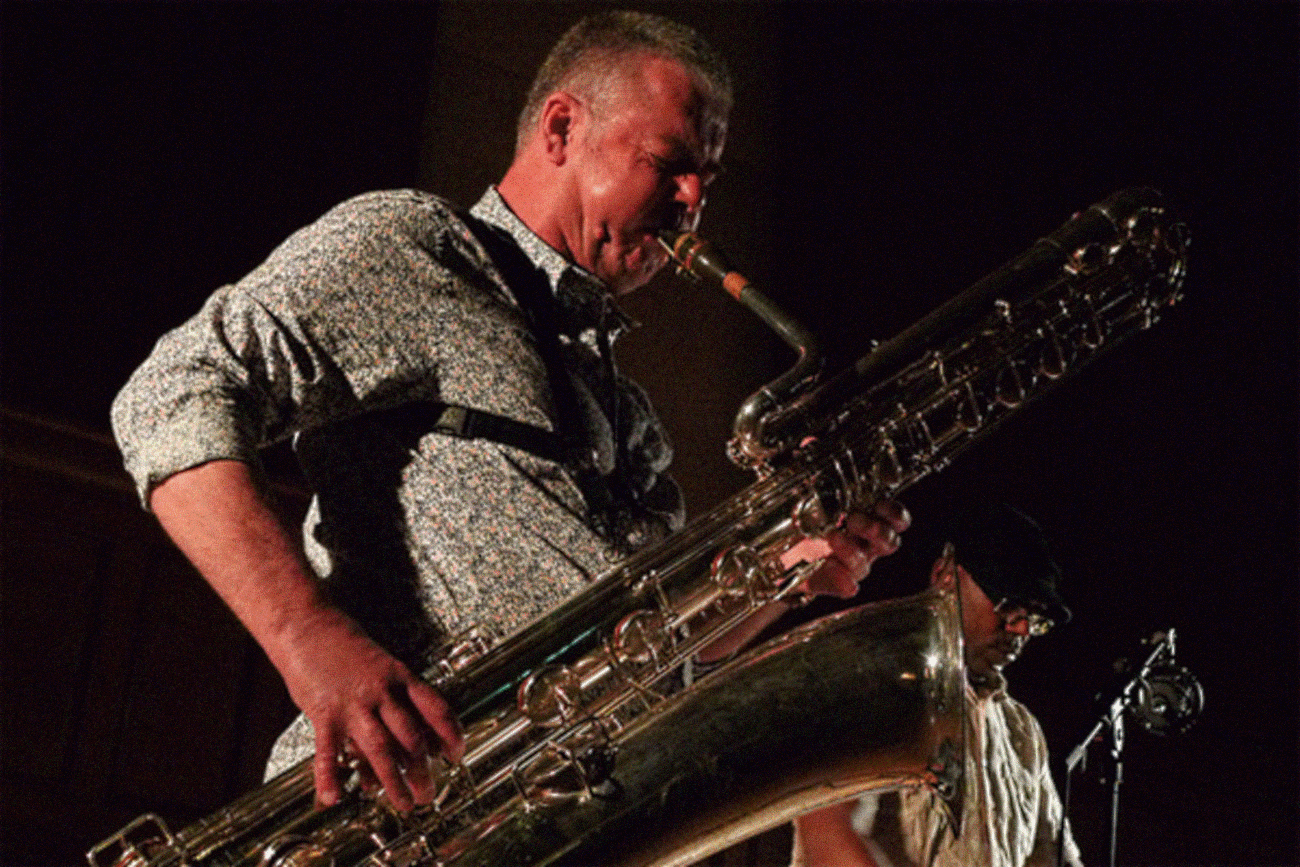
Tony Bevan is an improvising virtuoso on Soprano and Tenor saxophones, but perhaps is best known for his work on the Bass saxophone, on which he is probably Britain’s only major modern performer (“the world’s greatest improvising Bass saxophonist” - Timeout). He is closely linked with the late Derek Bailey, with whom he appeared and recorded many times, as well as with Free Jazz legend Sunny Murray, who, along with Edwards, he has been playing with for more than a decade, releasing a number of award winning recordings and appearing in Antoine Prum’s award winning film “Sunny’s Time Now”. He recently curated with Prum a 3 day festival on British Improvised Music in Berlin, which is released on film in late 2012, following more filming in the UK in early 2012 . His playing covers all bases from rock group Spiritualised (on whose new album he is a featured soloist) to Classical Avant-Garde composer Luc Ferrari, with the likes of Barre Phillips, Matthew Bourne, Joe Morris, Marc Ribot and Tony Buck of The Necks in between. 
He runs the Foghorn label.


Derek Bailey (29 January 1930 – 25 December 2005)

Sonically this is maybe not the best document (a straight-to-DAT recording from a gig at London’s 291 Gallery, acoustically somewhat muddled though quite acceptable) but it’s essential listening for Derek Bailey fans. As usual, the guitarist sought out the company of younger players – in this case, the acoustic/electronic (not electroacoustic) quintet responsible for Bruised, one of last year’s best and most overlooked improv records. The new disc is, among other things, the final chapter in the longstanding relationship between Bailey and bass saxophonist Tony Bevan. It’s hard not to hear real poignancy in Bevan’s playing here, which is stripped down so far it’s as if he’s trying to make an entire musical language out of achingly isolated notes. There’s also the tickle of hearing Bailey with the blue-chip UK free-improv rhythm section of John Edwards and Mark Sanders. The off-balance recording makes it harder to parse the electronic input from Orphy Robinson and (especially) Ashley Wales, but they’re certainly responsible for the haunting, elusive soundscaping (I was also surprised at the closeness in timbre between Robinson’s steel drums and Bailey’s distorted guitar). Derek Bailey was the kind of player an Oulipian would love, someone for whom obstacles were occasions for necessary creativity. By the time this disc was recorded in August 2004 he was already suffering from what was initially diagnosed as carpal tunnel syndrome but later turned out to be degenerative motor neurone disease. In response, he simply went calmly about refashioning his entire approach to the instrument. I’ve always loved the spacious, floaty interludes that occur on his discs, when isolated sound-events: a slow-swelling discord, a quiet scrape over the length of a string are dropped into silence like pebbles cast in a well. His playing throughout this album is like an album-length exploration of that particular corner of his music. His tone on the instrument is much softer than before by this point he was playing without a pick and his improvisations are constructed out of quiet, separately twisted fragments. There’s nothing overtly valedictory about the music the three tracks are called ‘Search’, ‘Locate’ and ‘Destroy’, after all but it is nonetheless hard not to be moved by a few moments here. Bevan’s soft-spoken duet with Bailey near the end of the album, in particular, serves as an achingly beautiful farewell to his mentor, so much so that it’s almost a relief when the full band regroups for a final pummelling blowout.
– ND “ParisTransAtlantic”

Foghorn Records:
http://www.foghornrecords.co.uk/shop/


Buy this album!

Friday, October 25, 2013

INTERMISSION with DEREK BAILEY, CHRIS BURN & GILIUS van BERGEIJK – UNanswered Questions (1999)


Label: BVHAAST Records – BVHAAST 9906 
Format: CD, Album; Country: Netherlands - Released: 1999
Style: Free Improvisation, Free Jazz, Contemporary Jazz
Tracks 1, 2 - Recorded live, 5.4.1998 at Lokaal 01 in Breda 
Tracks 3, 5 - Recorded live, 2.4.1998 at BIM-huis, Amsterdam 
Track 4 - Recorded live, 3.4.1998 at Paradox in Tilburg
Mastered By, Edited By – Gilius Van Bergeijk (tracks: 4), Klaas Hekman (tracks: 1 to 5), Marc Schots (tracks: 1 to 5)
Recorded By – Daan Van West (tracks: 1, 2), Guus Hoevenaars (tracks: 3, 4, 5), Marc Schots (tracks: 1 to 5)

Yes, this is art. No, it's not for everybody, but it is for those who think they have heard all there is to hear when it comes to improvisation.

INTERMISSION:
Bass Saxophone – Klaas Hekman
Double Bass – Hideji Taninaka, Wilbert De Joode, William Parker
 +
Guitar – Derek Bailey (tracks: 3, 4, 5)
Piano – Chris Burn (tracks: 1, 2)
Conductor — Gilius van Bergeijk

Intermission is the unit consisting of double bassists William Parker, Wilbert de Joode, and Hideji Taninaka and bass saxophonist Klaas Hekman. The five improvisations here, all recorded in 1998, are based on the assumption of the non-directionality of the bass -- in strong or reed -- an instrument that normally calls for no response. It is non-directional because its lower frequency acts differently, in that its upper register and partials, therefore spreading across the music spectrum instead of lying at one and or the other. These three bassists and Hekman have employed improvisers Derek Bailey and Chris Burn, and conductor Gilius van Bergeijk, to help them explore the notion that the bass, when it calls, goes unanswered in tonal space. Is this a hypothesis or is it simply musical fact? The music on this disc then, comes from the mouth(s) of the questioner(s). Their voices, though not unheard, would go unheeded if this were true. What proves to be the case is that the assumption is fiction. It is the questioner who sets in motion not only what will be answered but how. In this manner, Intermission is as much a linguistic construct as a musical one. The resultant music, no matter the guest, is under the ground music, absent of light, full of dense darkness and blind passageways that lead ever further into the conical center of a modal apparatus so unnerving that it's almost unbearable to listen to. Yes, this is art. No, it's not for everybody, but it is for those who think they have heard all there is to hear when it comes to improvisation. There is nothing like this in the world. Go ahead, listen to it for days and weeks and months, then sell your car and your house for more money to have the time to spend in a hotel room and listen some more. Memorize its every nuance and bowed note. No matter how long you probe this dark lovely monster, you will never fathom its question, let alone its answer. (By Thom Jurek)

Klaas Hekman
Derek Bailey
Chris Burn
Gilius Van Bergeijk

The quartet Intermission is conceptually severe: three contrabasses and organizer Klaas Hekman's bass saxophone. They get as low to the ground as any band anywhere. Rumbling underground moans unfold without haste, like a tape of Ligeti strings played at the wrong speed.
"Intermission" "pauze" was Duke Ellington's deprecatory slang for "bass solo," but the band avoids jazzy gestures: no 4/4 bass walking tonight. By conscious choice, it's a music of texture more than form, a risky business.
Sometimes pieces start frenetically and then drain of energy, musical entropy.
For their third Dutch tourneé, dubbed "Unanswered Questions," Intermission wrecks its own conceptual purity by inviting in polar opposites: English guitarist Derek Bailey, crusader for totally unfettered improvisation, and Hague composer Gilius van Bergeijk, in whose pieces each moment may address an ultimate goal. Both were excellent choices.
Bailey, guest on most of the program, is even more committed to free improvisation than they are. The "compositions" Intermission's members contribute are less thematic material than points of departure, setting them loose in one or another sonic area.
One piece started with three arco basses, another all pizzicato, to give a simple example; on another, Hekman blew into bass sax with trumpet embouchure, without reed or mouthpiece, getting a wistful sound like Israeli shofar or bass flute.
But even such rudimentary structure is too much for Bailey, who prefers to wing it. On first hearing, he sounds like he's splintering his amplified hollow body guitar into bits. He likes small sounds: ringing harmonics shaped with a volume pedal, rude chords swept away as soon as they're voiced. (Rejecting conventional style, Bailey in effect created a new style, imitated by guitarists around the world.) His sparse, spiky, sometimes high pitched pointillism is ready made contrast to what Intermission plays, but he is instinctive contrapuntist in any setting. Confronted with Intermission's own avoidance of form, at one point in Dodorama this anti composer fell into a rising and falling two chord sequence, just to go against the grain. (In Dordrecht and Breda, he'll be replaced by English pianist Chris Burn, an interpreter turned improviser, said to favour a Bailey like approach.)
For all his unorthodox sounds, in ensemble Bailey is often an incisive rhythm guitarist, booting the other players along. Playing duos with Han Bennink for 30 years hasn't hurt his timing. Indeed, he often favors a percussive attack, as do Zaans bassist Wilbert de Joode and his New York alter ego William Parker. For that matter, Hekman gets brushes on snare drum effects, blowing air through his mouthpiece in rhythm, a Ben Webster technique used to very different effect. (Bassist Hideji Taninaka, another New Yorker, is the band's least assertive presence.)
As composer, Gilius van Bergeijk is a sardonic deconstructionist by inclination, but his Omaggio a Pasolini inspired by the filmmaker's use of montage, the composer says put him at the service of the basic quartet, presenting them with a series of taped, distortion laden episodes they might improvise with, or against, or leave to sound on their own. The players let a loud noisy sequence drown them out, entered into quasi dialogue with the more spare passages, and blended bowed harmonics with high whirly or low grumbly bits, till you can't tell if a sound was live or taped.
The shifting focus of Pasolini 's montage led them from one strategy or textural area to another faster than they go on their own, giving them a sense of direction the open improvising sometimes lacks. The benefits were immediate.
The following, final quintet improvisation was the briskest, most finely detailed, most attractively shaped of the evening the fullest realization of the unit's capabilities with even Bailey consciously or unconsciously echoing sounds from van Bergeijk's tape.

_ By KEVIN WHITEHEAD
(Dodorama, Rotterdam, April 1998)


Link in Comments!

Saturday, July 13, 2013

COMPANY (Derek Bailey) – Company 6 & 7 (2LP-1977) - CD-1991


Label: Incus Records – CD07 
Format: CD, Compilation; Country: UK - Released: 1991 
Style: Free Jazz, Free Improvisation
These recordings were made during the first Company Week, which took place at the I.C.A. London. Recorded on May 25-27 1977.
Re-release of Incus 29 (Company 6) and Incus 30 (Company 7) with some missing tracks.
Design – Karen Brookman
Engineer – Howard Cross, Nick Glennie-Smith
Photography By – Roberto Massotti
Producer [Post Production] – John Hadden


Derek Bailey has always been interested in the way that musicians react and interact within unfamiliar situations. Beginning in 1977, he began organizing regular events called "Company Week", in which a group of musicians was assembled to play in ad-hoc formations throughout the course of several days. The players are chosen with care: some will have extensive backgrounds in free improvisation, others will not; some will have worked with each other, some will have never even have heard each other's music. Bailey has remarked that by the end of the week the musicians will have settled into a working rapport but that he's not necessarily most interested in the more polished or empathetic performances that might result: he's most interested in the earlier stages, where musicians test each other out, warily responding & trying to find ways of communicating.

This disc documents performances from the first event, in May 1977. (Originally the performances were released sequentially on LPs numbered 1-7; this CD compiles most but not all of the last two LPs.) This was a historic encounter between some of the finest European free improvisors with a number of American free jazz musicians. In the former group: Bailey himself on guitar (as usual with Company Week, Bailey is perhaps the least prominent musician here, & in fact only plays on 3 tracks); Evan Parker & Lol Coxhill on saxophones; Steve Beresford on piano & miscellaneous instruments; Han Bennink on drums, clarinet, viola, banjo & anything else within range; Tristan Honsinger on cello & Maarten van Regteren Altena on Bass. The Americans are Steve Lacy & Anthony Braxton on saxophones, & the trumpeter Leo Smith.

It's hard to describe this music at all: one's strongest sense is of how differences in temperament & approach between musicians can lead to bewildering differences in result from track to track, depending on the personnel. One division here is between some of the Europeans whose playing involves a lot of sheer mischief & humour, & the "serious" approach of the Americans & some of the other Europeans. Beresford, Honsinger & Bennink are loose cannons, making tracks like "SB/MR/HB/LC", "HB/LC/MR/TH" & "TH/MR/SB/HB/DB" (the tracks are simply titled after the personnel on them) Dadaist assemblages of noise & mayhem. On the other hand, there's the beautiful, austere "AB/EP", a duo between Braxton & Parker that anticipates their marvellous 1993 duet disc on Leo. Listening to the disc again, it strikes me forcibly exactly how good the American players are, especially Leo Smith & Braxton--Braxton's improvising was surely never more trenchant than when he was a young lion in the 1970s, & he gives a bravura multiinstrumental performance on the opening track (which features Lacy, Smith, Braxton with Altena & Honsinger) that has him blowing saxophone, flute & clarinet in succession. Leo Smith is also outstanding on this album--try out his careening duet with Honsinger, "TH/LS", or the spacious trio that closes the disc with Parker & Bailey. The album also features one track performed by an extraordinary, once-in-a-lifetime quartet of soprano saxophonists--Parker, Coxhill, Braxton, Lacy--& will be treasured by collectors for just that.

By any definition this is "difficult music". It is also very rewarding, & historically important. A very welcome reissue, though it's a pity that the original albums weren't reissued in their entirety. -- One final note: Derek Bailey's friend, the poet Peter Riley, wrote extensively about the 1977 Company Week, & these writings are worth seeking out. The poems were published as _The Musicians The Instruments_ (The Many Press, 1978); the prose was only published a few years ago by Bailey, in a book simply called _Company Week_.

Document of a crucial event (October 27, 2001)
_ By N. DORWARD  


Links in Comments!
  

Tuesday, April 30, 2013

BAILEY / STEVENS / WATTS – Dynamics Of The Impromptu - 1973/74 (1999)


Label: Entropy Stereo Recordings – ESR004
Format: CD, Album; Country: US - Released: 1999
Style: Free Improvisation
Recorded live at the Little Theatre Club, Garrick Yard. St. Martins Lane, London, in 1973/74.
Processed & premastered at Dynamic Audio Productions, Hastings, England.
Track 1 recorded 12/11/1973.
Tracks 2-3 recorded 18/12/1973.
Tracks 4-6 recorded 17/1/1974
Cover art by Mike Johnston. Photography by Jak Kilby (Traycard photo by Mike Johnston); Layout and design by Ben Bracken, Mike Johnston.
Executive Producer: Mike Khoury
Technician [Processed], Mastered By [Premastered] – Will Thompson


Imagine three scholars sitting under dim lights at a coffeehouse discussing world politics or social disorder? Dynamics of the Impromptu may imply such a scenario as three of the founding fathers of the British Free-Jazz movement coalesced at London ’ s “ Little Theater Club ” in 1973 and 1974. Dynamics of the Impromptu represents previously unreleased material which signifies a flourishing and historical time for this endearing and important era of free-improvised jazz.

Bailey, Stevens and Watts perform 6 improvised pieces titled “ Impromptu Dynamics 1-6 ” . Impromptu is an elegant word indicating spontaneity or in musical jargon — “ improvised ” . Here, the three masters immerse themselves in articulate dialogue through unconventional musical invention. Watts ’ spurious and at times briefly stated activities on soprano sax intersect Bailey ’ s uncanny, totally unique chord structures, harmonics and ingenious thematic approach. The late John Stevens, well known for his cutting edge Spontaneous Music Ensemble is a true clinician here and proves beyond a doubt that he was one of the early innovators or stylists within the British Free movement. Stevens, subtle and intricate patterns keep pace through suggestion or rhythmic intimation, which contrasts textbook style meter and tempo.

These pieces run the gamut from whispery low key musings through enraging or boisterous call and response. The moods constantly shift and evolve as Watts, Bailey and Stevens purvey musical structures that defy logic. Emotions flare up as in “ Impromptu Dynamics #6 ” . Arguments or debates are imminent. The sensibilities of unity and collaboration resurface as the music seems to transcend conventional ideology or acceptable agendas. Dynamics of the Impromptu provides a glistening snapshot of a thriving British music scene, which had initiated a campaign of renaissance spirit and anarchistic behavior enacted through music.

_ By GLENN ASTARITA, Published: May 1, 1999 (AAJ)


Links in Comments!

Friday, December 14, 2012

DEREK BAILEY / EVAN PARKER – Arch Duo (1999) (Live at 1750 Arch Street Berkely, Ca. 1980)


Label: Rastascan Records – BRD 045
Format: CD, Album; Country: US - Released: 1999
Style: Free Jazz, Free Improvisation
Recorded live Ocober 17, 1980 at 1750 Arch Street Berkely, Ca.
Recorded By – Robert Shumaker
Mastered by Myles Boisen/Headless Buddha Labs
Design and layout by Steve Norton/Red Notebook, with type by Michael Cina

This long-awaited release contains their entire 70+ minute 1980 duo performance at the legendary 1750 Arch Street in Berkeley, California. Bailey plays both electric and acoustic (and breaks a string mid-performance; see if you can tell where!) and Parker plays both soprano and tenor saxophones. This is their first duo release since 1985, and their first release by an American label. An important and historic recording.

Review:

This is a rather lengthy continuous improvisation from two of the most well-known and skilled British free improvisers. It's always interesting to hear Evan Parker before he began to stess circular breathing techniques as his primary mode. His lines are still longer than those of, say, Peter Brotzmann, but the shorter soprano spirals have a delightful way of doubling back as they dance about Bailey's spiky, angular instant edifices. I'll concede to the previous reviewer that Parker is playing circles around the guitarist for much of the disc, but this is characteristic of much of Bailey's "unresponsive" group playing. His frequent apparent obliviousness to other players can be chalked up to his stated preference for the unexpected quasi-Cageian juxtapositions that leaving the "jigsaw puzzle" incomplete can produce. However, there are many points on this cd where the two lock into a rapid tangle that turns into an exciting game where Bailey feints and parries while Parker uses his speed and fluidity to pre-emptively shadow the moves of one the most unpredictable improvisers of all time. Even when Bailey withdraws into disinterest, the saxophonist playfully darts about, attempting to prod him back into battle. Both players have much better cds available, but it's fascinating to hear these two pioneers going head to head before their falling out.

– By Phil Avetxori


Note:

Two different sets of artwork were prepared for the Arch Duo CD. One version was used (the cover of which can be seen here, up), but I thought that might like a look at the version that wasn't used. Sculptures, drawings, and cover lettering are all by Anthony Mostrom; layout and design was done by Steve Norton/Red Notebook.


Links in Comments!