Showing posts with label Fred Frith. Show all posts

Saturday, May 30, 2020

THE GOLDEN PALOMINOS – The Golden Palominos (CEL 6662 / LP-1983)


Label: Celluloid ‎– CEL 6662
Format: Vinyl, LP, Album / Country: France / Released: 1983
Style: Avantgarde, Free Improvisation
Recorded at Radio City Music Hall Studio/NYC and OAO Studio/Brooklyn
Mixed at RPM Studio/NYC and OAO Studio/Brooklyn
Design [Layout] – Jan Luss
Photography By – Thi-Linh Le
Engineer – Don Hünerberg, Martin Bisi
Engineer [Assistant At RPM] – Mike Krowiak
Mixed By – Anton Fier, Bill Laswell, Martin Bisi
Executive-Producer – Karakos, Roger Trilling
Producer – Anton Fier, Bill Laswell
Producer [Associate] – Arto Lindsay, Martin Bisi
Repetiteur [Vocal Coach] – Peter Blegvad
Matrix / Runout (A-Side Runout, Etched): Cel 6662 A
Matrix / Runout (B-Side Runout, Etched): Cel 6662 A

side 1:
A1 - Clean Plate   (Fier, Lindsay) .............................................................................. 6:32
A2 - Hot Seat   (Fier, Noyes, Miller) .......................................................................... 5:13
A3 - Under The Cap   (Fier, Lindsay) ........................................................................ 5:32
A4 - Monday Night   (Fier, Lindsay) .......................................................................... 6:29

side 2:
B1 - Cookout   (Fier) ................................................................................................. 4:38
B2 - I.D.   (Fier, Lindsay) ........................................................................................... 6:45
B3 - Two Sided Fist   (Fier, Lindsay, Frith) ................................................................ 7:42

Musicians:
ARTO LINDSAY – vocals, guitar
ANTON FIER – drums, oberheim DMX, percussion
FRED FRITH – guitar, violin
BILL LASWELL – bass guitar
JOHN ZORN – alto saxophone, clarinet, game calls
NICKY SKOPELITIS – guitar on "Monday Night" / "I.D."
THI-LINH LE – vocals on "Monday Nigh''
MARK E. MILLER – vocals on "Hot Seat", turntables on "Hot Seat" / "Monday Night"
DAVID MOSS – percussion on "Clean Plate" / "Under the Cap" / "Two Sided Fist"
MICHAEL BEINHORN – drums and Oberheim DMX on "Hot Seat", piano on "Cookout"
JAMAALADEEN TACUMA – Steinberger bass guitar on "Clean Plate" / "Two Sided Fist"
ROGER TRILLING – tape on "Cookout"

The group first featured drummer Anton Fier, singer-guitarist Arto Lindsay, saxophonist John Zorn, bass guitarist Bill Laswell and violinist/guitarist Fred Frith. Their self-titled debut album was released on New York's Celluloid Records in 1983, and featured guest appearances by bassist Jamaaladeen Tacuma, guitarist Nicky Skopelitis, percussionist David Moss, turntablist M.E. Miller and others.

Arto LindsayAnton Fier

For twenty years, the Golden Palominos have been musical chameleons, continually changing lineups and styles. The only constant has been drummer Anton Fier, whose vision and interests have steered the group through two decades of music making.
The Golden Palominos were formed in the early 1980s, as a joint project, by drummer Anton Fier and noise-guitarist Arto Lindsay. Fier came from Cleveland where he had played with new wave cult band Pere Ubu. In 1978, he left Ohio for New York City. Once there he moved through various bands including a band he formed himself, the Feelies and the Pedestrians. At the end of the 1970s, with Lindsay and John Lurie, he co-founded the Lounge Lizards, a band that played an indescribable combination of noise, rhythm, and jazz. “Actually, when I first started playing with the Lounge Lizards, Arto and I wanted to call the band the Golden Palominos,” Fier told Down Beat’s Bill Milkowski. “We liked the name but Lurie didn’t.” Lindsay, Fier said, was the reason he joined the Lounge Lizards. So when Arto left the band, Fier did too and decided the next step was for the two of them to form a new band together, which they were able to name the Golden Palominos.


The group’s first incarnation was as a super group of the late-1970s New York downtown improv scene. Its participants included luminaries such as saxophonist John Zorn, guitarists Fred Frith and Nicky Skopelitis,and bassists Bill Laswell and Jamaaladeen Tacuma. The music the band made was a marvelous combination of incongruous styles. On the one hand, the music was improvised, free, uncontrolled even. Lindsay, the Palominos de facto frontman, played chunks of noise on his 12-string guitar which he deliberately refused to tune and squawked out truncated, nonsensical lyrics, while Zorn was as likely to accompany the band with bird calls as with his horn. On the other, when the band played it locked into a throbbing, unrelenting funk groove driven by Tacuma and Laswell’s basses and Fier’s unerring backbeat.

The group gave a series of critically well-received concerts in the New York City area in 1982, and in 1983 released a record, simply titled Golden Palominos, on Bill Laswell’s Celluloid label. The New York Times lavished praise on the album. Down Beat called it “a masterpiece…an enormously important and satisfying album” and gave it five stars, the magazine’s highest rating.


If you find it, buy this album!

Wednesday, August 28, 2019

FRED FRITH / FERDINAND RICHARD – Dropera (RecRec Music ‎– 32 / LP-1991)


Label: RecRec Music ‎– RecRec 32
Format: Vinyl, LP, Album / Country: Switzerland / Released: 1991
Style: Avantgarde
Recorded August 1989 at Sound and Vision Studio, Zürich.
Mixed December 1989 at Cold Storage Studio, London.
Artwork [Lithography] – Busag Zurich
Cover – Peter Bäder
Photography By [Booklet] – Bill Gilonis
Recorded By – Andy Rathgeb
Engineer [Mix] – Tim Hodgkinson
Produced by Raymund van Santen
Translated By [English] – Fred Frith
Translated By [German] – Heike Liss
Matrix / Runout (Side 1): REC REC 32 A T
Matrix / Runout (Side 2): REC REC 32 B T

side A: ON VIT ! .......................................................................................................... 21:30
            Petite Entrée: Au Restaurant, On Se Regarde! – 3:31
            Tableau 1: Riche Et Mystérieux! – 5:56
            Tableau 2: Mauvaise Gauche! – 2:24
            Tableau 3: Deux Emballés! – 2:52
            Tableau 4: Tous Cuits! – 4:02
            Fin Tragique: Flottent Les Petits Morceaux! – 2:33

side B: ON EST MORT ! ............................................................................................. 24:54
            Enchaînement Alchimique: Nos Fantômes Naissent! – 3:42
            Tableau 5: La Mer Est Notre Mère! – 4:08
            Tableau 6: Ah, Que La Vie Est Dure! – 4:59
            Tableau 7: Allez, On Danse! – 4:08
            Tableau 8: Holà! Tu Rèves! / Fin Comique: A Quand La Suite? – 7:48

Music By – Ferdinand Richard, Fred Frith

Note:
A booklet with translation of the French text into English and German has been included for easy tracking.

Personnel:
Fred Frith – guitars, violins, keyboards, digital and analogue percussion, background vocals
Ferdinand Richard – six-string bass guitar, lead vocals
Raymund van Santen – alto saxophone, clarinet, flageolet


Dropera is a concept album by Fred Frith and Ferdinand Richard, credited as "Fred & Ferd". It was their first collaborative album as a duo and was recorded in Zürich, Switzerland in August 1989. It was released on both LP and CD by RecRec Music in Switzerland in 1991. The album's songs were sung in French and a booklet of the song lyrics in French, German and English accompanied the album.


Dropera is a "twisted rock opera" about the comic and surreal adventure of two diners in a French restaurant involving abduction, an aircraft crash, death and re-awakening. Frith and Richard composed the music, and Richard wrote and sung the song texts. The music has been described as a mixture of avant-rock, pastorale with a little improvisation.

I recommend! Great album.


If you find it, buy this album!

Thursday, January 15, 2015

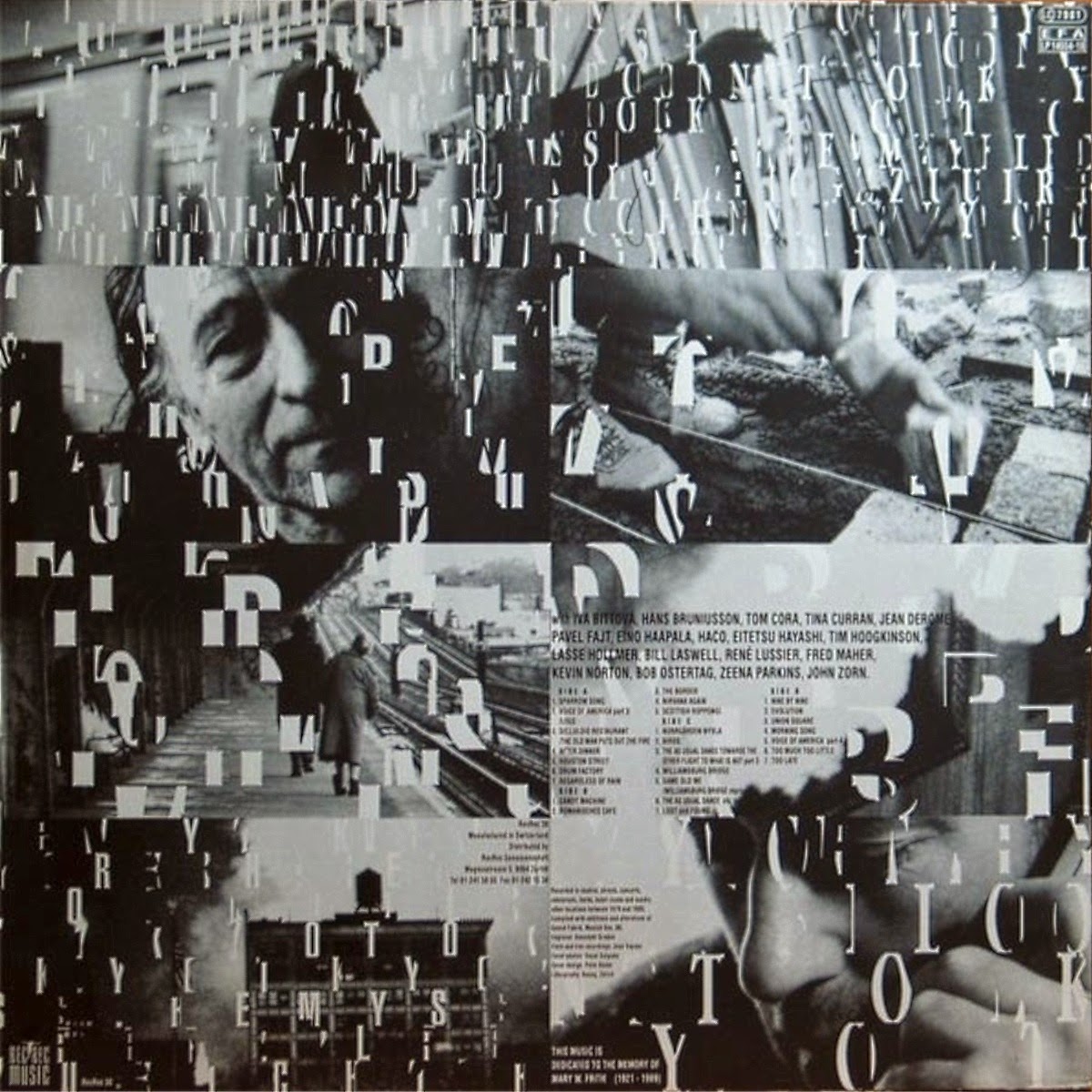
FRED FRITH – Step Across The Border (2LP-1990)


Label: RecRec Music – RecRec 30
Format: 2 × Vinyl, LP, Compilation / Country: Switzerland / Released: 1990
Style: Avantgarde, Experimental, Jazz-Rock
Music for the film by Nicolas Humbert and Werner Penzel, Recorded between 1979 and 1989.
Artwork [Lithography] – Busag, Zürich
Design [Cover] – Peter Bäder
Engineer – Benedykt Grodon
Photography By – Oscar Salgado
Recorded By – Jean Vapeur
Compiled with additons and alterations at Sound Fabrik, Munich Dec. 89.

A1 - Sparrow Song ........... (1:31)
A2 - Voice of America, Part III .......... (4:26)
A3 - Selluloid Restaurant ........... (3:12)
A4 - After Dinner .......... (1:49)
A5 - Houston Street .......... (2:56)
A6 - Drum Factory .......... (2:04)
A7 - Regardless of Rain ............ (3:07)
B1 - Candy Machine ............ (3:02)
B2 - Romanisches Café .......... (6:22)
B3 - The Border ........... (3:31)
B4 - Nirvana Again ............ (1:55)
B5 - Scottish Roppongi ........... (1:50)
C1 - Norrgarden Nyvla ............ (2:59)
C2 - Birds ........... (2:21)
C3 - The As Usual Dance towards the Other Flight to What Is Not, Part 3 ........... (1:50)
C4 - Williamsburg Bridge ........... (1:56)
C5 - Same Old Me .......... (4:13)
C6 - The As Usual Dance towards the Other Flight to What Is Not, Part 7 ........... (2:28)
C7 - Lost and Found .......... (3:20)
D1 - Nine by Nine .......... (5:54)
D2 - Evolution ........... (3:23)
D3 - Union Square .......... (1:44)
D4 - Morning Song .......... (2:03)
D5 - Voice of America, Part IV .......... (2:05)
D6 - Too Much Too Little ........... (2:09)
D7 - Too Late ........... (2:25)

Line-up / Musicians:
- Fred Frith / guitar, violin, bass, home-mades, DX7, Casio, voice, percussion, bottles, trumpet
- Tom Cora / cello, drum, voice
- Zeena Parkins / keyboards, drum, voice
- Bob Ostertag / Serge synthesizer, tapes, samples
- Bill Laswell / bass
- Fred Maher / drums
- John Zorn / alto saxophone
- Daihachi Oguchi / factory sound
- Jean Derome / alto saxophone
- René Lussier / bass
- Kevin Norton / drums
- Eino Haapala / guitar
- Marc Hollander / alto saxophone
- Lars Hollmer / keyboards
- Hans Bruniusson / drums
- Tim Hodgkinson / bass clarinet
- Iva Bittová / violin
- Pavel Fajt / beer cans, guitar, voice
- Eitetsu Hayashi / taiko
- Tina Curran / bass
- Haco / piano, voice

Step Across the Border is a 1990 avant-garde documentary film on English guitarist, composer and improviser Fred Frith. It was written and directed by Nicolas Humbert and Werner Penzel and released in Germany and Switzerland. The film was screened in cinemas in North America, South America, Europe and Japan, and on television in the United States, Germany, Switzerland, Austria and France. It was also released on VHS by RecRec Music (Switzerland) in 1990, and was later released on DVD by Winter & Winter (Germany) in 2003.

Shot in black and white, the 35mm documentary was filmed between 1988 and 1990 in Japan, Italy, France, Germany, England, the United States and Switzerland, and shows Frith rehearsing, performing, giving interviews and relaxing. Other musicians featured include René Lussier, Iva Bittová, Tom Cora, Tim Hodgkinson, Bob Ostertag and John Zorn.

The film won "Best Documentary" at the European Film Awards in 1990. A companion soundtrack album, Step Across the Border was also released by RecRec Music in 1990.


A ninety minute celluloid improvisation by Nicolas Humbert and Werner Penzel.
"Improvisation" here refers not only to the music, but also to the film itself. Humbert and Penzel state in the 2003 DVD release of the film:

“In Step Across the Border two forms of artistic expression, improvised music and cinema direct, are interrelated. In both forms it is the moment that counts, the intuitive sense of what is happening in a space. Music and film come into existence out of an intense perception of the moment, not from the transformation of a preordained plan.”

The film is not narrated, and the musicians, the music and the locations are not identified. Instead it is a sequence of "snapshots' taken of Frith and musicians he has worked with, rehearsing and performing, interspersed with apparent random images of movement (trains, cars, people, grass) that blend in with the music. The improvised nature of the film and its Direct Cinema approach make it more of an art film than simply a documentary on a musician.
The music in the film is performed by Frith on his own, with others, and by others on their own. Some of the music is improvised, some is composed material performed "live", and some is previously recorded material played as accompaniment to many of the "movement" sequences in the film.
The recording of the film coincided with the formation and activity of Frith's review band Keep the Dog (1989–1991), and many of the participants of the band appear in the film. There are even a few rare glimpses of the band rehearsing. René Lussier in particular, features prominently and "interviews" Frith about his musical upbringing and approach to music.

The title of the film comes from the lyrics of the song "The Border", recorded by Skeleton Crew on their album, The Country of Blinds (1986). A brief "video" of this song also appears in the film.


Although this is technically the soundtrack to a film of the same name by Nicolas Humbert and Werner Penzel, Step Across the Border actually serves as an excellent overview of Fred Frith's groundbreaking work as a soloist, bandleader, and collaborator. There's an example of his "guitars on the table" approach ("Romanisches Cafe"), and a couple of excellent duos with tape manipulation whiz Bob Ostertag ("Voice of America, Pt. 3," from the lost and lamented Voice of America album they made for the defunct Metalanguage label). There are also scraps of material from his work with Skeleton Crew as well as numerous other well-chosen miniatures that vary from tuneful and charming to stark and forbidding. Perhaps the best thing this album accomplishes is that it puts some of the material from the astounding (but, sadly, long out of print) album of avant-garde power trio compositions and improvisations Frith recorded with Bill Laswell and Fred Maher under the name Massacre back into circulation: the very fine "Legs" is included here, as is a previously unreleased live track from 1983. Very highly recommended.

_ Review by Rick Anderson


The collection itself is wonderful, showing all sides of Frith's skillful and innovative playing and composition. The songs range from sounds similar to The Residents, whose Commercial Album featured Frith as a sideman, to early Zappa, and even one song Evolution, with high pitched vocals and a reggae influenced beat, that sounds sort of like a deranged version of The Police.

This is a gem in my collection. Highly recommended for the RIO fan.


If you find it, buy this album!

Sunday, January 11, 2015

AQSAK MABOUL – Un Peu De L'Âme Des Bandits (LP-1980)


Label: Crammed Discs – Atem/Crammed 002
Format: Vinyl, LP, Album / Country: Belgium / Released: Jan. 1980
Style: Avantgarde, Jazz, Experimental, Prog Rock
Recorded February and August 1979 at Sunrise Studio, Kirchberg, Switzerland
Mixed by Etienne Conod and Fred Frith, assisted by Aqsak Maboul
Front cover by – Pat Andrea
Back cover and layout by – M.M.C. Octave

Un Peu de l'Âme des Bandits (English: A Little of the Bandit Spirit) is the second album by Belgian avant-rock band Aksak Maboul. It was recorded at Sunrise Studio in Kirchberg, Switzerland in February and August 1979, and released on LP in January 1980 on founding member Marc Hollander's Belgian independent record label, Crammed Discs. At the time the band had changed the spelling of their name to "Aqsak Maboul", and this is reflected on the album's record sleeve. When the album was re-issued on CD in 1995 (also on Crammed Discs) the spelling of their name reverted to "Aksak Maboul".

In addition to the Aksak Maboul line-up at the time, the album also featured ex-Henry Cow musicians Fred Frith and Chris Cutler whose contribution and names helped bring the album to the attention of a wider audience. Aksak Maboul's co-founder, Vincent Kenis did not play on this album, although he did arrange two of the tracks.


A1 - Bo Diddley / Modern Lesson . . . . . 4:58
            bassoon, oboe, choir – Michel Berckmans
            cello [violoncellos] – Denis Van Hecke
            drums [part I], performer [flipper], recorder, choir – Frank Wuyts
            drums [part II] – Chris Cutler
            electric guitar, acoustic guitar, violin, viola, bass – Fred Frith
            organ, piano, clarinet [Bb], bass clarinet, saxophone  – Marc Hollander
            voice, performer [flipper] – Catherine Jauniaux
            written-by – Hollander
A2 - Trio-Tango / Palmiers En Pots . . . . . 3:24
            alto aaxophone – Hollander
            bassoon – Berckmans
            cello – Van Hecke
            drums – Cutler
            piano – Wuyts
            violin – Frith
            written-by – Wuyts, Hollander
            written-by [Trio] – André Verchuren
A3 - Rondo / Geistige Nacht . . . . . 5:18
            bass – Frith
            bassoon, oboe – Berckmans
            cello – Van Hecke
            drums – Cutler
            piano, synthesizer [Oberheim] – Wuyts
            soprano saxophone – Hollander
            written-by – Frith
A4 - Truc Turc / I Viaggi Formano La Gioventù . . . . . 5:15
            cello [acoustic & electric cellos] – Van Hecke
            goblet drum [dumbeg], soprano saxophone, organ, – Hollander
            guitar [Guitars] – Frith
            oboe – Berckmans
            synthesizer [Oberheim], Piano – Wuyts
            written-by – traditional
A5 - Pogo / Inoculating Rabies . . . . . 1:50
            bass clarinet – Hollander
            bass, lead guitar – Frith
            bassoon – Berckmans
            drums – Cutler
            rhythm guitar, electric cello, voice – Van Hecke
            written-by – Van Hecke, Wuyts

B  -  Knokke  / Cinema . . . . . . . . . . . . . . . . . . . . . . . . . . . . . . . (22:45)
   a - Ce Qu' On Peut Voir Avec Un Bon Microscope . . . . . 7:25
            bass, guitar, guitar [prepared] – Frith
            cello [acoustic & electric cellos], voice – Van Hecke
            composed by – Wuyts, Hollander
            composed by [part of] – Jauniaux, Cutler, Van Hecke, Frith, Berckmans
            drums, percussion, performer [radio] – Cutler
            oboe, bassoon – Berckmans
            organ, alto saxophone, bass clarinet, xylophone, piano  – Hollander
            piano, synthesizer [Óberheim], percussion – Wuyts
            voice – Jauniaux
   b - Alluvions . . . . . 5:27
            bass, guitar, guitar [prepared] – Frith
            cello [acoustic & electric cellos], voice – Van Hecke
            composed by – Frank Wuyts, Hollander
            drums, percussion, performer [radio] – Cutler
            oboe, bassoon – Berckmans
            organ, alto sax, bass clarinet, xylophone, percussion – Hollander
            piano, synthesizer [Óberheim] – Wuyts
            voice – Jauniaux
   c - Azinou Crapules . . . . . 7:05
            bass, guitar, guitar [prepared] – Frith
            cello [acoustic & electric cellos], voice – Van Hecke
            composed by – Wuyts, Hollander
            drums, percussion, performer [radio] – Cutler
            oboe, bassoon – Berckmans
            organ, alto saxophone, bass clarinet, xylophone – Hollander
            piano, synthesizer [Óberheim], percussion – Wuyts
            voice – Jauniaux
   d - Age Route Brra! (Radio Sofia) . . . . . 2:48
            bass, guitar, guitar [prepared] – Frith
            cello [acoustic & electric cellos], voice – Van Hecke
            composed by – Aqsak Maboul
            drums, percussion, performer [radio] – Cutler
            oboe, bassoon – Berckmans
            organ, alto saxophone, bass clarinet, xylophone – Hollander
            piano, synthesizer [Óberheim], percussion – Wuyts
            voice – Jauniaux

Marc Hollander – organ, piano, clarinet, bass clarinet, saxophone , drum machine, alto  
                            saxophone, soprano saxophone, dumbeg, samples, xylophone, percussion
Frank Wuyts – drums, pinball machine flipper, recorder, piano, synthesizer, percussion, choir
Michel Berckmans – bassoon, oboe, choir
Denis van Hecke – acoustic cello, electric cello, voice, rhythm guitar
Catherine Jauniaux – voice, pinball machine flipper
Fred Frith – guitar, violin, viola, bass guitar, prepared guitar
Chris Cutler – drums, percussion, radio


_1.     Aksak Maboul (also spelled Aqsak Maboul for a while) were a Belgian avant-rock band founded in 1977 by Marc Hollander and Vincent Kenis. They made two studio albums, Onze Danses Pour Combattre la Migraine (1977) and Un Peu de l'Âme des Bandits (1980), the last one with ex-Henry Cow members Chris Cutler and Fred Frith. They were also active in the Rock in Opposition movement Maboul began in 1977 as a duo of Marc Hollander (keyboards, reeds, percussion) and Vincent Kenis (guitar, bass guitar, keyboards). Marc Moulin (keyboards) and Chris Joris (percussion, keyboards) joined later, and with this line-up, plus guests Catherine Jauniaux (voice) and others, they recorded their first album, Onze Danses Pour Combattre la Migraine (French for “Eleven Dances for Fighting Migraine”).

It was released in 1977 under the name Marc Hollander / Aksak Maboul on an independent record label, Kamikaze Records.Onze Danses Pour Combattre la Migraine was a playful mix of musical forms, cultures and genres. With drum machines and looping organ lines, it shuffled between improvised jazz, ethnic music, electronics and classical music. It was largely an instrumental album with snatches of singing and voices.In late 1977 Aksak Maboul started performing live, during which time Frank Wuyts (percussion, keyboards) replaced Joris and Moulin, and Denis van Hecke (cello) and Michel Berckmans (bassoon, oboe) of Univers Zéro joined. In early 1979, Hollander invited Chris Cutler and Fred Frith of the recently defunct avant-rock group Henry Cow to join Aksak Maboul on their next record.

They rehearsed together, performed in a few concerts and then went to Sunrise Studio, Kirchberg in Switzerland to record their second album, Un Peu de l'Âme des Bandits (French for “A Little of the Bandit Spirit”).This was released in 1980 on Crammed Discs, a new independent record label Hollander had created to release the album.Un Peu de l'Ame des Bandits was more intense and experimental than their first album. It contained complex written sections as well as improvised ambient pieces. It used sampling before samplers were invented and was a mixture of jazz, tangos, traditionals from the eastern Balkans, chamber rock, noisy punk rock and pseudo-Varèse music. Like the first album, it was instrumental with a little singing and voices.Back on the road again, Aksak Maboul joined the Rock in Opposition (RIO) movement and in April 1979 they performed at an RIO festival at the Teatro dell'Elfo in Milano, Italy.

Aksak Maboul were one of the last of the original RIO bands.In early 1980, Hollander founded the Crammed Discs independent record label. A few months later the original nucleus of Aksak Maboul (Hollander and Kenis) and the core of a Brussels band Les Tueurs de la Lune de Miel joined forces to become The Honeymoon Killers. They toured Europe between 1980 and 1981, although still under the name Aksak Maboul. 


They later recorded an album Tueurs de la Lune de Miel / Honeymoon Killers and toured for a few months under that name. The last recorded work by Aksak Maboul appeared on a 1984 compilation album, Made to Measure Vol. 1, where the original duo of Hollander and Kenis contributed seven tracks of new material composed for a play by Michel Gheude based on the life of Maïakovsky.The music here has been described as “minimalist rock” and is very different from their two studio albums.By the mid-1980s Aksak Maboul ceased to exist as a group, but Hollander and Kenis continued to play an active role in Crammed Discs' musical policies.


_2.     Aksak Maboul - Un peu de l'ame des bandits Aksak Maboul (a.k.a. Aqsak Maboul) was one of the original Rock-In-Opposition (RIO) groups. They were one of three that were officially elected into the movement after Henry Cow’s original selection of bands (Univers Zero, Etron Fou Leloublan, Samla Mammas Manna and Stormy Six) had explored the style and ideology. “Un peu de l’ame des bandits,” Aksak Maboul’s 1980 effort, is more or less quintessential to the RIO genre, and one that set the stage for many of the Avant-Prog groups that have followed since...

The late '70s were a heady time in European progressive rock circles. Chris Cutler, drummer 
of the leading group Henry Cow and unrepentant leftist seeking to distance himself from both major label and American rock influences, found similarly minded groups in France, Sweden, Belgium, and Italy, and brought them together for a British tour under the banner of Rock in Opposition (RIO). New musical influences and adventures gave rise to more short term formations for Cutler and Fred Frith (Cow's guitarist), including this venture with a Belgian duo, Aksak Maboul, comprised at the time of Marc Hollander and Vincent Kenis. This group had recorded an album in 1977, Onze Danses Pour Combattre le Migraine, which became a cult album in its own right. As Aksak toured, their paths crossed with the various RIO groups, which led to this album in 1980. Cutler and Frith brought a solid rhythm section, but ready to make terrific noise when appropriate (as on the backing tracks of Inoculating Rabies). Michel Berckmans, wind player from Univers Zero (one of the Belgian RIO groups), and Hollander were the wind and reed section. Frank Wuyts and Denis Van Hecke rounded out the group on keyboards and strings. Stylistically the album is all over the board. For example, the opening track, featuring Catherine Jauniaux on vocals, launches into a twisted blues number, with the singer freely improvising and trading licks with Van Hecke's cello and Hollander's sax. The second part of Modern Lesson features extremely intricate horn writing, with different players rapidly trading different elements of the lines. "I Viaggi" uses a Middle Eastern scale, with cello and voice doubling the melody line. "Palmiersen Pots is a classical piece for string trio, followed by a tango composed from several popular pieces cut up with scissors and reassembled at random. The album culminates with a long suite (originally all of side two on the vinyl release) based on a shorter peggiated figure, composed sections alternating with solos on bass, cello, electric cello, and synthesizer. On top of all of the great musicianship, Frith and lead engineer Etienne Conod performed significant studio wizardry after the sessions. Modern Lesson contains sounds from a pinball machine as well as bits from every other track (and this is well before the age of samplers). The lead bassoon/oboe lines of Inoculating Rabies would be inaudible over the guitar and percussion noise in a live situation, but the contrast makes the piece.  
This Aksak Maboul lineup and this album, is remains a pinnacle of the RIO movement.

_Review by Caleb Deupree


If you find it, buy this album!

Thursday, August 28, 2014

SLAPP HAPPY with HENRY COW – Desperate Straights (LP-1975)


Label: Virgin – V 2024
Format: Vinyl, LP, Album, Repress / Country: UK / Released: 1975
CD ReR Megacorp – ReR HCSH1 (UK) (2004)
Style: Avantgarde, Jazz Rock, Prog Rock
Recorded at The Manor & Nova Sound Studios, 1974.
Arranged By, Producer – Henry Cow, Simon Heyworth, Slapp Happy

A1 - Some Questions About Hats . . . (1:49)
A2 - The Owl . . . (2:14)
A3 - A Worm Is at Work . . . (1:52)
A4 - Bad Alchemy . . . (3:06)
A5 - Europa . . . (2:48)
A6 - Desperate Straights . . . (4:14)
A7 - Riding Tigers . . . (1:43)
B1 - Apes in Capes . . . (2:14)
B2 - Strayed . . . (1:53)
B3 - Giants . . . (1:57)
B4 - Excerpt from The Messiah . . . (1:48)
B5 - In the Sickbay . . . (2:08)
B6 - Caucasian Lullaby . . . (8:20)

Line-up / Musicians
- Peter Blegvad / guitar, voice
- Lindsay Cooper / oboe, bassoon
- Chris Cutler / drums
- Fred Frith / guitar, violin, xylophone
- John Greaves / bass guitar, piano
- Anthony Moore / piano
- Tim Hodgkinson / clarinet, organ, piano
- Dagmar Krause / voice, wurlitzer

Guest musicians:
- Mont Campbell / French horn
- Nick Evans / trombone
- Mongezi Fezza / trumpet
- Geoff Leigh / flute
- Pierre Moerlen / percussion


Shortly after recording 'Unrest', Henry Cow entered into a merger with label mates Slapp Happy. Slapp Happy comprised Dagmar, a German vocalist who would later win great acclaim for interpretations of Brecht (and sign my copy of this abum), Peter Blegvad, American born but raised and educated in England, played guitar and wrote most of the lyrics and would later contribute the unique strip cartoon Leviathan to the Independent, and Anthony Moore, English pianist who wrote most of the music and who would later work with the post Waters Pink Floyd. Together they produced a kind of skewed pop awash with literary and artistic references. They had recorded 2 albums with Faust, the second of which was re-recorded with session players for Virgin. 2 albums would come from this merger; Desperate Straights (Slapp Happy with Henry Cow) and In Praise Of Learning (Henry Cow with Slapp Happy).
Desperate Straights was the first of the joint ventures to be recorded, and the union of Henry Cow's avant rock with Slapp Happy's warped pop was both challenging and accessible. The majority of the songs were built around a piano/bass/drums accompaniment, with other instruments adding extra colour where needed. Tim Hodgkinson's clarinet is deployed as an instrumental foil to Dagmar's unique voice to superb effect, particularly on the opening song Some Questions About Hats. Elsewhwere, The Owl features Dagmar accompanied solely by horns and Europa has some superb percussion from Pierre Moerlen - all the arrangements are highly original and well thought out. Peter Blegvad takes the lead vocal on Strayed and does a neat pastiche of Lou Reed's drawl. Excerpt From The Messiah is a snippet of Handel as though played by a 70s glam metal band like Slade. There are 2 instrumentals, the title track which is a short, off kilter foxtrot, and the closing track, a lengthy piano/clarinet piece which features the 2 instruments playing scales very slowly. Caucasian Lullaby isn't bad at all, and would have been a superb addition to one of Eno's Obscure label releases, but it is somewhat out of keeping with the rest of the album.

This release is more representative of Slapp Happy than Henry Cow. All of Slapp Happy's albums are worth checking out - this album was released on CD as a twofer with their first album for Virgin, and is superb value if you can find it. If you've ever wondered what a cabaret band from mars would sound like, this album is definitly for you.

Review by Syzygy,
PROG REVIEWER, February 08, 2005


Buy this album!

HENRY COW – In Praise Of Learning (LP-1975)


Label: Virgin ‎– V 2027
Format: Vinyl, LP, Album / Country: UK / Released: 1975
CD ReR Megacorp – ReR HC3 (US) (2000)
Style: Avantgarde, Jazz Rock, Prog Rock
Recorded at the Manor, February & March 1975, except track A1, recorded November 1974.
Artwork By [Sock] – Ray Smith
Producer – Henry Cow, Phil Becque, Slapp Happy
Recorded By, Mixed By – Phil Becque
Remastered By – Matt Murman

ART IS NOT A MIRROR - IT IS A HAMMER (John Grierson)

A1 - War . . . (2:26)
A2 - Living In The Heart of the Beast . . . (15:30)
B1 - Beginning: The Long March . . . (6:27)
B2 - Beautiful as the Moon - Terrible as an Army With Banners . . . (7:02)
B3 - Morning Star . . . (6:06)

Line-up / Musicians
- Dagmar Krause / vocals
- Peter Blegvad / clarinet, guitar, vocals
- John Greaves / bass, piano
- Chris Cutler / piano, trumpet, drums, vocals
- Lindsay Cooper / bassoon, oboe, Wind
- Mongezi Feza / trumpet
- Phil Becque / synthesizer
- Fred Frith / guitar, piano, violin, keyboards, xylophone
- Tim Hodgkinson / organ, clarinet, piano, keyboards, saxophone, vocals
- Geoff Leigh / trumpet, saxophones
- Anthony Moore / synthesizer, piano, keyboards, electronics

The trademark chainmail sock was deep red, and the cover was adorned with a quote from the left wing film maker John Grierson - 'Art is not a mirror, it is a hammer'. The titles of the two instrumentals also explicitly refer to the band's left wing politics; Beginning: The Long March is a reference to the Chinese Revolution, while Morning Star is the name of the daily paper published by the Communist Party of Great Britain.
And what of the music?


HENRY COW had joined forces with the German trio SLAPP HAPPY as they collaborated to make the album "Desperate Straights" under the SLAPP HAPPY name. "In Praise Of Learning" sees this collaboration continue only this one is released under the HENRY COW name. This collaboration would end shortly after this album was released. Still this melding of the two bands makes "In Praise Of Learning" quite different from their previous two studio albums. More avant-garde i'd say plus having Dagmar Krause on vocals changes the mood completely. I am used to her vocals from the ART BEARS albums but those who haven't heard her sing before don't usually view her participation as a positive. Including guests we get eleven musicians involved with the making of this record. SLAPP HAPPY would fold after this recording when Dagmar announced she was staying with HENRY COW as the COW would tour a lot the following year or so. She would return to SLAPP HAPPY though as witnessed on their 1980 release "Acnalbasac Noom".
"War" is only 2 1/2 minutes long and was composed by the SLAPP HAPPY duo of Moore and Blegvad. Both Blegvad and Krause sing on it and Dagmar is quite passionate here. I like the brief instrumental sections. "Living In The Heart Of The Beast" opens with Frith ripping it up with some dissonant guitar leads. Krause comes in vocally and I like this song already much better than the first tune. It settles down before we get some more aggressive guitar. A calm follows with piano and Dagmar returns in a reserved manner. It turns dark before 3 minutes as we get a complex instrumental section that really impresses. Vocals are back before 4 1/2 minutes. Another calm a minute later as the vocals stop and the sounds become intricate. Vocals are back and they do get passionate at times. Another calm before 7 1/2 minutes with organ. Violin joins in from Frith after 8 minutes. It will kick in again but settle back quickly. This is so good ! Vocals are back before 12 1/2 minutes as it stays fairly relaxed. Great, great track composed by Tim Hodgkinson.

"Beginning- The Long March" like the final track "Morning Star" were joint efforts by the two bands. The first is experimental throughout as various sounds come and go. I like this instrumental a lot, it's a real trip. "Beautiful As The Moon-Terrible As An Army With Banners" is a Frith / Cutler composition. It opens with reserved vocals and a laid back sound with plenty of piano. It does become a little more passionate then settles back before 3 minutes. It picks back up before 4 minutes with an excellent instrumental section. Dagmar is back late. Another excellent track. "Morning Star" ends it as we get dissonant horns and random drum patterns to start and more. Avant is the word and it continues throughout. An adventerous instrumental to close out the album...

Review by Mellotron Storm
PROG REVIEWER, March 03, 2013


Whether you agree with their politics or not, music as passionate and committed as this is all too rare, and in the prog field it is almost unprecedented. Listen and be amazed.


Never have I heard such a radiant combination of instrumentation, song-writing, emotion, intellect, everything that makes each song unique and full of true magic. If you have not heard it, grant your ears the gift immediately. This album gets my highest recommendation of anything I could write.


Buy this album!