Showing posts with label Kevin Norton. Show all posts
Sunday, January 26, 2014
P. DUNMALL / P. ROGERS / K. NORTON – Go Forth Duck (2004) and Rylickolum: For Your Pleasure (2003)
Label: CIMP – CIMP 296
Format: CD, Album; Country: US - Released: 2004
Style: Free Jazz, Free Improvisation
Recorded at The Spirit Room, Rossie, NY, May 20, 2003.
Spirit Room Series, Vol. 175
Artwork By [Cover] – Kara D. Rusch
Engineer [Recording] – Marc D. Rusch
Producer – Robert D. Rusch
While the production appears rushed, the music is of the caliber that is to be expected from musicians such as Paul Dunmall, Paul Rogers, and Kevin Norton. The recording comes from the same session that produced the superb Rylickolum: For Your Pleasure but curiously, the notes for this one refer only to tracks from that earlier release, and Kevin Norton is listed as playing drums but not vibes, which he also performs in splendid fashion throughout. There are only three pieces, with two ("Go Forth Duck" and "I Am Not a Van [Ofocals]") of considerable length. Dunmall is a master of the small group performance: he paces each track carefully so that there is a relaxed sense of completeness. Dunmall plays his three favorite horns -- the soprano sax, bagpipes, and tenor sax -- and along with Norton's vibes and drums, plus Rogers' bass, there are a total of six instruments, making this more diverse and accessible than the usual sax-led trio album. In terms of Dunmall's discography, this is a quality set, equal to the reedist's best work. There is the requisite intensity, with Dunmall blowing hard when appropriate; there are also sections of introspective beauty. His magnificent solo on soprano following Norton's hardcore drumming near the end of "Go Forth Duck" shows why Dunmall is so respected as an improviser. Through the course of this solo alone, Dunmall springs off the bass and drums, develops moods, morphs in sometimes subtle ways, and engages in unmitigated flash, ending with a prime display of technical bravura with galloping clusters. His bagpipe reaches a majestic height as he merges sounds with Rogers' acoustic bass on "Come Back Weirdness Day." Rogers and Norton are about as tight a rhythm section as exists. They each know how to spur a soloist and they are each excellent soloists themselves. This is a power trio at the peak of their game, and here they project some wonderful moments.
_ STEVEN LOEWY, Rovi
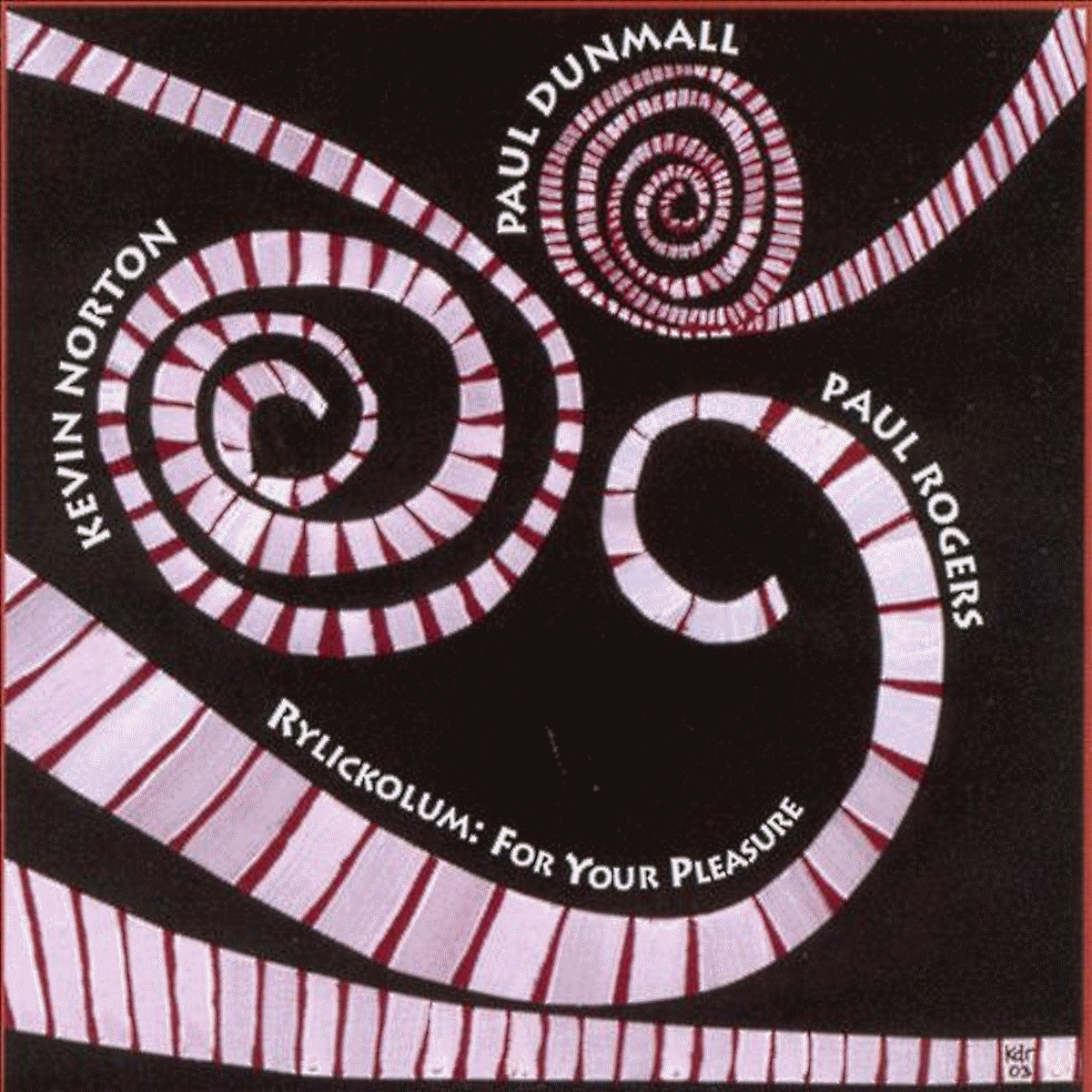
Label: CIMP – CIMP 289
Format: CD, Album; Country: US - Released: 2003
Style: Free Jazz, Free Improvisation
Recorded at The Spirit Room, Rossie, NY, May 19, 2003.
Artwork By [Cover] – Kara D. Rusch
Engineer [Recording] – Marc D. Rusch
Producer – Robert D. Rusch
NOTE:
The A.L.L. bass was designed by Antoine Leducq; it has a wide fretboard with 2 tiers of strings: 6 or 7 traditional-like bass strings on top and 12 or 14 sitar-like sympathetic strings running under the length of the fingerboard and just above the body of the bass.
REVIEW:
Saxophonist Paul Dunmall and bassist Paul Rogers share a longtime association playing European improvised music. With Keith Tippett and Tony Levin they complete the quartet known as Mujician. Dunmall also plays with singer Richard Thompson. With guitarist Phillip Gibb, Rogers and Dunmall comprise Moksha. With percussionist Ken Norton, an Anthony Braxton alumnus, they form a long-travelled trio that took time out here to document intimate empathy and free imagination.
The title track begins portentiously with struck chimes, Rogers softly grinding on bass, and Dunmall playing coy melodies. They quickly blossom into Norton and Rogers providing the clickety clack for Dunmall’s hard driving train. His powerful soprano runs itself out, Norton lets the bass drive for a while, and Norton switches to chilly vibes. Dunmall picks it back up, then rests while Rogers pulls rapid elastic bass and Norton offers light cymbal brush work. He gets crazy in the upper register and Dunmall returns to give chase. Norton adds more drums to the attack, adding thrust to the momentum, all three full force. As the rush dissipates, Norton returns to vibes and Dunmall confines himself to toneless breath, Rogers popping harmonics. Norton plays mysterioso vibes, with occasional drum splash.
The performance continues with “ Villaka, ” and Norton solos in stellar bursts on vibes. He continues creating spontaneous fire, and Dunmall joins him with a tenor full of gasoline. They make having a lot of ideas sound easy. Norton transitions to drums and Rogers returns with his aggressive fluency. The trio rocks hard, then Dunmall lingers over phrases, changing his purrs into barks, finally pops and squeaks coloring strenuous bass runnings from Rogers. Norton whizzes on brushes, switches to sticks, finally to vibes for Rogers’s high scratchings that drop low and Dunmall off again with Norton at his heels still on vibes. Going back to sticks on drums, he whips Dunmall into an inspired exchange.
After their retreat, “ Indokeluka ” begins with Rogers ’ continued soft scrape. Norton contributes tentative vibes and Dunmall a slow soulful melody. Rogers ’ itchy bowing infects Dunmall, who turns melodies in on themselves, finally disolving down to Rogers as the center. Dunmall breaks loose again with Norton casting rhythm nets under his feet, and Rogers continues his bowed meditation. With Norton back on atmospheric vibes, Dunmall rolls quick little phrases around; but as Rogers turns up the intensity, Dunmall gets raw. He slurs and overblows in duet with Rogers, Norton takes an uncluttered solo, and Rogers brings Dunmall back with him. Norton and Rogers take on a swinging rhythm and Dunmall plays all over it. With Norton blazing back on vibes, Rogers and Dunmall offer small comments.
As always, the recording boasts that patented CIMP sound: clear, clean, and refreshing. The unadulterated acoustics gives up every nuance and tone the trio can imagine.
_ By REX BUTTERS, Published: June 1, 2004
Links in Comments!
Sunday, July 22, 2012
PAUL DUNMALL SUN QUARTET – Ancient and Future Airs (2009) [Repost]
Clean Feed – CF138CD
Format: CD, Album; Recording Date : 2009; Style: Free Improvisation
Barcode: 5 609063 001389
Design – Travassos, Executive-producer – Trem Azul, Mastered By – Luís Delgado, Photography By – Hernani Faustino, Recorded By, Mixed By – Jon Rosenberg
Recorded on 16 June 2008 at The Living Theatre, New York; (Mixed June 24th 2008)
Review:
As he has proved in other situations – most notably his two decades long membership in both the London Jazz Composers Orchestra and the collective quartet Mujician – saxophonist Paul Dunmall is the consummate group player.
With wide-ranging influences that take in Carnatic sounds, semi-folk material, so-called Ecstatic Jazz and free-form improv, the London-based musician is known for his tenor saxophone playing, but also tries out other members of the saxophone family – including the saxello – and has recently turned his attention to the border bagpipes.
Each of these ancillary horns makes an appearance on these notable quartet sessions. Recorded in the company of fellow British improvisers, the September Quartet features bassist Nick Stephen and drummer Tony Marsh, the trumpet of Jon Corbett and Dunmall ’ s tenor and saxello playing. Flash forward two years to 2008, when after an appearance at New York ’ s Vision Fest, Dunmall recorded the next day as part of the completely different Sun Quartet. Here his partners are all well-regarded Americans: bassist Mark Helias and Kevin Norton on drums and vibraphone, plus Tony Malaby playing soprano and tenor saxophones.
Dunmall not only showcases his tenor work, but his bagpipe style as well.
Of similar build and hirsuteness, both Malaby and Dunmall bring the same lung power to their tenor saxophone playing, using split tones, inflating diaphragm vibratos and altissimo cries to good advantage. Operating in double counterpoint and exploring individual sonic paths only feature distinguishing Malaby from Dunmall – and vice versa – is that one sax appears to be pitched higher than the other. One sky shrieks while the other favors moderato timbres. Exact identification only happens when Malaby switches to the soprano and Dunmall brings out his bagpipes.
During those sections of the extended improv, Malaby ’ s soprano wriggles in serpentine lines which expose nodes as well as notes and uses a grittier tone to goose the tempo. Far away from pipe band harmonies meanwhile, Dunmall ’ s pipes and bellows pump up the available air supply with widened and pressured tones leading to triple and quadruple multiphonics. As the pitch-sliding bagpipe drone redefines the overall sound, Malaby narrows his output with reed biting abrasive tones.
Helias ’ thick lope and Norton ’ s slaps, rebounds and accentuated drum strokes hold the performance together regardless of the reedists ’ oral gymnastics. However the metallic sparkles and slides instituted by Norton ’ s vibraphone in the tune ’ s slower sections create a unique transitional texture. At points either one or another of his percussion instruments foreshadows tempo and pitch changes, as when cymbal taping introduces internal split tones intensity from the saxophonists or when pin-pointed drum strokes and rim shots usher in a section of mellow and balladic reed runs.
Divided into four long sections, as opposed to the massive single track and short encore that make up the other CD, What Goes Around is another ad hoc set up. British expatriate trumpeter Jon Corbett arrived from his home in Germany to record with his homeboys, who besides Dunmall, include veteran bassist Nick Stephens, who has recorded with everyone from Norwegian saxophonist Frode Gjerstad to American Norton, and drummer Tony Marsh, a frequent Stephens associate.
Unlike Norton, Marsh confines his work to the drum set and the drummer ’ s traditional time- keeping role, only figuratively stepping forward a few times to take sharp and restrained solos. In this different configuration, there ’ s less good-natured challenging from Dunmall – although his work with Malaby could scarcely be termed a saxophone battle – and more tone intermingling. Still, it ’ s the tenor man who, more often than not, steps outside the comfort zone with measured split tones, while Corbett specializes in andante trumpet flourishes, gentling grace notes and muted obbligatos.
At the same time, the brass man does reveal short, frenetic sound bites or hummingbird-quick tube explorations, as he does on “ Follow Me Follow ” . There, his gentling trumpet obbligato precedes soprano saxophone sluices and cymbal vibrations. Abutting one another, the horns ’ output separate lines as Stephens ’bass walks and Marsh’ s drums rebound. With the horns ’ irregular vibrato sweetened with oral splays and growls, the track ends with a conclusive double bass pluck.
Fittingly the four climax with “ All ’ s Well that End ’ s Well ” , with Dunmall back on tenor, Corbett playing chromatic lines, and the rhythm section creating a rolling wave of string- thwacked thunder plus skittering drum beats and rim shots respectively. As the saxophonist introduces squat split tones and slurs to break up the time, he ’ s aided by the bassist ’ s supple cross strokes and half stops. Eventually the trumpeter and reedist stutter tremolo tones at one another: with one man ’ s timbres echoing the first ’ s almost immediately after initial creation. Finally sul ponticello string work, clattering drum beats, brass flutter-tonguing and reed tongue-stops coalesce architecturally, until the sounds gradually diminishing into a warm flurry of grace notes from both horns.
Whichever part of this mixed Anglo-American program you prefer, each CD shows off Dunmall ’ s inventiveness in a context with equally impressive cohorts.
by Ken Waxman (Jazzword review on July 6, 2009)
Welcome to new prog-blog "Different Perspectives In My Room...!".
Enjoy the music, and please leave a comment. Thanks in advance.
Link in Comments!
Subscribe to:
Comments (Atom)


