Showing posts with label Kaoru Abe. Show all posts

Friday, June 16, 2017

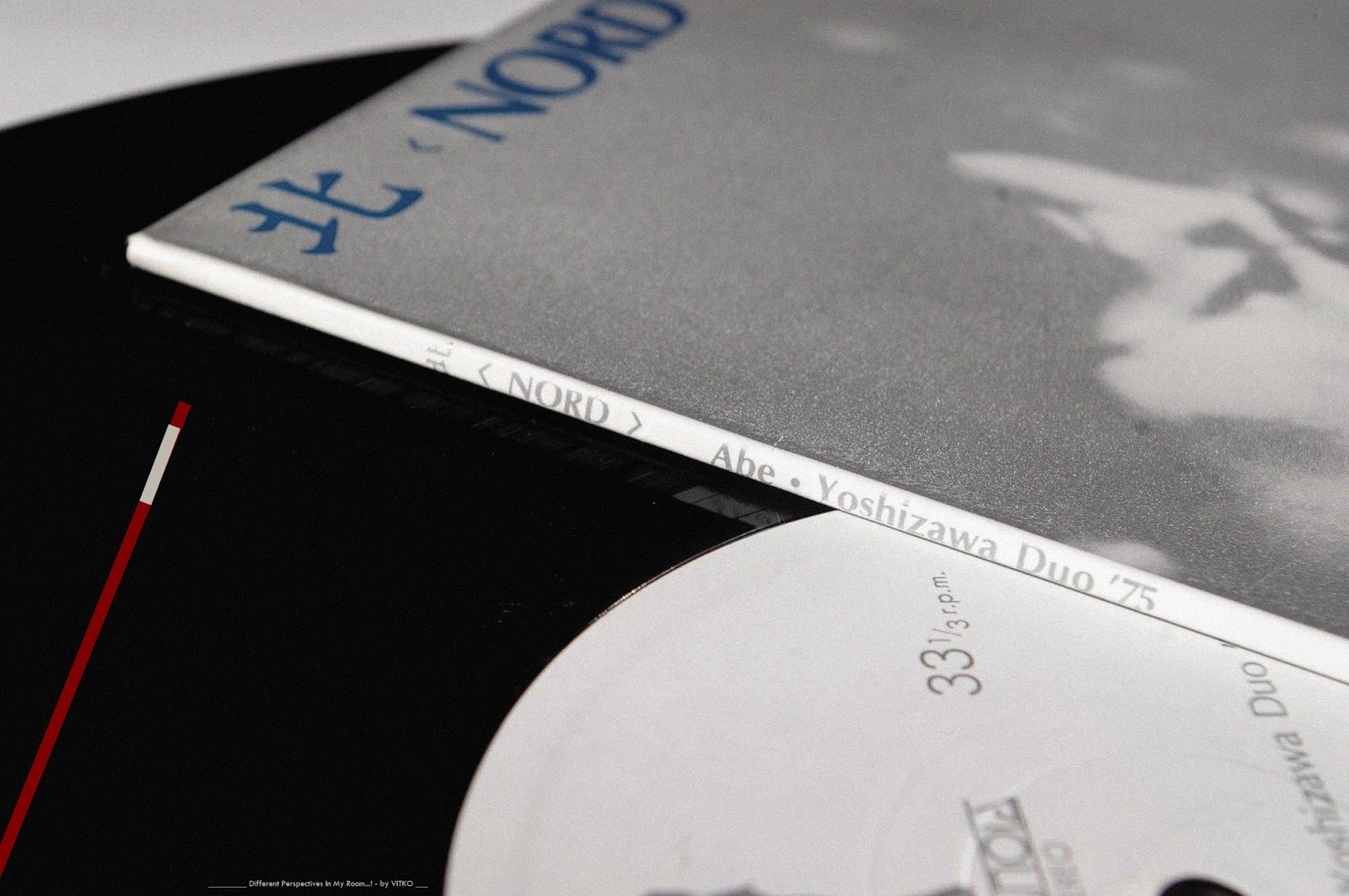
KAORU ABE/MOTOHARU YOSHIZAWA – 北 [NORD] Abe • Yoshizawa Duo '75


Label: ALM-Uranoia – UR-5
Format: Vinyl, LP, Album / Country: Japan / Released: 1981
Style: Free Jazz, Free Improvisation
Recorded at Iruma Shimin Kaikan, on October 15 (A1, A2) and recording live
at Aoyama Tower Hall from Concert "Mort À Crédit" (B), on October 18, 1975.
Artwork (Cover Design) – Akio Suzuki
Photography By – Tatsuo Nagao
Photography By, Other [Concert Producer] – Aquirax Aida
Liner Notes – Go Murakami, Toshihiko Shimizu
Recorded, Producer – Yukio Kojima

Tracks:
A1 - Duo Improvisation No.1 .................................................................................. 11:20
A2 - Duo Improvisation No.2 .................................................................................. 12:54
B  -  Duo Improvisation No.3 .................................................................................. 29:41

Kaoru Abe – alto saxophone
Motoharu Yoshizawa – bass, cello

Yoshizawa Motoharu wrapping strings and stringed resonance sound warmly flows, enveloping Kaoru Abe. Dialogue starts from there. It's gentle...


Hot air has already been lost from the block, and it was impossible to hear cracked agitations exhaled from the magnet speaker. While listening to their sounds, I remember the air of a time, I remember it a little, a little, somewhat, just a little...  it is certain that Kaoru Abe was watching "something beautiful" behind a scorched earthy sound. I felt strongly that it was not just roaring but something like an admiration for such a world to be built in a dialogue with a heavily light Yoshisawa bass...
The charm of Kaoru Abe is not actually found in the style as Free jazz but rather like the sound of ordinary people in Japan is scattered like a residue... Beautiful recording.


If you find it, buy this album!

Wednesday, July 27, 2016

KAORU ABE – Mort À Crédit (2LP-1976- ALM Records-AL-8/AL-9)


Label: ALM Records – AL-8 / AL-9
Format: 2 × Vinyl, LP, Album / Country: Japan / Released: 1976
Style: Free Jazz, Free Improvisation
Subtitled "Saxophone Solo Improvisations" / Gatefold sleeve
A-1, B-2 recorded live at Aoyama Tower Hall, October 18, 1975.
B-1 and C-1 to D-2 recorded at Iruma Shimin Kaikan, October 16, 1975.
Design [Designed By] – Nobukage Torii
Photography By [Photo] – Masahiro Imai
Includes liner notes in Japanese by Aquirax Aida
Producer – Aquirax Aida, Hangesha, Yukio Kojima
Recorded By – Yukio Kojima

AL-8
A  -  Alto Improvisation No.1 ............................................................... 26:00
B1 - Alto Improvisation No.2 .............................................................. 11:20
B2 - Alto Improvisation No.3 .............................................................. 12:30
AL-9
A1 - Sopranino Improvisation No.1 ...................................................... 6:17
A2 - Alto Improvisation No.4 Part 1 ................................................... 20:14
B1 - Alto Improvisation No.4 Part 2 ................................................... 18:50
B2 - Sopranino Improvisation No.2 ...................................................... 7:00

KAORU ABE – alto saxophone, sopranino saxophone

After the Partitas double album (recorded 1973, released 1981), Mort À Credit was to become the last Abe album to be released in his lifetime.


Mort À Credit was the title given to Céline's novel Death On The Installment Plan, not a coincidence and an analogy that makes at least a little bit of sense - Abe was reportedly a major Céline fan, and his solo disks on PSF have Japanese translations of Céline text attached to the songtitles in the CD inserts. It consists of two alto improvs from a show on October 18, 1975, and five more (three on alto, two on sopranino) from another performance a couple of days earlier. Released by Kojima on 2LP in 1976 (the reissue does not appear to contain any unreleased material), it can be said to mark a significant change in Abe's style. Abe is here a little soften from his usual urgency - this can perhaps be in part attributed to the passage of time - and become more interested in spacing and the exact rhythms of phrasing. While never entirely ignorant of these concerns, by now they had come very much to the fore, as is illustrated by the two recordings from the earlier show here, in which roughly cut-off notes are spaced so regularly that their rhythms are like watching a slowed-down strobelight. With run after run of harsh, crude and almost bawdy staccato honking, Abe speedily races through the octaves in ascending and descending anti-order cadence. He breaks regularly into very shrill squeaks and squeals (and the occasional bold wail-melody) and references non-existent simplistic and just about jokey tunes. The eventuall effect is like having someone tapdance on stilletoes on your temple. Some passages are about 50% clearer than others, and at more than one point the fidelity swings sharply, moving from distant, muffled high-pitch screeching tones to furoious forehead-centre blowing gusts in virtual machine-gun arc.


Of the three alto tracks from the October 16 performance, the first is the most impressive. Again beginning with twisting, dancing note clusters that somersault forth from the speakers, Abe soon moves into the increasingly familiar technique of aching, wrenching bursts of heavy shrieking alto, separated by stopwatched periods of silence. Dwelling almost exclusively in the upper register, Abe sets upon the sounds lying within a limited tonal range and squeezes hard, eking an incredibly broad range of textures from an ostensibly small palette. He continues to work thus in the following two pieces, nodding throughout to the temperately expressionistic style he would employ so effectively on the Nord duo with Yoshizawa, and further impressing the change that had by now come about in his playing. Though at this point still slightly unfocused in parts, these recordings offer a significant development of his earlier playing that's simultaneously evolved and honed down/devolved, and are crucial from a historical perspective, showing Abe to be almost out on his own at this point (and also helping to contextualise the efforts of present-day practitioners like Masayoshi Urabe and Tamio Shiraishi). The two sopranino cuts hint at more history to be dug up, like Abe's pieces on bass clarinet showing him to adapt to the instrument rather than forcing the instrument to adapt to him. The first in particular (though at the time of the show possibly intended as introductory in nature) sends lovely, moving and sustained melodies flowering forth, one after another; the second ups the pace, with Abe improvising in light, feathery strokes - a painfully abbreviated look at another potential big gun in Abe's arsenal, the only other available glimpse being the Graves record, and who knows how often Abe actually employed the instrument in the live setting.


Mort À Credit shows Abe in a fascinating period of transition, moving forth to something complexly and identifiably new, yet intransigently rooted in what had come before. Alan Cummings reports that the general consensus in circles there within which Abe's work is known and appreciated is that he was at his best ca. 1970-1973/74, a view I don't think I could ever really significantly disagree with. But for me the period summarised by Mort À Credit is also highly salient. While his earlier recordings focused on energy and an almost self-conscious encompassing of the saxophone's entire range and sonic potential (like some deliberately comprehensive inventory of Sounds You Can Make With An Alto), the material here shows Abe audaciously experimenting with a smaller range of sounds - those inherent in the instrument's upper limits - and pushing them further, narrowing his scope and coming up with improvisations which, in what they attempt to achieve, are arguably even further 'out'.
(– Review by Nick)


If you find it, buy this album!

Thursday, February 6, 2014

KAORU ABE and SABU TOYOZUMI – Overhang Party / Senzei - 1978 (2LP-2004)


Label: Qbico – QBICO 22/23
Format: 2 × Vinyl, LP; Country: Italy - Released: 2004
Style: Free Jazz, Free Improvisation
Recorded on February 25 and April 15 & 30, 1978 live at Gaya, Tokyo, Japan.
(Previously unreleased material)
Cover Design by Sabu (front) & Qbico (inside)
Artwork and Design on info pages by VITKO
Mastered By – Harumi Hayashi
Photography By – Kenshi Sudoh, Masaaki Ohthu
Recorded By – Shinji Ohno

KAORU ABE – alto sax
SABU TOYOZUMI – drums, percussion

Note:
..."for sure one of the most legendary qbico release. Abe was a hero for me, i was a long time admirer of his music/unique, angry voice; so this was more then a pleasure and honour to put out. Sabu worked on the front cover, me on the inside and ltd ed. Sabu also found many original flyers of the 1st Memorial Concert dedicated to Kaoru Abe which we used for the collectors ed.. Sabu told me so many stories about Abe: how much fun they had together, how he assaulted Milford Graves screaming his sax in front of him, which let to the conclusion that Mr. Graves refused to play with him again (i'd have loved to see that scene), how poor he was at the end of his life..." Qbico


"A real find: a clutch of unreleased duo performances from starcrossed free Japanese altoist Kaoru Abe recorded a few months prior to his death aged only 29 on September 9th 1978. Though he obviously owed plenty to Ayler's righteous whoops and shrieks, Abe's playing also had a distinctive, deeply lonely and melancholic air. Indeed, he was often most comfortable playing alone, when he could carve huge chunks of weighty black silence to construct his dynamic of tension and release, sometimes he'd remain motionless for long minutes on end before blasting through the static mess. As such he has been a major influence on contemporary sound-thinkers like Masayoshi Urabe and alongside guitarist Masayuki Takayanagi stands at the forefront of the first wave of Japanese avant garde musicians. This stunning double gatefold LP bundles four ferociously powerful sets where he ’ s accompanied by powerhouse drummer Sabu Toyozumi who has played with Peter Brötzmann, Derek Bailey, Exias-J and Arthur Doyle. Side A is Feb 25th, 1978 (3rd set), B is April 15th, 1978 (1st set), C is April 15th, 1978 (2nd set) and D is April 30th, 1978 (1st set). Outer sleeve designed by Toyozumi himself, nice archival shots of the duo inside. Comes on psychedelic multi-coloured vinyl. A major historic event for sure." _ DK

Note:
Unrelease recording available here for the 1st time after more then 25 years. "Long ago, when i started listening to free jazz records, the abrasive sax sound of Kaoru Abe immediatly fascinated me and he instantly became one of my heros... i'd have never imagined that one day i'd have released an unissued record by him. This dream came true thanks to my friend Sabu, who discovered these very well recorded magical live sessions. Here, you still hear Abe piercing sound, few months before his tragic death for acute stomach rupture. His solo activity had been documented on more then 15 releases, but his collaborations have been less documented: three releases with guitarist Masayuki Takayanagi, an LP with Motoharu Yoshizawa and finally group playing with Derek Bailey and Milford Graves. He was definitively one of the greatest improvisor from Japan and Sabu with his creative and powerful drumming, the ideal partner to let him freely express all his intense emotions." - Qbico


Links in Comments!

KAORU ABE – Solo Live At Gaya, Hatsudai, Tokyo, 1977-78 - Vol.1 and Vol.3 (1990)


Label: DIW Records – DIW-371
KAORU ABE – Solo Live At Gaya, Hatsudai, Tokyo, 1977-78 - vol.1
Format: CD, Album; Country: Japan - Released: 1990 
Style: Free Jazz, Free Improvisation
Recorded live at Gaya, Hatsudai, Tokyo, track 1 on September 30, 1977 
(2nd set), track 2 on October 29, 1977 (2nd set), and track 3, 4 on December 17, 1977 (4th set and 5th set, respecitvely)
Coordinator [Production Coordinated By] – Random Sketch
Design [Cover Design] – DIW Design Room
Painting [Cover Painting] – Hiroshi Ishihara
Producer, Illustration [Back Cover] – Emiko Gaya
Recorded By [Live] – Shinji Ohno

Kaoru Abe it was a very important free jazz player in the 70 ’ s, whose life was suffused in a haze of drugs, alcohol, depression and tragedy, culminating in his untimely death before his 30 th birthday. A perplexing individual, experimenting with wild improvisations and unfamiliar instruments, it is his saxophone playing for which he remains most acclaimed, possessing a tone harsher than Ayler and a technique on par with Coltrane. Yet to listen to Abe is an experience quite unlike anything else I ’ ve ever heard before. For one thing: culture. Abe ’ s music, while being technically “ jazz, ” is also strongly influenced by the music of his native Japan. On this set of solo performances for the alto sax, silence is often key, with gaps of almost a minute between bursts of dissonant horn honks. This unmelodious, almost percussion-like attack and treatment of his instrument is indicative of Japanese folk and classical music. There is no sense of time or rhythm or harmony or melody, just mere sketchings, vast empty spaces, unformed ideas sitting between the outbursts of what Abe wants to express at that time. The silence is often penetrating, tense and as alarmingly blunt as the moments when his horn screeches through the space like the cry of a murder victim, felled by the criminal ’ s dagger, echoing across the vast and bleak moors. After each blast, one can faintly detect the echo of what Abe has just played, somewhere far off in the distance, like a ghostly duet, an otherworldly, non-verbal communication between the living and the dead, the past and the present, of this world and the next. The communication between Abe and what ’ s he ’ s just played is important, taking cues, jumping onto new ideas, complimenting that sound, his mind constantly looking forward and back simultaneously. Often he ’ ll play a sustained note, wait for the echo and then play it again, creating the illusion of foresight, switching around the roles as if he is following the lead of the echo rather than the other way around. This deeply intelligent and spiritual sort of playing, this restraint and disciple gives this music a quality that escapes explanation.


Label: DIW Records – DIW-373
KAORU ABE – Solo Live At Gaya, Hatsudai, Tokyo, 1977-78 - vol.3
Format: CD, Album; Country: Japan - Released: 1990
Style: Free Jazz, Free Improvisation
Recorded live at Gaya, Hatsudai, Tokyo, on 10 March 1978.
Coordinator [Production Coordinated By] – Random Sketch
Design [Cover Design] – DIW Design Room
Painting [Cover Painting] – Hiroshi Ishihara
Producer, Illustration [Back Cover] – Emiko Gaya
Recorded By [Live], Liner Notes – Shinji Ohno

Solo Live At Gaya is like a sketchpad, presenting ideas in fragments, some more developed than others, but all going somewhere. And each of these ideas is deeply powerful, often disturbing and frequently harsh. This is not music for the faint hearted. Such naked aggression on a solo scale required your utmost attentiveness and demands more than just a lend of your ears. Merely listening to this will drive anyone mad: it ’ s about much more than that. Although I can ’ t know for certain, Abe ’ s sax playing seems to represent his inner turmoil, his depression and addictions and pains, and his channeling of these emotions into his playing. We hear each triumph and tragedy in his life, the anger and the struggle and so much more. It is, in fact, the perfect analogy. Although Abe ’ s playing implies a certain level of personal expression and tragedy, it nevertheless remains speculative, and only provides us with a brief picture of the artist at his most tortured and passionate. The inner workings of his mind and personal details remain a mystery: the fragments of music are clues towards revealing his inner self, yet some clues are missing. There is much to learn from his playing, but not everything. Abe puts up a wall, a shield, never revealing more than is necessary. Unlike the likes of Beethoven, whose entire inner being is projected through his Ninth Symphony, for example, Kaoru Abe ’ s music has the effect of reflecting his own personal abstruseness. We are offered a brief glimpse into some significant periods of his life and then shooed away. What he chooses to reveal in his music is as important as what he chooses to omit. Perhaps his method of projecting his emotional turmoil was a sort of coping mechanism… who knows. Due to his untimely death I think it ’ s safe to say much of his life will remain a mystery. Nevertheless, the glimpses into his life that we are offered on this disc are fascinating in their tragedy. Solo Live At Gaya represents one small step towards unlocking the enigma of Kaoru Abe.    (Words – Adam)

To be continued.


Links in Comments!