Showing posts with label Clifford Thornton. Show all posts

Saturday, May 16, 2015

CLIFFORD THORNTON – Ketchaoua (Actuel – 23 / LP-1969)


Label: BYG Records – 529.323
Series: Actuel – 23
Format: Vinyl, LP, Album / Country: France / Released: 1969
Style: Free Jazz, Free Improvisation
Recorded – August 18, 1969 in Paris, France
Composed By, Arranged By – Clifford Thornton
Coordinator [Coordination] – Jacques Bisceglia
Engineer – Claude Jauvert
Executive-Producer – Claude Delcloo
Photography By – Jacques Bisceglia
Producer – Jean Georgakarakos, Jean-Luc Young

A1 - Ketchaoua ...................................................................... 12:22
         alto saxophone – Arthur Jones
         bass – Beb Guerin
         congas, gong, percussion – Earl Freeman
         cornet, congas – Clifford Thornton
         drums – Sunny Murray
         piano, bells – Dave Burrell
         soprano saxophone – Archie Shepp
         trombone – Grachan Moncur III

A2 - Pan African Festival ....................................................... 7:50
         alto saxophone – Arthur Jones
         bass – Beb Guerin, Earl Freeman
         cornet, congas – Clifford Thornton
         drums – Sunny Murray
         piano – Dave Burrell
         soprano saxophone – Archie Shepp
         trombone – Grachan Moncur III

B1 - Brotherhood .................................................................. 10:43
         alto saxophone – Arthur Jones
         bass – Beb Guerin, Earl Freeman
         cornet – Clifford Thornton
         drums – Claude Delcloo

B2 - Speak With Your Echo (And Call This Dialogue) ........... 9:05
         bass – Beb Guerin, Earl Freeman
         cornet – Clifford Thornton

23rd volume in the BYG Actuel series; gatefold sleeve, 180 gram vinyl. This album was recorded in Paris on August 18, 1969 by Clifford Thornton (cornet and conga drums) with Grachan Moncur III (trombone), Archie Shepp (soprano saxophone), Arthur Jones (alto saxophone), Dave Burrell (piano), Sunny Murray (drums), Beb Guerin (bass), Earl Freeman (bass) and Claude Delcloo (drums).
"Clifford Thornton was a player and a composer whose obscurity was offset by the high esteem in which he was held by his fellow musicians... like Shepp, Thornton was actively involved in advancing the ideology of the black  movement... and all of his recordings are intense and important about those matters that were close to his heart -- liberation, communication and unity."
_ Byron Coley


Clifford Thornton's only Actuel date as a leader is, like many of the others in this BYG series, an all-star blowing session highly indicative of the times. For some, it will be difficult to tell whether taking credit for composing these pieces is a lost cause. This is some very free music and, save for a handful of scored passages, almost wholly improvised. A number of the scene's top players make appearances here in different groups.
Otherwise, "Brotherhood," a piece for quintet, is performed by Thornton, Jones, Guerin, Freeman, and this time, drummer Claude Delcloo, while on "Speak With Your Echo" only the two bassists (Guerin and Freeman) accompany Thornton's cornet. This piece in particular is especially enjoyable and reminiscent perhaps of Arthur Jones' fantastic ballad, "Brother B," from his own Actuel LP, Scorpio. At times the ensemble pieces sound like a Pan-African Morton Feldman, and at others, hazy, psychedelic post bop. Fans of brooding and contemplative improvised music will find a great deal to enjoy here. In fact, many would argue that this is the best LP under Thornton's leadership...

1969's Ketchaoua leaps through many styles in a way that reminds me of the Art Ensemble of Chicago and also Archie Shepp in this era—Shepp appears on half of the album.  Side A contains two long tracks that feature large ensembles and a lot of simple, interweaving percussion.  Both tracks gradually evolve into brief periods of recognizable jazz styles before floating back into more abstract terrain.  The opening title track might be the least prominent appearance from drummer Sunny Murray, who blends into the massed percussion.  The two tracks on side B are opposite extremes, though both feature smaller groups.  "Brotherhood" draws from New York energy jazz, with Claude Delcloo's percussion prominent in the mix.  "Speak with Your Echo" ends the album with its sparsest arrangement, featuring only Thornton and two bassists.  The recording quality varies, with the large groups sounding better than "Brotherhood", where the explosive percussion reverberates awkwardly in a boxy room. Who cares, it still sounds great.

Yes, definitely raw, awesome, volatile and atmospheric. Brilliant!


If you find it, buy this album!

Sunday, June 22, 2014

JOE McPHEE and SURVIVAL UNIT II – At WBAI's Free Music Store, 1971 (CD / hat ART-1996)


Label: hat ART – hat ART CD 6197
Format: CD, Album, Limited Edition; Country: Switzerland - Released: 1996
Style: Free Jazz, Free Improvisation
Recorded At WBAI's Free Music Store, N.Y. N.Y., October 30, 1971.
Design Concept [Graphic Concept] – fuhrer vienna
Liner Notes – Chris Albertson, Joe McPhee
Liner Notes [Producers Note] – Werner X. Uehlinger
Mixed By [Mix], Mastered By [CD Master] – Peter Pfister
Photography By [Photo] – Ken Brunton
Producer – Pia And Werner X. Uehlinger
Recorded By – Chris Albertson

The Hat Art label (Werner X. Uehlinger) was formed in the mid-'70s partly to document the music of multi-instrumentalist Joe McPhee. The tapes of this live concert, which was broadcast by the small New York radio station WBAI, were released for the first time on this 1996 CD. Doubling on tenor and trumpet, McPhee is joined by Clifford Thornton (heard on baritone horn and cornet), Byron Morris (on soprano and alto), pianist Mike Kull, and percussionist Harold E. Smith. Due to the passionate nature of much of this fairly free music and the use of Thornton's baritone horn, one does not really notice the absence of a string bass. The six lengthy pieces (which are sandwiched by somewhat stilted announcing) are full of fire but also have their quiet and lyrical moments. A strong all-around performance that should not have taken 25 years to release.


McPhee – the Poughkeepsie-based saxophonist/trumpeter/composer – came on the scene in the late 1960s and appeared on a now-reissued recording by his mentor Clifford Thornton (whose Gardens of Harlem is in desperate need of reissue, by the way). After a few releases on CJR (all now available on Atavistic’s Unheard Music Series), Uehlinger released McPhee’s Black Magic Man and the relationship has existed ever since, resulting in some of the finest improvised music of the period. The music – by McPhee on tenor and trumpet, Thornton on baritone horn, Byron Morris on soprano and alto, Mike Kull on piano, and Harold E. Smith on percussion – is hot and intense, coming straight from McPhee’s most fiery period. It features the core of McPhee’s repertory at the time, including the acetylene torch intensity of “Black Magic Man,” the declamatory “Nation Time” (where the horns blend with wonderful color), and the gorgeous ballad “Song for Lauren,” where McPhee really begins to establish his powerful lyric strain that would become so recognizable on later recordings. McPhee already sounds in full command of his horns – listen to his lovely trumpet intro to “Message from Denmark” – and the band sounds great too (the underrated Kull just crushes on “The Looking Glass I”). They’re at their most powerful on the intensely dark rise-and-fall of “Harriet,” an exceptional document of free improvisation from one of the music’s true masters.
_ By JASON BIVINS, 1996

hat Hut catalog:  http://www.hathut.com/home.html


If you find it, buy this album!

Thursday, June 19, 2014

CLIFFORD THORNTON NEW ART ENSEMBLE – Freedom & Unity (Goody LP-1969)


Label: Goody – GY 30001, Goody – GY 30.001
Goody Series Vol. 1
Format: Vinyl, LP, Album, Reissue, Unofficial Release
Country: France - Released: 1969
Style: Free Jazz, Free Improvisation
Recorded on July 22, 1967 at Sound City Studios in New York City.
(Track 2 - ''Babe's Dilemma'', bonus track, is not on the original release)
Engineer – Orville O'Brien
Liner Notes – Archie Shepp
Photography By – Philippe Gras
Producer [Serie Directed By] – Claude Delcloo, Jean Luc Young

For those who don't know better, the free jazz movement is considered a sharp break with the past heritage of the music. That really wasn't the case. As Albert Ayler and Archie Shepp hearkened back to field hollers and very basic folk forms, musicians like Clifford Thornton went in the opposite direction, building on the music of the sophisticates and expanding the possibilities for jazz. Listening to music with this much space in it, it might be hard for some listeners to hear the Mingus. But it's there. And because that's there, Ellington is here in heaping handfuls as well. Sure this stuff is rough in spots. But the myriad of tones this man uses to express himself keeps things interesting and alive — the bright clarion of cornet and trumpet, the somber, thoughtful vibes, and a rhythm section that embraces two bass players to keep things rooted. The leader plays valve trombone, an enormously flexible instrument that allows him to meld with a variety of moods and produce music at once heartachingly simple and brain-twistingly complex.
For those with open ears — and minds.


Trombonist/trumpeter Clifford Thornton, is a natural extension of the music of Ornette Coleman.
Recorded one day after John Coltrane’s funeral, this session features Trane sideman Jimmy Garrison on two tracks and Joe McPhee (playing trumpet) on three. Thornton, who rehearsed across the hall from Ornette’s trio, certainly was listening. His piano-less quintet and extended New Art Ensemble pursue Coleman’s breakthroughs in melody and rhythm with different instrumentation. They certainly prove that free principals can be applied to the vibes, as Karl Berger does here and on later recordings with Don Cherry. Alto saxophonist Sonny King (we should find out more about this guy) tears through songs bridging bebop and freedom principles.
Thornton’s valve trombone is the payday here. He floats lines, setting moods or barking replies to the cornet. Thornton’s trombone later recorded with Sunny Murray, Sun Ra and Archie Shepp. The liner notes point out he was denied a visa to enter France because they suspected him of belonging to the Black Panthers. His revolutionary music and self-produced LP’s received little attention in the mainstream press, as he had no access to distribute his music, and in the late 1960s and 1970s, American record companies were withdrawing their support of creative music. The Cecil Taylors, Anthony Braxtons and Joe McPhees of this world either became exiles or recorded for small foreign labels. Clifford Thornton moved to Europe and died in relative obscurity in the mid-80s. This document of significant music calls for further exploration of the ever-neglected free jazz past.

 _ By MARK CORROTO,
Published: November 1, 2001 (AAJ)


Originally issued on Third World Records in 1969 as Third World LP 9636.
http://www.restructures.net/Thornton/thornton_disco_home.htm
http://www.jazzdisco.org/clifford-thornton/discography/
http://www.ebay.ca/itm/JAZZ-LP-CLIFFORD-THORNTON-NEW-ART-ENSEMBLE-FREEDOM-UNITY-THIRD-WORLD-/181410145726


If you find it, buy this album!

Saturday, November 30, 2013

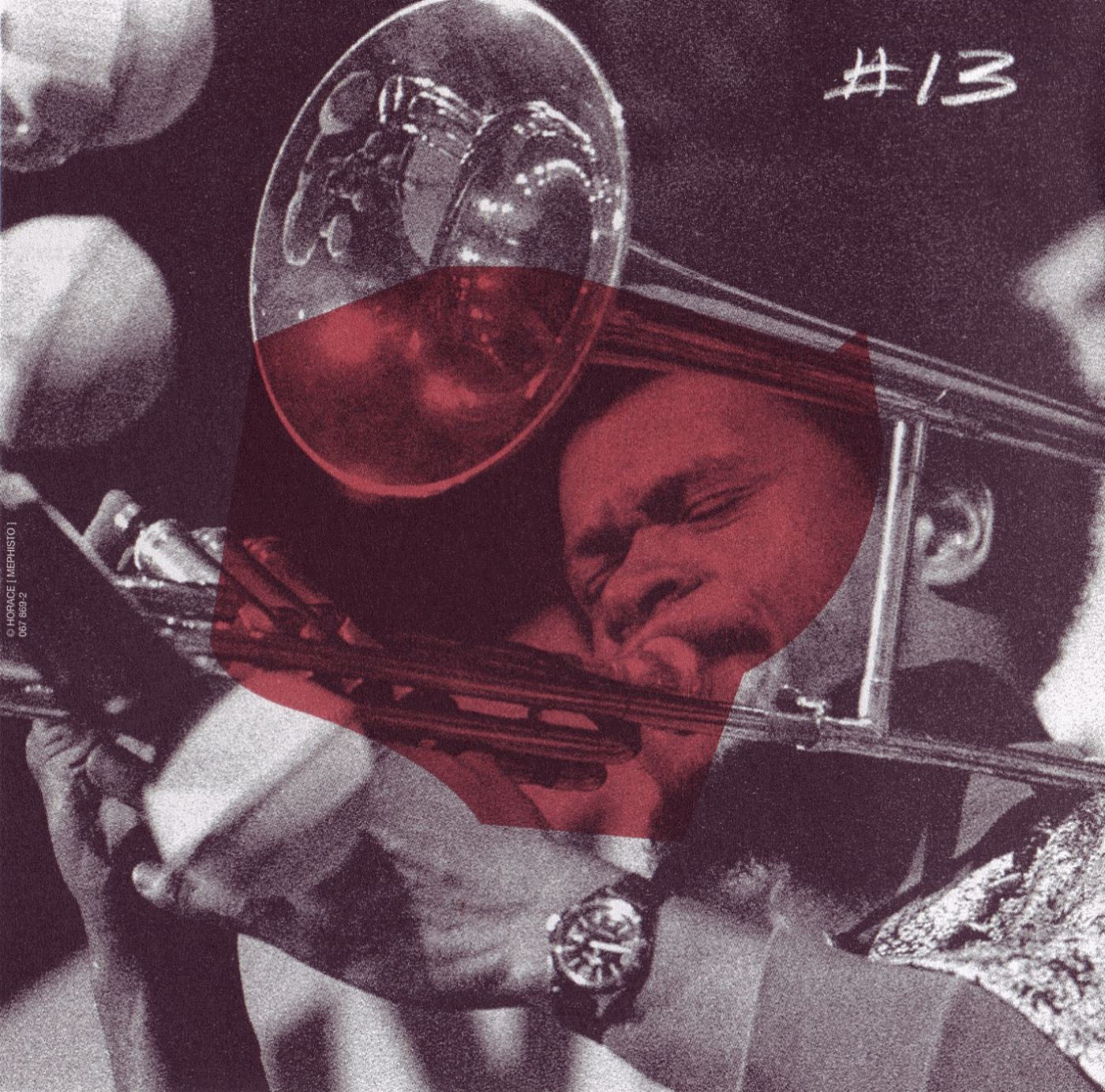
CLIFFORD THORNTON QUARTET – The Panther And The Lash (1970) - Re-2004


Label: America Records – 067 869-2
Series: Free America – #13
Format: CD, Album, Reissue, Remastered, Limited Edition
Country: France - Released: 2004
Style: Free Jazz, Free Improvisation
Live concert at "La Maison de la Radio" (ORTF) Paris on November 7, 1970
Art Direction, Design, Painting – Gilles Guerlet, Jérôme Witz
Liner Notes – Philippe Carles
Photography By [Paintings] – Fredéric Thomas
Producer – Pierre Berjot
Reissue Producer [Prepared For Reissue By] – Bruno Guermonprez
Supervised By [Reissue] – Daniel Richard
Transferred By [Transfers], Mastered By [Mastering] – Alexis Frenkel


The album title, referencing the first truly great anthology of poetry written by an African- American, Langston Hughes's 1926 book of the same name, nails Clifford Thornton's political colors firmly to the mast, and they're black. Described, with some justification, by Philippe Carles, the co-author of the seminal Free Jazz Black Power, as the quintessential free jazz performer, Thornton is in absolutely breathtaking form throughout this live set recorded in Paris on November 7, 1970, on which he plays not only the cornet but also trombone, piano, percussion, and shenai, accompanied by the cream of the crop of the local free music warriors, pianist François Tusques and bassist Beb Guérin, as well as the woefully under- recorded American expat drummer Noel McGhie. It's one of the highlights of the America back catalog and its reissue is cause for celebration. Thornton was able, in an all too brief career (he died in Geneva in relative obscurity in 1989), to sign three truly great free jazz albums under his own name. The Panther and the Lash fills the gap between Freedom & Unity (recorded on the day after Coltrane's funeral in 1967, reissued by Atavistic in 2001) and 1975's Jazz Composers Orchestra outing The Gardens of Harlem (JCOA), and is just as indispensable. _ (AMG)


Enjoy. This is one incredible recording.


Links in Comments!

Thursday, November 28, 2013

ARCHIE SHEPP / CLAUDE DELCLOO and the FULL MOON ENSEMBLE – Live In Antibes Vol.1 & Vol.2 (LPs-1971)


Label: BYG Records – 529.338  -  (vol. 1)
Series: Actuel – 38 Format: Vinyl, LP, Country: France/US - Released: 1971
Style: Free Jazz, Free Improvisation, Avant-garde Jazz
Recorded live at Antibes - Juan les Pins Jazz Festival, July 18, 1970, by O.R.T.F.
Producer – Jean Georgakarakos, Jean-Luc Young

Archie Shepp And The Full Moon Ensemble:
CLIFFORD THORNTON (trumpet, piano), ALAN SHORTER (flugelhorn), ARCHIE SHEPP (tenor saxophone, piano, recitation), JOSEPH DÉJAN (guitar), BEB GUÉRIN (bass) CLAUDE DELCLOO (drums)

A - The Early Bird (Part 1)  -  22:16
B - The Early Bird (Part 2)  -  26:31


Superb live recordings (dated July 18 and July 20, 1970) captured in France at the Antibes- Juan Le Pen Jazz Festival. Archie Shepp and the Full Moon Ensemble (featuring Clifford Thornton on piano and trumpet, Beb Guerin on bass and Claude Delcloo on drums) play through four long tracks with an intensity that still sounds fresh more than four decades later."


Label: BYG Records – 529.339  -  (vol. 2)
Series: Actuel – 39 Format: Vinyl, LP; Country: France/US - Released: 1971
Style: Free Jazz, Free Improvisation, Avant-garde Jazz
Recorded live at "Antibes - Juan-les-Pins" Jazz Festival, July 20, 1970, by O.R.T.F.
Producer – Jean Georgakarakos, Jean-Luc Young

Archie Shepp And The Full Moon Ensemble:
CLIFFORD THORNTON (trumpet, piano), ALAN SHORTER (flugelhorn), ARCHIE SHEPP (tenor saxophone, piano, recitation), JOSEPH DÉJAN (guitar), BEB GUÉRIN (bass) CLAUDE DELCLOO (drums)

A1 - Huru (Part 1)  -  26:15
B1 - Huru (Part 2)  -  22:40


Like many saxophonists and jazz musicians in general, Archie Shepp moved to New York City in 1959 in search of becoming a professional musician. Things moved slowly, but by 1965 he had performed with pianist Cecil Taylor and had made the acquaintance of several musicians in the burgeoning free jazz or "new thing" cadre. Most importantly was his relationship with the great saxophonist John Coltrane who recommended him for Impulse Records. Shepp recorded for about a decade with Impulse, but also for other labels like BYG/Actuel which released this concert featuring Shepp on tenor saxophone, piano and vocals, Clifford Thornton on trumpet and piano, Alan Shorter on flugelhorn, Joseph Dejean on guitar, Beb Guerin on bass and Claude Delcloo on drums. The album is taken from two concerts at the French jazz festival in 1970 with "The Early Bird: Parts 1 and 2" on the Vol. 1 and then "Huru: Parts 1 and 2" on the Vol. 2. The music is very wide open and seems use piano as its anchor, with either Shepp or Thornton laying down massive slabs of dark keyboards that lock in with the deeply percussive bass and drums to give the music a haunting and hypnotic effect. Shepp takes a lengthy saxophone solo on "Huru: Part One" where he ranges from deep guttural moans to high energy squalls and howls. "The Early Bird" he incorporates vocals and shouts from his composition "Mama Rose" into the overall fabric of the performance. This is a very interesting and freewheeling set of music. It is a fine example of the way that jazz had evolved in the early 1970's. Incorporating elements of African music as well as the past and present in jazz, it makes for compelling listening.

_ By Tim Niland (MusicandMore)
http://jazzandblues.blogspot.com/2013/07/archie-shepp-and-full-moon-ensemble.html


Links in Comments!