Showing posts with label Jimmy Lyons. Show all posts

Thursday, April 20, 2017

CECIL TAYLOR – Nuits De La Fondation Maeght Vol. 1 / Vol. 2 / Vol. 3 (3LPs-1972)


Cecil Taylor – Nuits De La Fondation Maeght Vol. 1

Label: Shandar – SR 10011 / 83 507
Format: Vinyl, LP, Album / Country: France / Released: 1972
Style: Free Jazz, Free Improvisation
Recorded live on 29 July 1969 at Saint-Paul-de-Vence, France.
Photography By – Horace, Philippe Gras
Engineer [Sound] – Claude Jauvert
Producer [Conception] – Georges Perdriaud
Sleeve Notes [Inside] – Daniel Caux
Matrix / Runout (Side A): 10011 A [83507A]
Matrix / Runout (Side B): 10011 B [83507B]

A - Second Act Of A ............................................................................... 21:25          
B - Second Act Of A ............................................................................... 19:55

Cecil Taylor – piano
Jimmy Lyons – alto saxophone
Sam Rivers – tenor saxophone, soprano saxophone
Andrew Cyrille – drums, percussion

Nuits De La Fondation Maeght is a live album by Cecil Taylor recorded in St. Paul de Vence, Nice, on July 29, 1969. The album was originally released as Nuits de la Fondation Maeght on the French Shandar label, 3LPs-1971 as a box set.
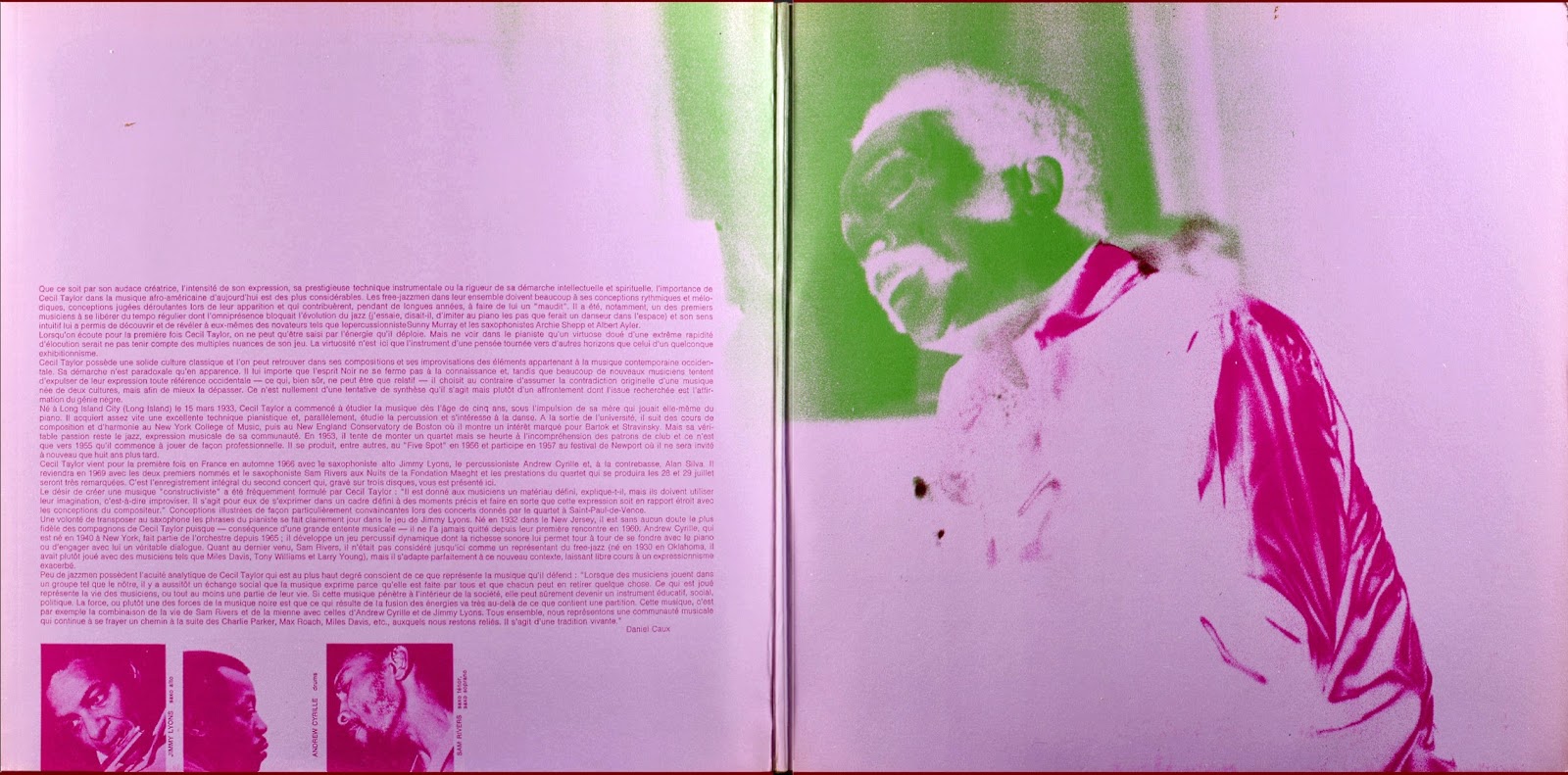
In 1972 the French label Shandar also announced 3 albums individually packaged, Nuits De La Fondation Maeght Vol. 1 / Vol. 2 and Vol. 3. Each has a gatefold cover with same photo but different tint. Black labels with disc logo.


This was a truly magical night for the Taylor unit. The interplay between Lyons and Rivers is impeccable, exploring intervallic reaches of tonal ambience and equanimity. The lack of a bassist in this case is a plus, not a minus, as Taylor gets to indulge his rhythmic impulse to the extreme in order to let the two sax players go into arpeggio overdrive in tandem. The polytonality of Rivers is especially important here as he doesn't so much collide with Lyons, who instinctively knew, in 1969, how Taylor articulated his language, he "extends" him linguistically. Rivers brittle tone on tenor and his shrill soprano engage the steady polyrhythmic attack of Lyons whose ostinato are the cues Taylor takes for his own when moving the piano into solo position. And the two horns find the striated expanses of sonic terrain Taylor prepares them for. And Cyrille knows just how to escalate; the result is no less spectacular than John Coltrane and Pharaoh Sanders on Live in Seattle -- the only real difference is, it's Taylor who does the yelling and shouting when the music gets to the outer limits and can't express what he needs it to. The great Paris concert in its entirety is a Taylor masterpiece.
(Review by Thom Jurek)


Cecil Taylor – Nuits De La Fondation Maeght Vol. 2

Label: Shandar – 83 508
Format: Vinyl, LP, Album / Country: France / Released: 1972
Style: Free Jazz, Free Improvisation
Recorded live on 29 July 1969 at Saint-Paul-de-Vence, France.
Photography By – Horace, Philippe Gras
Engineer [Sound] – Claude Jauvert
Producer [Conception] – Georges Perdriaud
Sleeve Notes [Inside] – Daniel Caux
Matrix / Runout (Side A): NPO SR 83508A
Matrix / Runout (Side B): NPO SR 83508B

A - Second Act Of A ............................................................................... 18:20          
B - Second Act Of A ............................................................................... 16:22


Nuits De La Fondation Maeght, trilogy recordings (for me) is his best work from a particularly enigmatic period. Taylor was playing sprawling immeasurably intense reckless refulgence & asymmetrical avant wizardry with the insane Andrew Cyrille, for me indubitably one of the most fantastic & original drummers ever. Out of the many things that could be said, I would emphasise that Taylor & his unit redefined the elongated-outburst & prolonged-peaking coming with ceaseless surging’s of unparalleled clamour & volatility. Frequently without intervals, extenuation or cessation they would dance an immensely detailed & dynamic squall within the singularity of remorseless & unforgiving outermost, fully-cyclic, hell-for-leather frenzy. A heteronomous hurricane & blitzing blizzard of ebullient fulmination Cyrille was able to maintain physically these momentous requirements but also inflect with a cycle of extensive improvisational embellishment & continually capricious contrasting...


Cecil Taylor – Nuits De La Fondation Maeght Vol. 3

Label: Shandar – 83 509
Format: Vinyl, LP, Album / Country: France / Released: 1972
Style: Free Jazz, Free Improvisation
Recorded live on 29 July 1969 at Saint-Paul-de-Vence, France.
Photography By– Horace, Philippe Gras
Engineer [Sound] – Claude Jauvert
Producer [Conception] – Georges Perdriaud
Sleeve Notes [Inside] – Daniel Caux
Matrix / Runout (Side A): NPO SR 83509A
Matrix / Runout (Side B): NPO SR 83509B

A - Second Act Of A ............................................................................... 13:00          
B - Second Act Of A ............................................................................... 20:00

...Taylor’s closest adjutant saxophonist Jimmy Lyon’s would also duck in & out with sax screel & hysteria. These Olympic stints of decadent comminute went way beyond the threshold, agreeable limitation or somatic restriction that pretty much everybody else was on, with an unapologetic & frankly extremist activity/ideology of severe surplus pandemonium & improvident forceful action whilst exercising immense technical credibility. Many a marvel of withering extravagance was being exercised by other legends during this great era, but this lot did it, to my knowledge, longer & harder without intermission including mostly for each individual musician (consecutive group participation), never slacking & all exploding into one sustained shock-wave of terrific turbulence. these recordings though, do offer the secondary function of a more Avant-Garde slower & emotionally alternate medium occasionally with vocal extracts from Taylor. They are stunning diverse & intricate but also often bizarre. This is another phenomenon of Cecil Taylor & much of his music, lyrics & imagery. It’s dark, I would say at times even quite minatory. Much of the furore from the depths of Free Jazz’s sonic battle field encompassed anger, madness & intensity are as a commodity, but Taylor as with Sunny Murray often depicts & conjures stuff that I would not feel at error calling nasty, dark, or threatening in a direct & mostly unequivocal manner...


...Yes, for me, tones of hazard, tragedy & outright tenebrous madness etc are very apparent (hell, it could be just my misinterpretation, but I feel these elements skulk within his work amongst other sentiments & energies of a far more positive distinction). This is another specialist feature of Taylor & contributes even more to his significant idiosyncrasy. Anyway, as for this mind-blowingly marvellous 3LP set released by Shandar, there is another foreign element/irregularity that kicked shit completely into hyper-space. On these recordings they threw fucking Sam Rivers into the mix! Can you imagine? As if things were not preposterous enough, the absolute madman Rivers was air-dropped into the vortex with his tenor & soprano cannons. The results are just ridiculous & why these recordings are amongst the most precious & heavily rotated in my stash. Unfortunately, to my knowledge, no further foray frenzy was created with Rivers after this tour. Thank the goddess that someone was recording & captured this brain scattering murrain so expertly & issued it in this cult vinyl trilogy...

Enjoy!


If you find them, buy these albums!

Saturday, May 9, 2015

WILDFLOWERS 4 – The New York Loft Jazz Sessions (Douglas / LP4-1977)


Label: Douglas – NBLP 7048
Series: Wildflowers: The New York Loft Jazz Sessions – 4
Format: Vinyl, LP, Album / Country: US / Released: 1977
Style: Free Jazz, Free Improvisation
Recorded May 14 thru May 23, 1976 at Studio Rivbea, 24 Bond Street, New York.
Engineer [Assistant] – Les Kahn
Engineer [Chief] – Ron Saint Germain
Engineer [Remote Assistant] – Matt Murray
Executive-producer – Harley I. Lewin
Liner Notes – Ross Firestone
Mastered By – Ray Janos
Photography By – Peter Harron
Producer – Alan Douglas, Michael Cuscuna, Sam Rivers

A1 - Hamiet Bluiett – Tranquil Beauty ....................................................... 6:30
         Baritone Saxophone, Clarinet – Hamiet Bluiett
         Bass – Juney Booth
         Drums – Charles Bobo Shaw, Don Moye
         Guitar – Billy Patterson, Butch Campbell
         Trumpet – Olu Dara

A2 - Julius Hemphill – Pensive ................................................................. 10:00
         Alto Saxophone – Julius Hemphill
         Cello – Abdul Wadud
         Drums – Phillip Wilson
         Guitar – Bern Nix
         Percussion – Don Moye

B1 - Jimmy Lyons – Push Pull ................................................................... 5:20
         Alto Saxophone – Jimmy Lyons
         Bass – Hayes Burnett
         Bassoon – Karen Borca
         Drums – Henry Maxwell Letcher

B2 - Oliver Lake – Zaki .............................................................................. 9:30
         Alto Saxophone – Oliver Lake
         Bass – Fred Hopkins
         Drums – Phillip Wilson
         Electric Guitar – Michael Jackson

B3 - David Murray – Shout Song ............................................................... 2:30
         Bass – Fred Hopkins
         Drums – Stanley Crouch
         Tenor Saxophone – David Murray
         Trumpet, Flugelhorn – Olu Dara

...The common critical consensus is that the 1970s, particularly the latter half of the decade, were the historical low point for jazz in America. Very few albums survive from that era, compared with the avalanches of reissues and vault clearing box-sets of 1950s and 60s groups. Part of this is, of course, due to the short shrift granted the avant-garde by most jazz historians. The music of the so-called "New Thing," which by rote doctrine had burned itself out by 1968, in fact continued throughout the 1970s, expanding to Europe in search of audiences and growing and evolving artistically to astonishing levels of power and beauty...

The 5-LPs set Wildflowers documents one small part of this forgotten music scene. Recorded over ten days in May 1976 at Sam Rivers’s Studio RivBea, this set contains an overwhelming amount of truly beautiful jazz performances, by names recognizable to almost anyone with a serious interest in the music. Saxophonists include Sam Rivers, David Murray, David S. Ware, Roscoe Mitchell, Anthony Braxton, Byard Lancaster, Oliver Lake, Jimmy Lyons, Julius Hemphill and Henry Threadgill. Drummers include Sunny Murray, Don Moye, Steve McCall, Andrew Cyrille, and Stanley Crouch. Bassist Fred Hopkins is practically omnipresent here...


If you find it, buy this album!

Monday, January 20, 2014

JIMMY LYONS – The Box Set (5CDs-1972/'85) - ayler-2003


Label: Ayler Records – aylCD-036 - 040
Format: 5 × CD, Album, Box Set, Limited Edition
Country: Sweden - Released: 2003
Style: Free Jazz, Free Improvisation
Cover [Cover Art], Design – Åke Bjurhamn
Engineer – Joe Walker (tracks: 1-1 to 3-1), Judy Schwartz (tracks: 5-1 to 5-7), Verna Gillis (tracks: 3-2 to 3-7)
Executive-Producer – Jan Ström
Photography By – Chris Green, Jerry Kambisis, Lona Foote, Maryanne Driscoll, Nils Edström, Willard Taylor
Producer [Concert-producer] – Bea Rivers (tracks: 1-1 to 3-1), Chris Rich (tracks: 5-1 to 5-7), Sam Rivers (tracks: 1-1 to 3-1), Verna Gillis (tracks: 3-2 to 3-7)
Remastered By – Per Ruthström
Transferred By, Mastered By, Liner Notes – Ben Young


Jimmy Lyons is one of the most intriguing musicians to emerge in the 1960s, as the alto saxophonist provided one of the strongest links between bebop and the New Thing. Unlike many of the movement's provincially raised exponents, Lyons spent his formative years in New York, where he was able to jam with the likes of Cannonball Adderley and Elmo Hope before his historic, quarter-century association with Cecil Taylor began in 1961. Unlike some of his contemporaries, Lyons' solos were about not just notes but phrases: short, jolting cries and serpentine, blues-drenched lines passionately and expertly strung together. There is no more direct route connecting Charlie Parker to the '60s and its ongoing aftermath than Jimmy Lyons.

Yet this did not initially benefit Lyons, who, for a number of reasons, was slow to make his own records. After balking at an offer of a Prestige date in '61, Lyons had to wait until 1969, and then only made the minor classic Other Afternoons (BYG/Actuel) because of the last- minute cancellation of a Taylor-led session. Gaining traction as the leader of working bands took even longer. Lyons' units worked primarily in the New York loft scene until well into the '70s, and it was only a few years before his death in 1986 that Lyons found a steady outlet for their music with the Black Saint label. Still, Lyons left a sufficient body of work for him to be considered a major voice in his own right, a legacy significantly enhanced by The Box Set, a five-CD collection of ensemble and solo concerts spanning the years 1972 to '85.

In a 1978 interview excerpt with WKCR programmer Taylor Storer that is included in the collection, Lyons states that he saw few distinctions between composition and improvisation, a sensibility no doubt reinforced by his association with Cecil Taylor. However, Lyons pursued this position through conventionally formatted pieces, with themes usually stated in unison by the front line. The evolution of his thematic materials is an important thread of this collection, one that is potentially overlooked given the wealth of impassioned performances. The earliest concert, a '72 Studio Rivbea set with trumpeter Raphe Malik, bass player Hayes Burnett and drummer Sidney Smart, reveals Lyons to be navigating several overlapping currents. The tune that came to be Lyons' signature, "Jump Up," is a revving motivic line somewhat in the vein of Sonny Rollins' "East Broadway Run Down." "Mr. 1-2-5 Street" shows adeptness at the early Ornette Coleman gambit of gluing together fragmentary phrases with buoyant rhythmic shifts. And "Ballad 1" initially drifts toward Coleman and then veers with a Coltrane-ish phrase.

Largely because of his alto's central role, Lyons' pieces never seem derivative. The saxophonist bonded a jabbing attack and a plaintive tone in an instantly recognizable manner, and everything he wrote flowed from the resulting soul-stirring sound. This is most evident in the hour-plus solo concert recorded in '81 at Soundscape. It is simply engrossing to hear Lyons' sense of design morph effortlessly into cascading improvisations without being triggered by the abrupt abandonment of the theme by a second horn or the on-cue stretching of the rhythm section. This is not to suggest that Lyons could not achieve comparable results at the helm of a small group, a fact attested to by the expansive '75 trio outing with Burnett and drummer Henry Letcher. Still, this 90-minute Studio Rivbea workout does not represent Lyons' music at its pinnacle.
It takes the enlistment of two musicians outside the New York loft scene for Lyons' ensemble sound to reach full maturity. One is Paul Murphy, a drummer whose relentless drive and conservatory-honed precision and agility could single-handedly propel Lyons' music, as confirmed by a bass-less 1984 concert recorded in Geneva. However, the crucial catalytic voice in Lyons' group was bassoonist Karen Borca, the most dazzling double-reed player in jazz history. Not only did Borca's throaty chortle perfectly complement Lyons' tone, her virtuosity gave Lyons the latitude to ratchet up the degree of difficulty of his rapid-fire themes and to explore contrapuntal writing. On both the Geneva concert and the '85 Brown University concert that closes this set (with the now omnipresent William Parker rounding out the quartet), Borca's subwooferlike rumble in the heads and her high-voltage solos prove to be essential to Lyons' music.

All in all, The Box Set is a triumph.

_ By BILL SHOEMAKER, JazzTimes


Links in Comments!

Thursday, December 12, 2013

JOEL FUTTERMAN / JIMMY LYONS / RICHARD DAVIS / ROBERT ADKINS – Inneraction (LP-1984)


Label: JDF – NDEJJ-3
Format: Vinyl, LP, Album; Country: US - Released: 1984 
Style: Free Jazz,  Free Improvisation
Recorded At – Mastersound, New York, release date: 1/1/1984
Engineer – Stephen Peppos
Painting – Joseph Schwarzbaum
Photography By – Linda Wood

Very rare vinyl record. Great free jazz musicians with the legendary alto of Jimmy Lyons.

A  -  Inneraction Part 1 ............................................................ 20:02
B1 - Inneraction Part 1 Cont. .................................................. 13:25
B2 - Inneraction Part 2 .............................................................. 6:32

JOEL FUTTERMAN - piano
JIMMY LYONS - alto sax
RICHARD DAVIS - bass
ROBERT ADKINS - drums


Futterman, a Chicago native who now resides in the East, is one of the few pianists who has the mental and physical equipment to be usefully influenced by Cecil Taylor.

His group here (alto saxophonist Jimmy Lyons, bassist Ricard Davis, drummer Robert Adkins) mirrors the basic sound of the many Taylor units that have had Lyons as their horn voice, and Futterman also strives for Taylor`s aura of near-unrelieved, breakneck intensity.

It`s much to the leader`s credit, though, that the results sound more personal than one might expect--perhaps because the challenge of playing in this manner is so extreme that, amid the blizzard of Taylor-esque patterns, Futterman`s own vision eventually has to emerge.


Completely new FLAC rip. I think you'll be satisfied.
Enjoy!


Link in Comments! 
If you find it, buy this album!

Thursday, December 5, 2013

The UNIT: CECIL TAYLOR in 1978 – "Cecil Taylor Unit" (LP-1978), "3 Phasis" and "Live In The Black Forest", LPs-1979


Label: New World Records – NW 201
Format: Vinyl, LP, Album; Country: US - Released: 1978
Style: Free Jazz, Avantgarde, Free Improvisation
Recorded in April 1978 at Columbia Recording Studios, 30th Street, New York, NY.
Artwork [Cover] – David X. Young; Design [Cover] – Elaine Sherer Cox
Engineer [Recording, Editing, Mixing] – Don Puluse
Mastered By – Ted Jensen

A1 - Idut  14:40
A2 - Serdab  14:13
B - Holiday En Masque  29:41

Cecil Taylor (piano) Jimmy Lyons (alto saxophone) Raphe Malik (trumpet) Ramsey Ameen (violin) Sirone (bass) Ronald Shannon Jackson (drums)

The Cecil Taylor Unit (band and album) announces itself with “ Idut, ” a piece running just under 15 minutes. The first sound we hear is Ameen’s violin, bolstered by Sirone’s bowed bass. The two men attack the strings in sharp and jagged fashion, reminiscent of an Elliott Carter string quartet. After a few seconds, Malik’s trumpet enters, a fountain of rich, full notes like a fanfare announcing a king. Lyons, for his part, offers boppish phrases full of life and joy. This is an erupting music.

Behind everything else, Taylor is there, striking the keyboard with great force, rumbling at the low end of a ninety-six key Bösendorfer, similar to the instrument he plays on the solo albums Air Above Mountains and The Willisau Concert, from 1975 and 2000 respectively. This is an imposing instrument, the ideal vehicle for a player of Taylor’s intensity and rigor. But it’s best heard by itself; surrounded by other sounds, its strength is diminished slightly. At the 90- second mark, when all the other instruments drop away, leaving only the piano, the purpose of all that hurtling exposition becomes clear—the band was setting the stage for Taylor, whose high-speed runs and teeth-rattling rumbles are accented by thunderous rolls from Ronald Shannon Jackson. The piece shifts again and again in this manner, offering solo piano passages, duos between Taylor and various other bandmembers, duos and trios, and explosive sections involving the entire band.

The album’s second track, “ Serdab, ” is much quieter. There are still moments of thrilling fire and fury, but Taylor’s solo passages are longer and more frequent, with Jackson pitter-patting behind him, creating rhythm (he ’ s a totally unique jazz drummer in that he plays marching-band and militaristic rhythms as often as he swings or grooves) without imposing it. It’s an interlude of gentle beauty, a bridge between the opening fanfare and thunder of “ Idut ” and the cataclysm that is the album’s second half.

“ Holiday en Masque ” is a half-hour, album-side-long avalanche of sound. The liner notes to the album, written by Spencer Richards , describe it as a “ masterful achievement in ensemble playing, ” and it truly is that and more. The dominant voices are Taylor’s and Ameen’s, with Jackson rattling and crashing in the back. At times the horns and strings and piano are so loud the drums can barely be discerned, even though they’re being played with as much energy as any other instrument in the studio. At other times, Jackson’s rhythms are quite clearly audible, his kit sounding more like one belonging to a hard rock drummer than a jazz player. He’s got a massive kick drum sound going on, and his toms slam like heavy wooden doors battered by a hurricane. Unison passages, arising out of the overall storm of sound like rainbows arcing between thunderclouds, reveal the scored nature of this music and the intense, focused rehearsals Taylor called before the recording began. As Ameen, who also contributed liner notes to The Cecil Taylor Unit (and was the only member of the band to do so), points out, “ Because in fact he has continued to make music of overwhelming originality, Cecil Taylor has been increasingly successful in exercising his right to determine the working conditions such music requires—in particular, pianos of the best quality, and extensive practice and rehearsal…This record was prepared under Taylor’s artistic direction and is a document not only of his power of musical expression but also of the success of the comprehensive working methods and the fierce independence he has developed and maintained during the past quarter of a century. ”


Label: New World Records – NW 303
Format: Vinyl, LP, Album; Country: US - Released: 1979
Style: Free Jazz, Avantgarde, Free Improvisation
Recorded in April 1978 at Columbia Recording Studios, 30th Street, New York, NY.
Artwork [Cover] – Paul Jenkins; Design [Cover] – Michael Sonino
Engineer – Don Puluse
Mastered By – Ted Jensen

A - 3 Phasis, Side One  28:22
B - 3 Phasis, Side Two  28:50

Cecil Taylor (piano) Jimmy Lyons (alto saxophone) Raphe Malik (trumpet) Ramsey Ameen (violin) Sirone (bass) Ronald Shannon Jackson (drums)

The second album by this group, 3 Phasis, was recorded on the final day of the sessions, and the issued take is the final one (of six), a performance that ran beyond the scheduled time and into overtime. According to the album notes by jazz critic Gary Giddins , the earlier versions all ran in the 20-30 minute range. The issued performance is a marathon, even an endurance test, at 57:17, but not a moment of that is wasted on vamping, casting about for inspiration, or anything but the most intense playing of which the group members are capable.

The piece begins with solo piano, but again the strings are the first instruments to join the fray. Ameen and Sirone come in bowing, with Lyons ’ alto saxophone keening romantic ballad melodies, Malik ’ s trumpet squalling in a less florid, more sardonic way than on the previous album…and Jackson announcing his arrival with tremendous, rolling-thunder assertiveness.

The horns keep dropping out, though, and the piece becomes chamber music with drums. Passages of violin and piano, or violin and bass, Ameen jabbing sharply into the airspace between himself and Taylor with shrieks of the bow not unlike Bernard Herrmann ’ s famous score for Alfred Hitchcock ’ s movie Psycho. Ameen adds more than classical filigree to this music, though. He ’ s also prepared to be a hillbilly fiddler when the occasion calls for it, conjuring the spirit of African-American string bands (violin, banjo, upright bass) with a single raucous phrase behind the horns.

Giddins was present at the recording, and wrote the liner notes to the album. He describes the recording engineer’s panic as the take that was eventually released runs longer and longer, finally coming to a halt just shy of the one-hour mark (and consequently nudging the limits of 33 1/3 rpm vinyl’s storage capacity).

“ Previous takes had averaged twenty to thirty minutes and seemed to get tighter each time,” Giddins writes. “ The fifth take produced a splendid array of dynamics and a rollicking dance exuberance, but saxophonist Jimmy Lyons was dissatisfied with his solo, and there was a general feeling that an earlier take had been more successful. Taylor decided to work on some of the other pieces, and it wasn’t until midnight that they returned to the suite. From the first notes, there was an excitement in the studio, an electricity, and after about twenty minutes producer Sam Parkins said, ‘ This is the best yet by far. If Jimmy Lyons holds up in the shuffle, I don’t care how long it goes. ’ Later Parkins noted, ‘ This is more of a piano concerto than the others.’ A significant difference between this and earlier versions was that Sirone, the bassist, who had previously played mostly against the rhythm, now fell into a steady 4/4 shuffle meter (heard in the second half). Taylor conducted the music from the piano without eye contact, as the others stood poised. Lyons, awaiting his entrance, lit a cigarette. Then the shuffle started: Taylor instigated a rocking stomp with chords in both hands; Sirone bore down on the time; drummer Ronald Shannon Jackson alternated between mallets and sticks; Lyons steamed through like a train. After about forty minutes, Parkins exulted, ‘ We’ve got a record now! ’ —but ten minutes later he was worried about whether Taylor would stop in time: ‘ I hope he stops pretty soon, because I’d hate to cut this. I ’ ve never been to anything like this before, have you? ’ Taylor punched out a riff, his hands leaping as fast and deft as a cheetah, his arms almost akimbo. Everyone was eyeing the clock nervously and with giddy excitement. And then, nearing fifty-seven minutes, just short of the maximum playing time for a long-playing album, Taylor began to wind down for a dramatic finish. Observers burst into the studio with excited praise, and the laconic Taylor was heard to say, ‘ Well, you know we knew it was good, too. ’”

Taylor didn’t typically go on the road with the same bands he recorded with. Throughout his career, studio sessions have been relatively rare; live recordings make up the bulk of his discography. But in 1978, he took this Unit on the road for several weeks of shows in Europe, at least three of which were documented, two of them on albums that are among his greatest work.


Label: MPS Records – 0068.220
Format: Vinyl, LP, Album; Country: Germany - Released: 1979
Style: Free Improvisation, Free Jazz
Recorded live on 3 June 1978 in SWF-Radio JazzConcert in Kirchzarten, Black Forest, West Germany.
Artwork – Müller & von Frankenberg
Engineer – Norbert Klövekorn; Producer – Joachim E. Berendt

A - The Eel Pot   24:57
B - Sperichill On Calling   25:08

Cecil Taylor (piano) Jimmy Lyons (alto saxophone) Raphe Malik (trumpet) Ramsey Ameen (violin) Sirone (bass) Ronald Shannon Jackson (drums)

Live in the Black Forest was the first to appear, on the unjustly obscure MPS label. Featuring two 25-minute pieces recorded on June 3 for broadcast on German radio, it’s a somewhat more “ crowd-pleasing ” and less abstruse set of music than the Unit ’ s self-titled debut or the crushing 3 Phasis. The first piece, “ The Eel Pot, ” begins with solo piano, followed quickly by the entry of Malik and Lyons (playing unison phrases) and then Ameen. Jackson hits huge thunderous tom rolls, and the band has become fully present. Then things can truly get started. Piano and trumpet exchanges, violin and alto saxophone tinkering at the margins. Martial drumming. There’s bass work, but it’s not particularly high in the mix at first; only later does Sirone’s forceful plucking assert itself, when the group becomes, of all things, a piano trio, albeit the most aggressive one I’ve ever heard. Jackson is playing something close to a death metal blast beat, as Taylor dances across the keyboard like a maniac and Sirone throbs between them. The next player to re-enter after this thunderous passage is Ameen, offering almost Bela Bartók -like stabs as though to pay tribute to the concert’s central European location. He and Taylor duet passionately, with Sirone still lingering in the background. Eventually, the full ensemble returns to roaring life, and the piece comes to a raucous close, celebrated by wild applause from what sounds like a large audience.

The disc’s second half, “ Sperichill On Calling, ” is more or less in the same spirit as its predecessor, but it’s less aggressive, a midtempo marathon with occasional eruptions. Around the 11-minute mark, Jackson bursts into a particularly aggressive drum solo, smashing the cymbals and battering the snare, as Malik’s trumpet unleashes a repeated, fanfare-like figure. Malik gets a lot of solo space during “ Sperichill, ” his rippling upper-register lines extraordinarily full and vibrant. When Taylor takes the lead, his playing is often quite delicate; during one quiet passage, he and Ameen duet totally unaccompanied, and it’s possibly the album’s high point. Again and again throughout this group’s discography, it becomes unmistakable that the violin is the most important instrument, besides the piano, to the whole project. Two decades later, on Algonquin (recorded 1999, released 2004), Taylor would explore this combination of sounds again, in a live duet with violinist Mat Maneri at the Library of Congress.

_ Story by PHIL FREEMAN

The fourth part see:
http://differentperspectivesinmyroom.blogspot.com/2013/11/cecil-taylor-one-too-many-salty-swift.html


Links in Comments!

Tuesday, November 5, 2013

CECIL TAYLOR – One Too Many Salty Swift and Not Goodbye (3LP-1980)


For Dominique,
I think that's she only lady who visits this blog.

Label: Hat Hut Records – 3R02
Format: 3 × Vinyl, LP, Album Box Set; Country: Switzerland - Released: 1980
Style: Free Jazz, Free Improvisation
Recorded live in concert on 14 June 1978 at Liederhalle/Mozartsaal Stuttgart Germany.
Artwork [Cover] – Klaus Baumgärtner
Edited By – Peter Pfister
Mastered By – David Crawford
Photography By, Liner Notes – Spencer Richards
Producer – Pia Uehlinger
Producer, Edited By – Werner X. Uehlinger
Recorded By – Süddeutscher Rundfunk

... In 1978 Cecil Taylor not only formed a band, he took it into the recording studio (something he hadn’t done since Conquistador!, a dozen years earlier) and on a European tour. The Cecil Taylor Unit of spring and summer 1978 is not only one of the pianist’s most vital ensembles, it’s also unique in its instrumentation, and its development of a collective identity makes it a rarity among his groups. The four releases by this sextet—its self-titled debut; 3 Phasis; and the live albums Live in the Black Forest and One Too Many Salty Swift and Not Goodbye—are among my favorite Cecil Taylor albums, and the subject of this essay.

The group consisted of Taylor; alto saxophonist Jimmy Lyons , his creative foil from 1962 to his death in 1986; trumpeter Raphé Malik ; violinist Ramsey Ameen ; bassist Sirone ; and drummer Ronald Shannon Jackson . Malik, originally from Massachusetts, had played with Frank Wright and the Art Ensemble of Chicago in Paris in the late 1960s, during the great free jazz migration from the US to France that gave the BYG label the majority of its catalog. He met Taylor in the early 1970s, and first appeared on 1976’s Dark to Themselves, alongside Lyons, tenor saxophonist David S. Ware and drummer Marc Edwards . Sirone, born Norris Jones , was from Atlanta, and arrived in New York just in time for the first flowering of the free jazz scene; he recorded with many major players within that milieu, including Albert Ayler , Pharoah Sanders and Marion Brown , for sessions on ESP-Disk and Impulse!, and was one of the three co-founders, along with Leroy Jenkins and Jerome Cooper , of the violin-bass-drums trio the Revolutionary Ensemble . Jackson, a transplanted Texan, was another highly regarded player on the New York out-jazz scene; prior to joining Taylor’s group, he had backed Albert Ayler and been the original drummer for Ornette Coleman’s Prime Time —he can be heard on Dancing in Your Head and Body Meta. Ramsey Ameen is the odd man out in the band. He made his recorded debut with the group’s April 1978 studio sessions, which yielded both the self-titled album and 3 Phasis, and seems to have retired from music sometime in the 1980s. And yet his contributions to this group are crucial, serving as a bridge between avant-garde jazz and 20th Century chamber music. Indeed, if you choose to view bridging that distance as the ultimate purpose and greatest success of this band, as I do, then Ameen is the indispensable man, the one without whom the whole project would collapse...


Eleven days after the recording of Live in the Black Forest, the Cecil Taylor Unit made its most expansive and passionate (and final) statement. On June 14, they performed at the Liederhalle/Mozartsaal in Stuttgart, Germany, an event which was recorded for the mammoth One Too Many Salty Swift and Not Goodbye. It was the final night of a six-week tour, and not all venues and not all presenters were as respectful of the musicians as they should have been. On this night, there was a well-tuned grand piano in the hall that was covered and locked up backstage; the people in charge said it was reserved for classical pianists, and provided Taylor with a less ideal instrument. Similar disrespect was afforded Ramsey Ameen, with the result that he played the show in his undershirt as a form of silent protest. Still, it’s an astonishing musical event, running nearly two and a half hours in total and originally broken up into three vinyl LPs, later reorganized into two 70-plus minute CDs.

Taylor is not even present onstage for the first twenty minutes of music. He allows the other members of the band to begin without him, in a series of duos and solos, steadily building tension and energy so that when he does finally sit at the keyboard, the resulting explosion will be that much greater. First up are Raphé Malik and Jimmy Lyons, offering a four-minute passage of rippling interplay more conventionally melodic than what they’d play as part of the full Unit, yet still exciting; they sound like yelping puppies, cavorting around the stage. Ameen and Sirone follow them, the violinist building from short, tentative tugs at his strings with the bow to longer, more haunted-house phrases. The bassist, meanwhile, plays with a bow as well, at first, though eventually he moves back to plucking the strings by the end of this over 11-minute passage. The last member of the group to make an individual statement is Jackson, whose solo is as crushing and explosive as anything he’d do eight years later with the jazz-metal improvising quartet Last Exit .

Once Taylor strikes the keys, the music becomes overwhelming. I mean that; One Too Many Salty Swift and Not Goodbye is almost too much to take. The performance is continuous; though the untitled piece, simply labeled “ Cecil Taylor Unit ” is divided into five sections (two on the first disc, following the duets and drum solo, and three on the second), the back cover makes it plain:

“ The track points are provided for the listener’s convenience and do not indicate divisions of the work. ”

If you can manage to stagger away to a safe distance and gain some perspective, it becomes apparent that Taylor’s methodology at this concert was the same as in the studio or on Live in the Black Forest. The group fractures into subsets again and again—trumpet/violin, violin/piano, a piano trio, piano trio plus Lyons, even an extended solo piano section to launch the concert’s final half hour. But the ultimate impression is of standing in the path of an avalanche. Every player included is hitting so hard, emitting so much raw energy, that to listen to the entire performance in one sitting is the kind of thing that should earn a person a trophy or a plaque. One Too Many is a fitting capper to this band’s short life, because when it finally ends, you can be forgiven for believing you’ve heard all the music your brain will ever be able to store, by Cecil Taylor or anyone else, for the rest of your life.

Should you want more, though, there’s one more document of this band out there, and to my mind it’s maybe the most important one of all. On June 10, seven days after Live in the Black Forest and four days before One Too Many, the group performed in the Grosser Sendesaal (main hall) of the Funkhaus in Köln. This performance (an hour of it, at any rate) must have been recorded for German radio, because a pristine tape has been circulating in bootleg form for decades. Naturally, it’s readily available on the Internet.

The bootleg recording isn’t ideal. The sound quality is pristine, mind you—every instrument is clear and isolated in the mix, allowing as careful an analysis of each member’s contribution as is possible with the studio recordings. But the music cuts off after an hour, and it’s obvious from what was going on when it ends that there was much more heard that night. Also, the version I have splits the second of the two pieces performed ( “ Third Part of One ” and “ Third Worlds Making ” ) into two chunks, with nearly 10 seconds of silence in the middle. But once you get past those two flaws, the Funkhaus performance is genuinely revelatory, for one huge reason: Cecil Taylor plays the blues.

Not for the whole hour, of course. For the majority of the time, the ensemble conducts themselves as they do on each of their other recordings, thundering along together or splitting into factions. But about ten minutes into “ Third Part of One, ” right in the middle of a powerful burst of Jimmy Garrison -esque strumming from Sirone, Ronald Shannon Jackson begins to smash the hi-hat in a forceful, swinging pattern, and all of a sudden Taylor begins comping like he hasn’t (on record, anyway) since about 1960! Lyons and Malik come in, blowing the blues, and Ameen plucks his strings like a high-pitched guitar, as Sirone walks the whole thing forward and the drums clatter out an even more emphatic beat, one almost recalling Art Blakey . The whole band continues like this for an astonishingly long time, Taylor finally returning to his usual cascades of notes somewhere around the 14-minute mark. But Lyons continues to solo in a lyrical, even somewhat romantic manner, and Sirone and Jackson keep the groove going, until nearly 15 minutes into the piece. And when the drummer does abandon swing, it’s only so that he can take a jackhammering solo of his own. Of all the things this sextet did on record and in concert, this patch of (almost) straight-up hard bop may be the most shocking, and in some ways it puts everything else into an entirely different light.

The 1978 Cecil Taylor Unit was about connecting the dots—about joining blues and swing to modern classical and free jazz, about making it all sing as one. Where the studio albums could be bombastic and crisp at the same time, the live albums had a stark beauty born of subdividing the ensemble into its component parts, the better to reveal the power of the whole. This band’s short lifespan kept its music from stagnating; they never had time to develop rote bits of business, or clichés to endlessly re-work. They burned like a white-hot flame, and then they dissipated. Ameen remained with Taylor through 1979; Lyons through his death in 1986. The others went on to long, productive careers—Malik and Sirone are dead now, but Jackson’s still out there, hitting as hard as ever. And of course, Taylor continues to perform, taking listeners on epic journeys every time he sits down at the piano. I’ve seen him perform four times with ensembles of varying sizes, and own dozens of his albums. But for me, this band might be his ultimate achievement.


Links in Comments!