Showing posts with label Mike Kull. Show all posts

Saturday, April 1, 2017

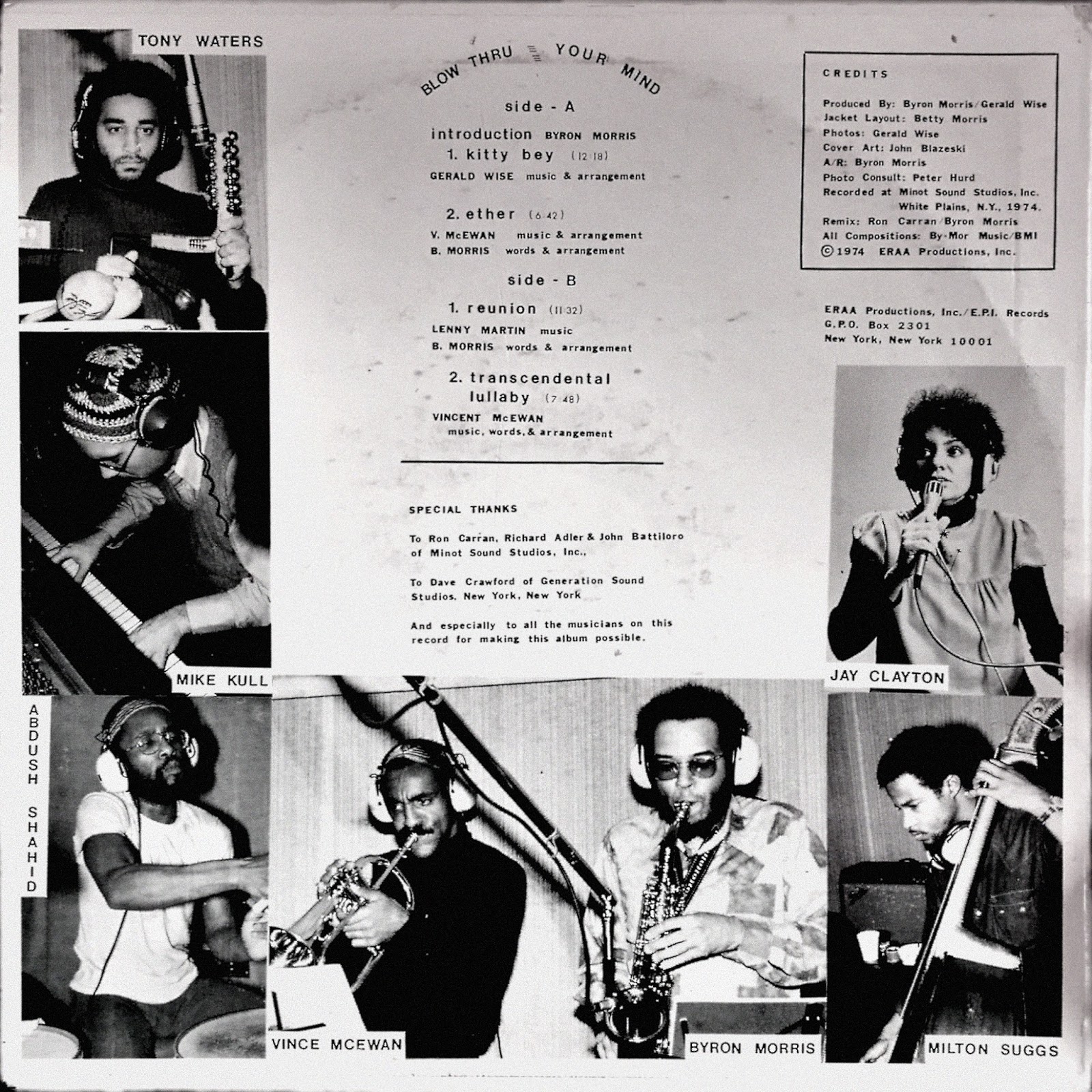
UNITY / BYRON MORRIS – Blow Thru Your Mind (E.P.I. Rec - EPI-02 / LP-1974)


Label: E.P.I. Records – EPI-02
Format: Vinyl, LP, Album / Country: US / Released: 1974
Style: Free Improvisation, Modal
Recorded on December 30, 1973, at Minot Sound Studios, White Plains, NY.
Cover [Cover Art] – John Blazeski
Photos By – Gerald Wise
Photography By [Photo Consult] – Peter Hurd
Layout – Betty Morris
Mixed By – Byron Morris, Ron Carran
Producer – Byron Morris, Gerald Wise
Matrix / Runout (Side A): EPI-02-A
Matrix / Runout (Side B): EPI-02-B

A1 - Kitty Bey ............................................................................................. 12:25
A2 - Ether ..................................................................................................... 6:20
B1 - Reunion .............................................................................................. 11:40
B2 - Transcendental Lullaby ........................................................................ 7:00

Personnel:
Byron Morris – baritone saxophone, alto saxophone
Vince McEwan – trumpet
Mike Kull – piano
Jay Clayton – vocals
Milton Suggs – bass
Abdush Shahid – drums
Tony Waters – percussion, congas, maracas

The music on this LP is excellent. A major departure from the dissonant free jazz that Morris explored on 1969's Unity session, Blow Thru Your Mind contains modal post-bop that is melodic and relatively accessible. This is a very spiritual album; a lot of spirituality goes into the solos of Morris and trumpeter Vincent McEwan, as well as the ethereal vocals of female singer Jay Clayton (who is featured on tracks like "Ether," "Reunion," and "Transcendental Lullaby"). Blow Thru Your Mind is enthusiastically recommended to anyone who is seriously into modal jazz...


Byron Morris and Unity released Blow Through Your Mind originally in the US in 1974. 
The LP was recorded a year earlier at Minot Sound Studios in White Plains, New York. This studio was a favorite with many independent Jazz groups at this time -- for instance, many recordings for the independent Strata East Records, co-owned by Stanley Cowell and Charles Tolliver, were made here. Unity was formed with similar values, aims and objectives of many similar groups at the time, as the name suggests. Uniquely, it managed to match the musical and spiritual searching of John Coltrane, Pharoah Sanders and Ornette Coleman alongside an equally experimental New York art-music dimension that was brought into the group by vocalist Jay Clayton, who has performed with, amongst many others, Steve Reich. With bassist Milton Suggs having played in Sun Ra's Arkestra, and Byron Morris studied with Ornette Coleman and Rahsaan Roland Kirk, it is possible to see the path that makes up 'Kitty Bey', twelve minutes of musical intensity, that sounds like nothing else ever recorded. 
Kitty Bey was originally featured on Universal Sounds Of America on Soul Jazz. Originally released on Unity's own EPI label and distributed by hand, this record has remained an underground classic recording for over 25 years?......


Note:
Blow Thru Your Mind, which first came out on vinyl in 1974, was EPI's second release. In 2002, Blow Thru Your Mind and Morris' next album, Vibrations, Themes and Serenades, were both reissued on CD by Céleste Music (a Japanese label). But those Céleste reissues weren't the first time that Morris' '70s recordings had been heard on CD; in 1994, Morris combined material from Blow Thru Your Mind and Vibrations.
Unfortunately, all of these re-releases have long ago are out-of-print.

Review by Alex Henderson


If you find it, buy this album!

Sunday, June 22, 2014

JOE McPHEE and SURVIVAL UNIT II – At WBAI's Free Music Store, 1971 (CD / hat ART-1996)


Label: hat ART – hat ART CD 6197
Format: CD, Album, Limited Edition; Country: Switzerland - Released: 1996
Style: Free Jazz, Free Improvisation
Recorded At WBAI's Free Music Store, N.Y. N.Y., October 30, 1971.
Design Concept [Graphic Concept] – fuhrer vienna
Liner Notes – Chris Albertson, Joe McPhee
Liner Notes [Producers Note] – Werner X. Uehlinger
Mixed By [Mix], Mastered By [CD Master] – Peter Pfister
Photography By [Photo] – Ken Brunton
Producer – Pia And Werner X. Uehlinger
Recorded By – Chris Albertson

The Hat Art label (Werner X. Uehlinger) was formed in the mid-'70s partly to document the music of multi-instrumentalist Joe McPhee. The tapes of this live concert, which was broadcast by the small New York radio station WBAI, were released for the first time on this 1996 CD. Doubling on tenor and trumpet, McPhee is joined by Clifford Thornton (heard on baritone horn and cornet), Byron Morris (on soprano and alto), pianist Mike Kull, and percussionist Harold E. Smith. Due to the passionate nature of much of this fairly free music and the use of Thornton's baritone horn, one does not really notice the absence of a string bass. The six lengthy pieces (which are sandwiched by somewhat stilted announcing) are full of fire but also have their quiet and lyrical moments. A strong all-around performance that should not have taken 25 years to release.


McPhee – the Poughkeepsie-based saxophonist/trumpeter/composer – came on the scene in the late 1960s and appeared on a now-reissued recording by his mentor Clifford Thornton (whose Gardens of Harlem is in desperate need of reissue, by the way). After a few releases on CJR (all now available on Atavistic’s Unheard Music Series), Uehlinger released McPhee’s Black Magic Man and the relationship has existed ever since, resulting in some of the finest improvised music of the period. The music – by McPhee on tenor and trumpet, Thornton on baritone horn, Byron Morris on soprano and alto, Mike Kull on piano, and Harold E. Smith on percussion – is hot and intense, coming straight from McPhee’s most fiery period. It features the core of McPhee’s repertory at the time, including the acetylene torch intensity of “Black Magic Man,” the declamatory “Nation Time” (where the horns blend with wonderful color), and the gorgeous ballad “Song for Lauren,” where McPhee really begins to establish his powerful lyric strain that would become so recognizable on later recordings. McPhee already sounds in full command of his horns – listen to his lovely trumpet intro to “Message from Denmark” – and the band sounds great too (the underrated Kull just crushes on “The Looking Glass I”). They’re at their most powerful on the intensely dark rise-and-fall of “Harriet,” an exceptional document of free improvisation from one of the music’s true masters.
_ By JASON BIVINS, 1996

hat Hut catalog:  http://www.hathut.com/home.html


If you find it, buy this album!