Friday, May 16, 2014

INTERMISSION – Live In Bimhuis, Amsterdam, December 6, 2008


Label: Private Recording / DP-0821
Format: CD, Album; Released: 2008
Style: Free Improvisation, Free Jazz
VPROJazzLive vanuit het Bimhuis, Amsterdam, The Netherlands
Artwork and Complete Design by ART&JAZZ Studio, by VITKO
December 6, 2008, Amsterdam, (Netherlands)in collaboration with VPRO Radio6 – VPRO Jazz Live from the Bimhuis

This is a radio broadcast of their concert at Bimhuis (December 6, 2008) and the announcement of the start of their long awaited European tour. Beautiful recording.

01 Intermission (Bimhuis, Amsterdam 2008) - set 1 . . . 49:25
02 Intermission (Bimhuis, Amsterdam 2008) - set 2 . . . 51:47

Intermission:
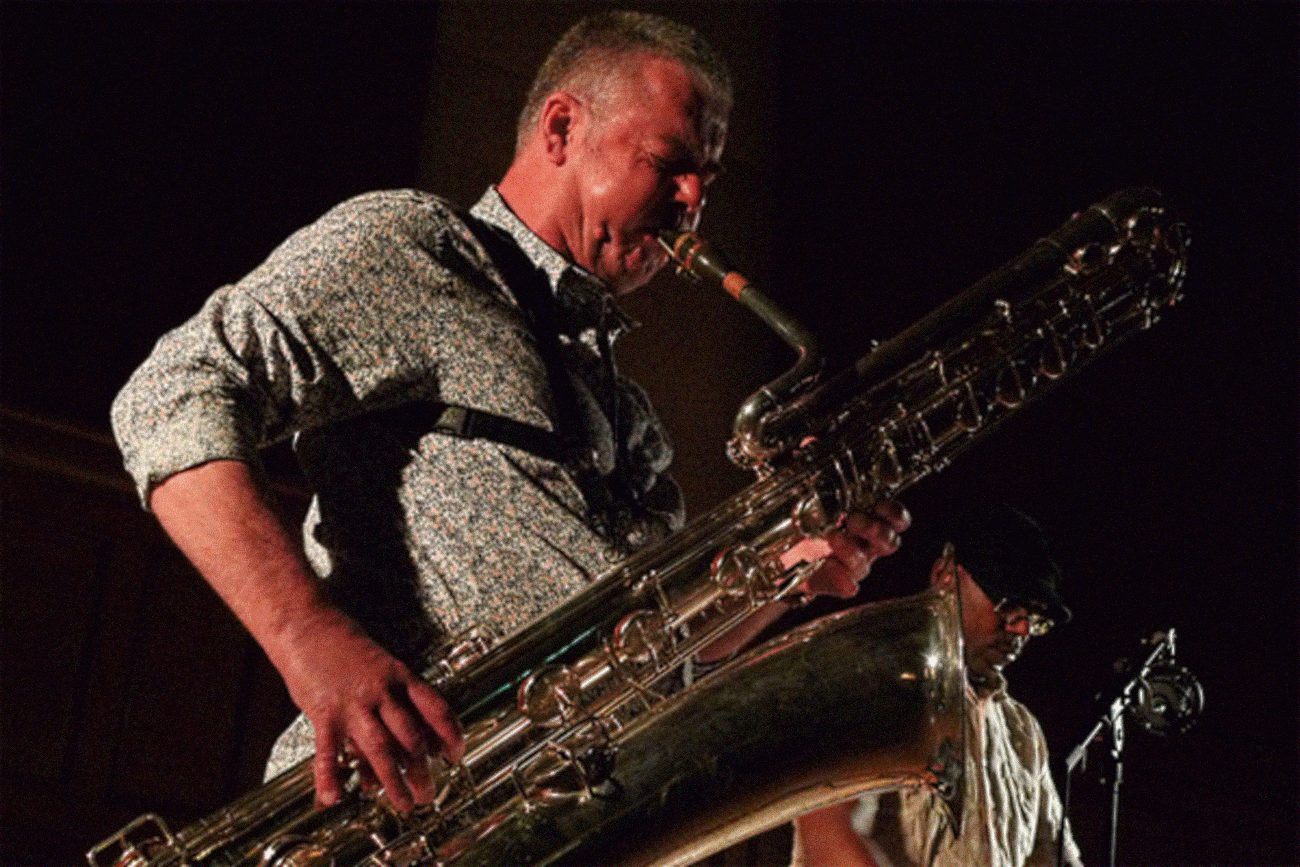
Klaas Hekman - bass saxophone
Hideji Taninaka - double bass, singing bowls, sho
William Parker - double bass, shakuhachi, zurna, guimbri, doson ngoni, poetry
Wilbert de Joode - double bass, singing bowls


With its three double bass players the quartet Intermission emphasizes the lowest sounds and makes them tangible. After a break of several years New Yorkers William Parker and Hideji Taninaka once again meet Wilbert de Joode and initiator Klaas Hekman, who plays bass saxophone. ‘Feel the deep boneshake’ (Downbeat).

See also:
INTERMISSION with Derek Bailey
http://differentperspectivesinmyroom.blogspot.com/2013/10/intermission-with-derek-bailey-chris.html


Wednesday, May 14, 2014

BRUISE: T. Bevan / J. Edwards / A. Wales / M. Sanders / O. Robinson – Bruise With Derek Bailey (2006)


Label: Foghorn Records – FOGCD006
Format: CD, Album; Released: 01 Apr 2006
Style: Free Jazz, Free Improvisation
Recorded live at the 291 Gallery, Hackney Road, London E2, on Tuesday August 17th 2004.
Post-production and Mastering: Asa Bennett at sonic studios.
Engineer by – Ashley Wales
Design by Paul Dunn @ diablo based on original artwork by Ashley Wales

Gig of the year – Derek Bailey’s return in triumph from Barcelona to East London. – Phillip Clark, Jazz Review

01. Search . . . 20:50             
02. Locate . . . 16:01 
03. Destroy . . . 34:02

BRUISE is:
Tony Bevan – bass saxophone
Ashley Wales – soundscapes, electronics
Orphy Robinson – electronics, marimba, percussion, steel drums, trumpet
John Edwards – double bass
Mark Sanders – drums, percussion
with
Derek Bailey – electric guitar

Tony Bevan is an improvising virtuoso on Soprano and Tenor saxophones, but perhaps is best known for his work on the Bass saxophone, on which he is probably Britain’s only major modern performer (“the world’s greatest improvising Bass saxophonist” - Timeout). He is closely linked with the late Derek Bailey, with whom he appeared and recorded many times, as well as with Free Jazz legend Sunny Murray, who, along with Edwards, he has been playing with for more than a decade, releasing a number of award winning recordings and appearing in Antoine Prum’s award winning film “Sunny’s Time Now”. He recently curated with Prum a 3 day festival on British Improvised Music in Berlin, which is released on film in late 2012, following more filming in the UK in early 2012 . His playing covers all bases from rock group Spiritualised (on whose new album he is a featured soloist) to Classical Avant-Garde composer Luc Ferrari, with the likes of Barre Phillips, Matthew Bourne, Joe Morris, Marc Ribot and Tony Buck of The Necks in between. 
He runs the Foghorn label.


Derek Bailey (29 January 1930 – 25 December 2005)

Sonically this is maybe not the best document (a straight-to-DAT recording from a gig at London’s 291 Gallery, acoustically somewhat muddled though quite acceptable) but it’s essential listening for Derek Bailey fans. As usual, the guitarist sought out the company of younger players – in this case, the acoustic/electronic (not electroacoustic) quintet responsible for Bruised, one of last year’s best and most overlooked improv records. The new disc is, among other things, the final chapter in the longstanding relationship between Bailey and bass saxophonist Tony Bevan. It’s hard not to hear real poignancy in Bevan’s playing here, which is stripped down so far it’s as if he’s trying to make an entire musical language out of achingly isolated notes. There’s also the tickle of hearing Bailey with the blue-chip UK free-improv rhythm section of John Edwards and Mark Sanders. The off-balance recording makes it harder to parse the electronic input from Orphy Robinson and (especially) Ashley Wales, but they’re certainly responsible for the haunting, elusive soundscaping (I was also surprised at the closeness in timbre between Robinson’s steel drums and Bailey’s distorted guitar). Derek Bailey was the kind of player an Oulipian would love, someone for whom obstacles were occasions for necessary creativity. By the time this disc was recorded in August 2004 he was already suffering from what was initially diagnosed as carpal tunnel syndrome but later turned out to be degenerative motor neurone disease. In response, he simply went calmly about refashioning his entire approach to the instrument. I’ve always loved the spacious, floaty interludes that occur on his discs, when isolated sound-events: a slow-swelling discord, a quiet scrape over the length of a string are dropped into silence like pebbles cast in a well. His playing throughout this album is like an album-length exploration of that particular corner of his music. His tone on the instrument is much softer than before by this point he was playing without a pick and his improvisations are constructed out of quiet, separately twisted fragments. There’s nothing overtly valedictory about the music the three tracks are called ‘Search’, ‘Locate’ and ‘Destroy’, after all but it is nonetheless hard not to be moved by a few moments here. Bevan’s soft-spoken duet with Bailey near the end of the album, in particular, serves as an achingly beautiful farewell to his mentor, so much so that it’s almost a relief when the full band regroups for a final pummelling blowout.
– ND “ParisTransAtlantic”

Foghorn Records:
http://www.foghornrecords.co.uk/shop/


Buy this album!

Monday, May 12, 2014

FRIEDRICH GULDA – Vienna Revisited (LP-1969)


Label: MPS Records – MPS 15 226 ST
Format: Vinyl, LP, Album; Country: West Germany - Released: 1969
Style: Contemporary Jazz, Jazz-Chanson
Recorded at MPS-Tonstudio Villingen / Black Forest, Febr. 1969.
Written-By – Friedrich Gulda
Producer, Engineer – Hans Georg Brunner-Schwer
Recorded By [Recording Director] – Willi Fruth

...But the greatest discovery in this respect is, of course, Golowin - a singer who can't be heard because he doesn't give a damn about a musical careeer or anything connected with it...

A1 – Sonatine - 1. Satz . . . 4:58
A2 – Sonatine - 2. Satz . . . 6:18
A3 – Sonatine - 3. Satz . . . 3:25
A4 – Die Reblaus . . . 3:38
B1 – Wann I Geh . . . 11:02
B2 – Du Und I . . . 3:35
B3 – Wann Du Mi Einmal Loswerd'n Willst . . . 3:01
B4 – Auf Visit' . . . 4:13

Friedrich Gulda – piano
J. A. Rettenbacher – bass (tracks B1-B4)
Manfred Josel – drums (tracks B1-B4)
Albert Golowin – vocals (tracks B1-B4)


Friedrich Gulda (16 May 1930 - 27 January 2000) was an Austrian pianist.

Born in Vienna as the son of a teacher, Gulda began learning to play the piano from Felix Pazofsky at the age of 7; in 1942, he entered the Vienna Music Academy, where he studied piano and musical theory under Bruno Seidlhofer and Joseph Marx. After winning first prize at the International Competition in Geneva four years later, in 1946, he began going on concert tours throughout the world. Together with Jörg Demus and Paul Badura-Skoda, Gulda formed what became known as the “Viennese troika”.

Although most famous for his Beethoven interpretations, Gulda also performed the music of J. S. Bach, Mozart, Schubert, Chopin, Debussy and Ravel.

From the 1950s on he cultivated an interest in jazz, writing several songs and instrumental pieces himself and combining jazz and classical music in his concerts at times. Gulda wrote a Prelude and Fugue with a theme suggesting swing. Keith Emerson performed it on Emerson, Lake & Palmer’s The Return of the Manticore. In addition, Gulda composed Variations on The Doors’ Light My Fire. Another version can be found on As You Like It (1970), an album with standards such as ‘Round Midnight and What Is This Thing Called Love. In 1982, Gulda teamed up with jazz pianist Chick Corea, who found himself in between the breakup of Return to Forever and the formation of his Elektric Band. Issued on The Meeting (Philips, 1984), Gulda and Corea communicate in lengthy improvisations mixing jazz (Someday My Prince Will Come and the lesser known Miles Davis song Put Your Foot Out) and classical music (Brahms’ Wiegenlied).


This album is a contribution by Ricardo. 
Thanks.


If you find it, buy this album!

Friday, May 9, 2014

DÖRNER / ERICSON / HÅKER FLATEN / STRID - The Electrics – Live At Glenn Miller Café (2005)


Label: Ayler Records – aylCD-034
Format: CD, Album; Country: Sweden - Released: 2006
Style: Free Jazz, Free Improvisation
Recorded in concert at Glenn Miller Café, Stockholm, on October 3 and 4, 2005.
Composed By – Dörner, Flaten, Strid, Ericson
Cover – Åke Bjurhamn
Executive-producer – Jan Ström
Mixed By [Cd] – Billström, Strid, Ericson
Photography By – Lars Jönsson
Recorded By, Mastered By – Niklas Billström

Excellent session at Ayler's favorite Glenn Miller Café, free blowing yet tight arrangement with an open-minded approach to improvisation, including the minimal and fascinating "Electrance." Exciting and cutting edge music.

Axel Dörner 

Ayler Records first documented this quartet with Sture Ericson on reeds, Axel Dörner on trumpet, Ingebrigt Håker Flaten on bass, and Raymond Strid on drums during a live set on their first tour back in 2000. This release captures the group five years later during a run at the venerated Glenn Miller Café in Stockholm. In the intervening years, Dörner, Håker Flaten and Strid have gone on to record and perform in a wide variety of contexts (Ericson, a figure from the '80s Swedish jazz scene has still remained elusive based on his scant recorded output.) Like their first outing, this is another free blowing session and it is clear that the four revel in it. While Håker Flaten and Strid are known for this kind of setting, it is a kick to hear Dörner let loose in full free-jazz mode. While many think of him in settings like his trio with John Butcher and Xavier Charles, he's continued to show his passion for jazz-based outings like his recordings with Otomo Yoshihide's New jazz Orchestra or Alex Von Schlippenbach's Monk workouts. Ericson is more of an unfettered firebrand, whether sparring with Dörner or careening over the thundering pulse of the music. Yet he can also drop down to subtle textural abstractions, whispering his clarinet against the quiet shudders and creaks like the start of a piece like "Electroots". Here the four show that they are about more than just brawn and buster, kicking things off with a spare, floating, collective improvisation and slowly ratcheting up the activity level as the piece progresses. On the closing "Electraps", Ericson's bubbling bass clarinet, Dörner's muted trumpet smears, Håker Flaten's scraped arco, and Strid's pin-prick percussion etch out pointillistic interactions that builds with eddies of activity. This is the sort of session that showcases how the Northern Europeans continue to carve out their take on the free jazz tradition.
_ By MICHAEL ROSENSTEIN

Ayler Records:  http://www.ayler.com/cd-catalogue.html


Buy this album!

Sunday, May 4, 2014

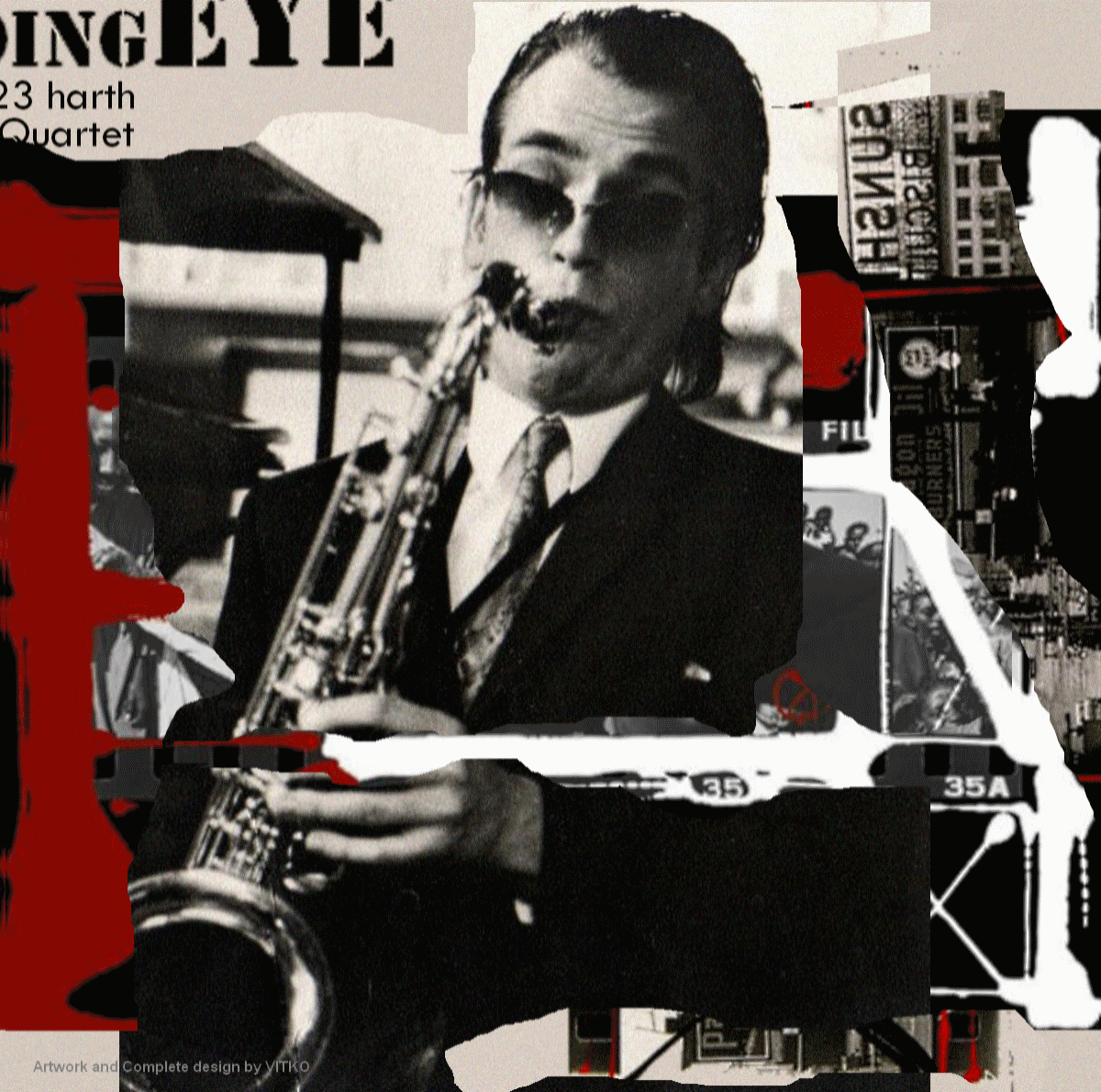
ALFRED 23 HARTH QuasarQuartet – POPendingEYE (1993)


Label: Free Flow Music Production – ffm 0493
Format: CD, Album; Country: Germany - Released: 1993
Style: Free Jazz, Free Improvisation
Recorded live 5th December 1992 at the Hindemith Hall of the Old Opera, Frankfurt
New Cover Design by ART&JAZZ Studio, by VITKO
Photography By – William Klein
Producer – S. Siebenlist
Technician [Ton] – T. Raisig

Live-Mitschnitt aus dem Hindemith-Saal der Alten Oper Frankfurt, 5. Dezember 1992.
Straight ahead energetic Jazz. Enjoy!

01. 1st2nd3rd&4th . . . 29:18
02. BukzokWestWostokSude . . . 29:38

QuasarQuartet:
Alfred 23 HARTH - tenor sax, bassclarinet
Simon NABATOV - piano
Vladimir TARASOV - drums and percussion
Vitold REK - bass


"I want more POPEYE", writes Alfred Harth. "Possessing uncompromising moral standards and resorting to force when threatened". He also refers to "my artist's way through postmodernism", which at the beginning of the 90s brought him to grow tired of "all those mixes, remixes, postmodernisms and pop" that he had gone through during the previous decade: he was ready to return to a "pure" approach, essentially based on real players and real instruments. Enter Russian drummer Vladimir Tarasov from the Ganelin Trio, a long-time admirer of Harth, met for the first time in 1992 when Mr.23 was invited by Moscow TV for a program about him; the next character after his portrait would be none other that Popeye the Sailor (hence the album's title, a word game with the ironical "end" of the "pop phase" of Alfred's career). Tarasov had imported all the early Harth albums in the USSR, playing together became a necessary consequence. The QuasarQuartet, formed by the saxophonist in the same year, sees Harth on tenor sax and bass clarinet and Tarasov on drums and percussion, plus the fabulous pianist Simon Nabatov and the excellent Vitold Rek on bass. "POPendingEYE" features two half-hour tracks in which everything (Coltrane-derived ascensions, logical freedom, contaminations of marching band rhythms, folk melodies, pyrotechnical pianism, sadly pensive reed lines) obeys to a logic that's inspired by Harth's idea of "opening to the East": in fact, besides this new musical situation, he met his current partner - South Korea's visual artist Soonjoo Lee - right at that time . Even the track titles, "1st2nd3rd&4th" and "BukzokWestWostokSude", respectively refer to the world's divisions ("...we know what the 3rd world is, but which would be the 1st?" says Harth) and to a mixture of Korean and English language to describe directions. And many directions this music points at, with a stimulating alternance of high-charge improvisations and melodic crystals that doesn't remind us about the players' originary lands, but it rather stands as a primary example of reciprocal instant comprehension: no language is a barrier when the instruments are the ones doing the talking. "POPendingEYE" - a meaningful record in the free music scene of the early 90s - has remained pretty obscure despite its quality; but it sure helped Alfred Harth to be "strong to the finish", as the Sailor himself would have it. The fact is, his creativity shined then and it still does. What finish, then? And what's your favourite brand of spinach, Alf?
Highly recommended.

_ Review by MASSIMO RICCI


Buy this album!

Friday, May 2, 2014

THE WUPPERTAL WORKSHOP ENSEMBLE – The Family (LP-1982)


Label: FMP – FMP 0940
Format: Vinyl, LP; Country: Germany - Released: 1982
Style: Free Jazz, Free Improvisation
Recorded live on September 7th 1980, during the 8th Wuppertaler Free Jazz Workshop
Design by Peter Kowald
Photography By – Unknown Artist
Producer – Jost Gebers, Peter Kowald
Recorded By – Jost Gebers

A1 - Improvisation I (Charig/Rutherford/Poore/Brötzmann/Parker/
        Trovesi/Wachsmann/Van Hove/Kowald/Sommer) . . . 5:50
A2 - Fantale (Evan Parker) . . . 9:31
A3 - Bones and wishes (Phil Wachsmann) . . . 6:13
B1 - Improvisation II (Charig/Rutherford/Poore/Brötzmann/Parker/
        Trovesi/Wachsmann/Van Hove/Kowald/Sommer) . . . 10:05
B2 - The Family (Fred Van Hove) . . . 11:35

Marc Charig - trumpet, alto horn
Paul Rutherford - trombone, euphonium
Melvyn Poore - tuba
Peter Brötzmann - saxophones & clarinets
Evan Parker - soprano & tenor saxophone
Gianluigi Trovesi - saxophones & clarinets
Philip Wachsmann - violin
Fred Van Hove - piano
Peter Kowald - double bass
Günter Sommer - drums

This short-lived all-star assemblage of European talent only released one LP, and this is it! A large group that wears its size lightly, there is a lot of space for solos and smaller group work, while also allowing for some tremendously beautiful, all-in crescendos. And don't let the "workshop" of the title lead you astray: this is a band with a full understanding of the repertoire, and complete command of the material. Come join The Family!


DISCOGRAPHY: FMP Numbers (LP's, CD's & Singles), SAJ Numbers, Uhlklang:
http://www.fmp-label.de/fmplabel/discographie/fmpnumbers_en.html


If you find it, buy this album!

Thursday, May 1, 2014

PETER KOWALD QUINTET – Peter Kowald Quintet (LP-1972)


Label: FMP – FMP 0070
Format: Vinyl, LP; Country: Germany - Released: 1972
Style: Free Jazz, Free Improvisation
Recorded live January 19, 1972 at Akademie der Künste in Berlin
Artwork – Danny, Dietrich Maus, Geges Margull, Gerd Hanebeck, Heiko Hösterey, Krista Brötzmann, Paul Miron, Peter Paulus, Tomas Schmit, Toon Lem, Winfried Gaul, Wulf Teichmann
Producer – P. Kowald
Recorded By – Eberhard Sengpiel
Supervised By – Jost Gebers

"It was recorded at a concert in Berlin, during a Free Music Festival January 19, 1972 , and is a thoroughly excellent example of the kind of music to be heard at such events all over Europe....this LP is highly recommended."

A1 - Platte Talloere . . . 13:16
A2 - Wenn Wir Kehlkopfoperierte Uns Unterhalten . . . 7:06
B1 - Pavement Bolognaise . . . 14:00
B2 - Guete Luuni . . . 2:49

Peter van de Locht: alto saxophone
Günter Christmann: trombone
Paul Rutherford: trombone
Peter Kowald: double bass, tuba, alphorn
Paul Lovens: percussion

The informal freemasonry among European practitioners of the New Music grows daily stronger. Although the Continentals are rarely allowed to play here (thanks to antiquated regulations), British musicians now regularly cross the Channel to appear side-by-side with the best players Europe has to offer.
This album represents just such a collaboration, with trombonist Paul Rutherford taking his place in the band of German multi-instrumentalist, Peter Kowald, which itself contains one Belgian (van de Locht) and one Dutchman (Lovens).
It was recorded at a concert in Berlin, during a Free Music Festival last January, and is a thoroughly excellent example of the kind of music to be heard at such events all over Europe.
The work of the trombone team is what catches the ear first; Rutherford produces his vast array of technical effects, and manages to make music out of them all the time. Near the end of “Pavement Bolognaise”, for instance, he plays a long unaccompanied passage made up of long, low growls, ending with a delicious smear, which is quite riveting.
Christmann is a rather more straightforward player (though not much) and makes a fine complement. When he, Rutherford, and Kowald (on Alphorn, I think) play together on the short “Guete Luuni”, the effect is like a brass band lament from outer space.
The leader himself has some impressive moments on bass, particularly on “Platte Talloere”, where he plays a long solo made up of strange scratching sounds (caused by pressing the bow down hard on the strings) and is beautifully accompanied by Lovens – who seems to have calmed down a lot since I first heard him a couple of years ago.
Van de Locht sounds like a very promising young musician, giving his best work in the ensemble improvisations, when he provides an upper line with a poignant, bitter-sweet flavor.
A quintet, then, which is integrated as well musically as it is nationally; and a LP of informal, enjoyable music, which is highly recommended.

_ By RICHARD WILLIAMS
from: Melody Maker, June 17, 1972


If you find it, buy this album!