Thursday, September 5, 2013

IRENE SCHWEIZER QUINTET – The Storming of the Winter Palace (Moers-Zurich 1986/'88) - LP-1988 / CD-2000


Label: Intakt Records – Intakt CD 003
Format: CD, Album, Reissue; Country: Switzerland - Released: 2000
Style: Free Improvisation, Contemporary Jazz
Track 1 recorded May 18th, 1986 at the International-New-Jazz-Festival-Moers by WDR (Cologne)
Tracks 2 & 3 recorded March 25th, 1988 at the Taktlos-Festival at Rote Fabrik, Zurich
First released on Intakt LP 003 / 1988
Composed By – George Lewis (tracks: 3), Günter Sommer (tracks: 3), Irène Schweizer (tracks: 1, 2), Joëlle Léandre (tracks: 1), Maggie Nicols (tracks: 2)
Cover Art: Ruedi Wyss
Executive Production: Patrik Landolt
Engineer – Peter Pfister

At the Moers Jazz Festival in 1986, the quintet of Irène Schweizer, Maggie Nicols, George Lewis, Joelle Leandre and Guenter Sommer caused quite a commotion. The "Frankfurter Allgemeine" wrote: "a great moment of free improvised music; the listeners gave endless ovations, were stunned, moved, even happy just like the protagonist themselves, who lay in each others arms after the magic process of spontaneous interaction". The album with excerpts from the Moers concert as well as from the subsequent performance at the Zurich Taktlos Festival was awarded the German Record Critics Prize.


The Storming Of The Winter Palace was originally released on LP in 1988 as Swiss based “ Intakt Records ” has thankfully chosen to reissue this most interesting recording on CD. The 26-minute opener, “ Now and Never ” offers a hearty mix of disparate motifs, glistening choruses and endearing interplay among trombonist George Lewis, vocalist Maggie Nicols, pianist Irene Schweizer, percussionist Gunter Sommer and bassist Joelle Leandre. Here, Ms Nicols displays a supremely masterful vocal range complete with spurts of humor, scat and spoken word intermingled with weaving, multidimensional ensemble work along with an abundance of peaks and valleys. The musicians entice one another with interesting dialogue and shrewd on-the-fly development yet many of these sequences sound composed or pre- planned. On “ The Storming of the Winter Palace ” George Lewis and Ms Leandre are the instigators who often prod Ms Nicols into operatic-style vocal pyrotechnics, which unto itself is rather amazing. The audience in attendance must have literally been on the edge of their seats during the final piece, titled “ Living on the Edge ” as the band pursue vivid theatrics, circular thematic movement along with some downright awe-inspiring drumming/percussion from Gunter Sommer. 

The Storming Of The Winter Palace is a showstopper as this writer often thought of the visual aspects; hence, a video of this performance would have been an added treat as the music and overall intensity alludes to one heck of a live performance! * * * * ½

_ By GLENN ASTARITA
Published: February 1, 2000 (AAJ)


Links in Comments!

Tuesday, September 3, 2013

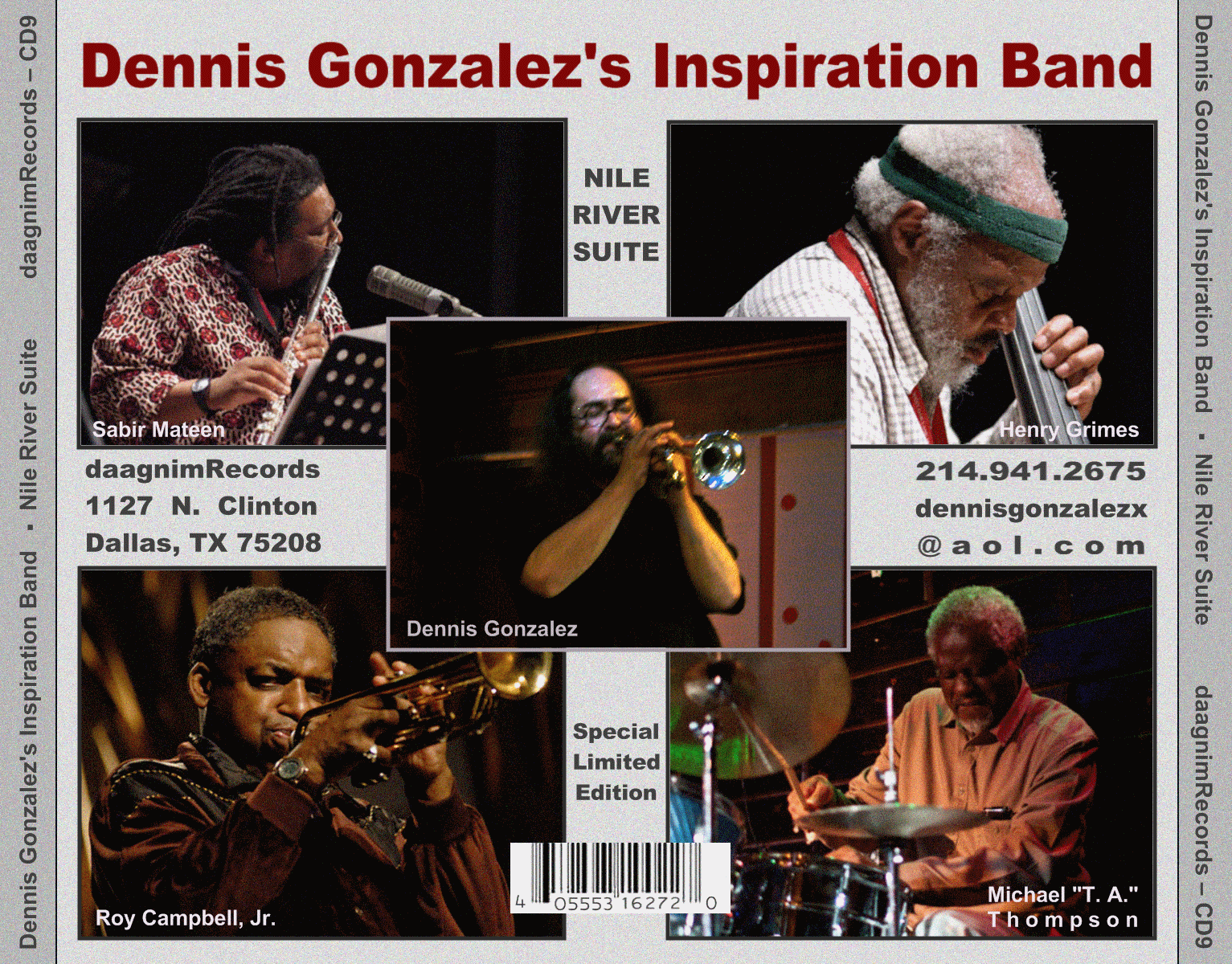
DENNIS GONZALEZ'S INSPIRATION BAND – Nile River Suite (2004)


Label: daagnimRecords – CD9
Format: CD, Album  - Special Limited Edition
Country: US - Released: 2004
Style: Free Improvisation, Contemporary Jazz
Recorded on 23 November 2003, at Universal Rehearsal, NY.
Composed By – Dennis González (tracks: 1, 2, 7); "Nile River Suite" By - González, Grimes, Thompson, Campbell, Mateen
Recorded By, Mixed By – Dennis González

Dennis González – trumpet [C]
Sabir Mateen – tenor sax, alto sax, alto clarinet, clarinet [B-flat], flute
Roy Campbell, Jr. – trumpet, flugelhorn, trumpet [Pocket], flute
Henry Grimes – acoustic bass
Michael "T. A." Thompson – drums, percussion

Dennis González
 Henry Grimes
 Roy Campbell, Jr.
 Sabir Mateen
Michael "T. A." Thompson

Free Jazz is full of stories like that of Dennis Gonzalez. A very talented trumpeter and composer, Gonzalez played with a veritable who's who of free jazz in the 80s and early 90s. Unfortunately, like so many fine musicians of that era, he became discouraged by the lack of adequate opportunities in the jazz world and left active performing, preferring instead to teach music and French in Dallas, Texas. But Gonzalez just couldn't stay away from the free jazz scene and in 1999 he recorded again after a five year hiatus, with an eclectic ensemble featuring himself on keyboards, trumpet and samples and even a Tejano accordionist. Since then, Gonzalez has embarked on a steady mix of touring and recording, all the while continuing to teach his high school students.

Nile River Suite is the latest in an impressive series of recordings Gonzalez has made over his career. This CD is notable in many ways. It marks the first time that legendary bass player Henry Grimes has recorded since his dramatic re-entry into the music scene two years ago. Grimes' story is fascinating. After recording on many seminal LPs with Cecil Taylor, Albert Ayler and others, Grimes moved to Los Angeles and disappeared. He was widely reported dead. However, two years ago he was discovered living in an LA SRO. Given a bass by William Parker, Grimes began to play again with a triumphant set at the Irridium in NY and then a knockout group at the Vision Festival. On this disc he sounds like he hasn't missed a beat! (Henry says he practiced bass in his head during his thirty missing years and you can believe it!) On an instrument that is often overlooked by musicians fascinated by the more showy reed instruments, Grimes is powerful. His lines and tone seduce you almost hypnotically. He is a powerful presence that only gets better with age.

The disc also includes some of the top New York free jazz musicians. Sabir Mateen on reeds is a true wonder. This musician is perhaps one of the most underrated reed players on the scene. Mateen is unusual in that, like Eric Dolphy before him, he has a distinct voice on each of his instruments and a marvelous tone. And though Mateen has perhaps the best altissimo shriek this side of Albert Ayler, his playing is marked by a captivating melodic sense and an unfailing technique. Drummer Michael "T.A." Thompson is another crack NY musician, capable of driving bop-inflected grooves, subtle polyrhythms and powerful tom-tom work. Adding brass player Roy Campbell to the mix was particularly audacious for Gonzalez. Campbell is a true master of all aspects of the instrument, with a tone and style that shows the influence of the entire history of jazz trumpet, from Louis Armstrong through Lee Morgan and on out. That Gonzalez stands up well to such a master is a credit to his own sense of style. You always know which musician is soloing. They are distinct, but complimentary.

The compositions on the disc are impressive, and the multi-part Nile River Suite is truly marvelous. The disc opens with an 18 minute "Lyons in Lyon," a tribute to the late alto player Jimmy Lyons, which sits on the stylistic edge between free bop and total out playing. Gonzalez gives a wonderful, almost Clifford Brown style solo. "Sand Baptist" is a similarly tradition-infused cut, with mellifluous solos by Mateen and Campbell. The major work on the disc, the three part "Nile River Suite," begins with an atmospheric extended introduction for wind trio (Campbell and Mateen on flutes with Gonzalez on trumpet) and then features some inspired solo work before seamlessly moving into a hypnotic Middle Eastern jazz groove. A beautiful lyrical solo by Campbell introduces the second movement of the work with a dark, Lee Morgan-inspired tone. The interplay between Grimes and Thompson is magical. The third movement is dominated by a beautifully constructed, melodic drum solo by Thompson and some soulful blowing by Mateen before the piece winds down to a peaceful conclusion. The final cut on the disc, "Hymn for the Ashes of Saturday," is pure avant-funk, with a groove that would have done Lee Morgan or Cannonball proud. A marvelous way to round out a beautiful album.

This is disc, like so many produced in the new millennium, is a limited addition on the daagnimRecords label. The sound is wonderful, with lively present bass and yet a very clear high end. The music on this disc is adventurous, but ultimately melodic and appealing. This is not the scream fests of Peter Brotzman or other extreme players. Rather it is a deeply felt and almost spiritual disc and a wonderful introduction to the musicians on this album. Find it while you can!

_ Reviewed By CHRIS FORBES


Links in Comments!

Saturday, August 31, 2013

DAVID S. WARE QUARTET – Oblations And Blessings (1996)


Label: Silkheart – SHCD 145
Format: CD, Album; Country: Sweden - Released: 1996
Style: Free Jazz
Recorded on 27, 28 September 1995 at Sound On Sound Studio, NYC.
Artwork [Front Cover Art] – Miroslaw Balka
Front cover art titled "A Piece To Keep Doors Open"
Design, Layout – Jörgen Renhorn
Edited By – Allan Tucker; Edited By [Assistant] – Nicholas Prout
Executive-Producer – FS-MAB, Keith Knox
Photography By [Booklet Session Photographs] – Cheung Ching-Ming
Photography By [Front Cover Art] – Börje Svensson
Recorded By [Assistant] – Devin Emke
Recorded By [Digitally] – Nicholas Prout

This session, recorded in a superb midtown studio in New York during September 1995, shows the David S. Ware Quartet at the height of its powers. This is one of the foremost groups who played then and their performance here is captured by engineer Nick Prout with extraordinary clarity. The development of David S. Ware 's music is one of the more significant histories in today's jazz and earlier examples from the Silkheart catalogue are 113, 127, and 128.


Oblations And Blessings is certainly one of David S. Ware's best recordings, and maybe the best if you're into extended blowing vehicles. The players are inspired, the sound is well- balanced so you can hear all of them clearly, and there's plenty of variety in the pieces. And Matthew Shipp, William Parker and Whit Dickey are up to the task of playing follow the leader because no one has more to express here than Ware. It's a disc for hearing David S. Ware blow hard, long and free--he plays every second of the closer "Serpents and Visions" and doesn't go in for much laying out anywhere.

The opening 17-minute title track hits the ground running with a spiritual intensity close to late John Coltrane that in spots pushes Shipp close to McCoy Tyner territory. It builds inexorably through ebb-and-flow periods of rumbling Parker, pounding Shipp and propulsive Dickey triggering Ware's harmonic squawks before falling away to a bowed bass solo that gives Ware his first break after 10:20 of full-bore playing. 100 seconds of down time later, he's back for the duration until Shipp's lurching chords brings the piece to an exhausted close.

"Riff Unknown" is more in a classic jazz vein with Parker close to double time walking and Dickey close to swinging while Ware swirls and twists, turns and doubles back around the melody. Shipp enters in mid-song--a common device here--and his long solo retains an appealingly light texture after the density of the opener. "Of Shambhala" boasts a gorgeously spare atmospheric opening, with Ware entering crying, then ruminating and extending the lines before handing the baton over for a restrained Parker solo with Shipp's elegant support.

But "Fire Within" gets Ware off and running again with Parker whooping behind him to trigger answering yelps and buzzsaw riffing over Dickey's light cymbals. "Manu's Ideal" is an excellent return to a sort of Trane-spiritual melody with Ware's big, burry tone carrying the medium tempo before a Parker solo and Shipp's re-entrance triggers the saxophonist's closing theme statement.

Ware's outside start to "Serpents and Visions" sounds like musical visions of serpents, Shipp ripples his way in at the two-minute mark and it evolves progressively into Ware's serious pushing to get to Albert Ayler-esque shrieks and cries over Shipp's lower register hammering. You can really hear the interaction between the two on this track before into peters out in honks and silence.

Music is the last thing you should reduce to numbers but David S. Ware is literally playing on 54 of the 69 minutes (give or take one or two) of music here, a simply staggering amount. And he's playing so intensely for that long with that huge tone doing interval leaps and Ayler shrieks, high harmonics and lower-register honks, buzzsaw-quick runs and scale slurs, wringing every possible melodic permutation out of every theme.

The liner notes define "oblation" (via Webster's) as "the act of offering something as worship or thanksgiving." No one who hears Oblations and Blessings could ever doubt the generosity of Ware's offering here. The man must have been absolutely, utterly drained--emotionally, physically and spiritually--after this session.

_ Review by DON SNOWDEN


Links in Comments!

Thursday, August 29, 2013

RICK JENSEN TRIO – Live Performances 2003 / 2004 (4CDs Box Set)


Lebel: Postmoderncore – pcm035/pcm036/pmc046/pcm047 - DP001
http://postmoderncore.com/
This album is licensed under a Creative Commons Attribution-NonCommercial-NoDerivs 3.0 New Zealand License.
Format: 4 × CD, Album; DP001 Compilation; Country NZ 
Style: Free Improvisation, Experimental
Design by ART&JAZZ Studio SALVARICA - 2013
Artwork and Complete Design By VITKO

The Rick Jensen Trio/Quartet was started in New Zealand 1999, now based in London U.K. The group is a live performance ensemble that has many members come and go throuhg the years. All the music is completely improvised, making every performance and recording completely unique.

THE AGE OF ILLUMINATION
Recorded live at the Photospace in Wellington NZ in 28 July 2003

SNOWDRIFT
Recorded live at Bodega in Wellington NZ on the 29th April 2003

CITY OF CONFUSION
Recorded live at the Newtown Community Centre in Wellington NZ, April 4, 2004

THE EXCURSIONIST
Recorded live at the Newtown Community Centre in Wellington NZ on the 7th of August 2004


Many different musicians have played with the band, some only once and others have stuck around for a couple of years.Originally formed in Wellington, New Zealand, they are now based London and there are various musicians who come and go from the group, the line-up can change with each performance.The group isn't always a trio but thats usually what it works out to be. They are experimented with all kinds of combinations and instrumentation, often dictated by who was around and able to perform.The group has been as large as 6 and as small as 2. They are essentially a live band and perform as often as possible. They have 16 releases most of which were released in limited edition CDRs and are no longer in print, currently available is “ A Fundamental Problem ” and “ High Tension ” a limited CDR. They currently working on future releases. Rick is also a member of I-C-E an improvising clarinet ensemble, Nova Scotia a free form abstract trio, The Radioactive Ensemble an international music/art collective and performs in other collaborative projects. He is a photographer and has had over 20 exhibitions in NZ and the U.K. and is currently working on publishing his first book.


The Rick Jensen Trio/Quartet Archive Series Volume Four to Six: U.K live, released in April 2013
http://therickjensentrio.bandcamp.com/ 

Enjoy !


Links in Comments!

Monday, August 26, 2013

AMM – Laminal - Aarhus 1969, London 1982, New York 1994 (3CD-1996)


Label: Matchless Recordings – MRCD31.
Format: 3 × CD, Album; Country: UK - Released: 1996
Style: Abstract, Free Improvisation, Experimental
Disc 1 recorded in Aarhus on 16th December 1969. 
Disc 2 recorded Goldsmiths' College, London on 20th February 1982. 
Disc 3 recorded at Context Studios, New York on 3rd May 1994.
Front cover artwork: Keith Rowe
Liner Notes – Eddie Prévost, Jim O'Rourke, John Tilbury, Malcolm Le Grice, Victor Schonfield
Mastered By [Restored By] – Adam Skeaping (tracks: 1-1 to 2-2)
Producer – Bruce Lee Gallanter (tracks: 3-1 to 3-6)
Recorded By – James McLean (tracks: 3-1 to 3-6)

 Cornelius Cardew, 1969
 Eddie Prévost, 1982
Keith Rowe, 1982

A triple CD set to mark 30 years of making AMMmusic. Each features an AMM concert performance.

Disc-1
The Aarhus Sequences: Aarhus 1969
Denmark 16th December 1969
1.       51:07
2.       14:23
3.       6:40
Cornelius Cardew ,Chrisoper Hobbs
Lou Gare, Keith Rowe , Eddie Prévost

Disc-2
The Great Hall: London 1982
Goldsmiths' College, London 20th Febrary 1982
1.       36:45
2.       38:56
John Tilbury , Keith Rowe, Eddie Prévost

Disc-3
Context Studios
New York 3rd May 1994
1.       71:17
John Tilbury , Keith Rowe, Eddie Prévost


John Tilbury / Eddie Prévost

Released in 1995 to commemorate the 30th anniversary of this astonishing improvising cooperative, Laminal contains three complete concerts from the early, middle, and later portions of AMM's career. For all the free music, noise, and what-have-you that was created since, the music from the 1969 Aarhus performance remains striking, assaultive, and sublimely creative. If one tries to give a comparative reference to similar music at the time, the nearest approximation might be to take the wildest, most unearthly Sun Ra explorations and filter them through the prism of Iannis Xenakis' "Bohor" to come close to providing a vague description of what occurs here. Performing as a quintet, the dual percussion of Eddie Prevost and Christopher Hobbs leads the way, solidly buttressed by Keith Rowe's guitar and electronics. Determining which musician does exactly what at any given time is a losing proposition, until a few wails at the close of the piece; if Lou Gare ever makes a remotely "traditional" sound on his tenor sax, it's impossible to detect. The music is loud (roaring, for the most part), uncompromising, enveloping, and entirely selfless -- no solos here, only pure group sound. Warning: Exposure to this recording may make it difficult to listen to much contemporary, so-called avant-garde music again; it will almost seem bloodless in comparison. By the time of the concert captured on the second disc, pianist John Tilbury, arguably the foremost interpreter of the piano music of Morton Feldman, had joined Rowe and Prevost to form the trio that would comprise the essential AMM unit in years to come. It also becomes clear, perhaps in part due to Tilbury's arrival, that a strong tendency toward quiet has asserted itself. Though the piece begins with frantic piano and raucous guitar noise, the moments of calm are more frequent than before, and seem to serve as nodes from which further exploration springs. True, this set features a larger-than-normal amount of relatively straight and loud drumming from Prevost (who is quite capable of going through a show without once making any sounds one usually associates with drums), but there is a much wider sonic palette in play. Tilbury's use of, in this context, surprisingly melodic and Feldman-esque arpeggios and clusters exerts a serene and meditative force that often, not always, persuades Rowe and Prevost to follow suit. Rowe's utilization of a transistor radio injects some humor into the affair as strains of "Love Me Do" and "Heatwave" percolate to the fore. When, from some unknown source, a woman's voice begins intoning a seemingly random series of numbers in German (code?), the effect in conjunction with the live music is nothing short of electrifying. The final recording, with the same trio, shows further steps toward a music centered on stillness, though not so much as other albums from the period such as Newfoundland. Again the set begins aggressively, again Prevost displays his impressive jazz chops, but ever more the trio returns to near silence, a rich minimalism where more and more beauty is found with less and less material. From the maelstrom of sound in its early years, AMM evolved toward a kind of musical kabuki, a sequence of gestures strengthened by extremely deep listening, where any sound, however slight, could be placed with unerring precision to form a whole. While it's impossible to capture all facets of this remarkable band in its entirety, this three-disc set serves wonderfully as both an overview of their art and a brilliant illumination of their immense sound world. Very highly recommended.

_ Review By BRIAN OLEWNICK


Links in Comments!
 

Wednesday, August 21, 2013

HANS KOLLER & WOLFGANG DAUNER – Free Sound & Super Brass (LP-1976)


Label: MPS Records – 68.109, MPS Records – MPS 15.461
Format: Vinyl, LP, Album; Country: Germany - Released: 1976
Style: Avant-garde Jazz, Free, Big Band
Recorded live at Audimax Techn. Universitat, Vienna, Oct. 4, 1975.
Design [Cover Design] – Rolf Becker
Photography By – Hans Koller
Producer – Willi Fruth

Personnel:
Hans Koller - sopranino, soprano sax, co-leader
Wolfgang Dauner - keyboards, co-leader
trumpets:
Robert Demmer, Friedrich Hujer, Conny Jackel, Herbert Joos, Ernst Lamprecht, Robert Politzer, Kenny Wheeler
trombone:
Roy Deuvall, Garney Hicks, Erich Kleinschuster, Albert Mangelsdorff
Rudolf Josel - bass trombone
Günter Lenz - e-bass
Janusz Stefanski - drums


Hans Koller was based in Hamburg through the 1960s, working as musical director of the city's Schauspielhaus at the decade's end. In 1970 he returned to his hometown of Vienna and began exploring free jazz with Wolfgang Dauner in his Free Sound Ensemble (Free Sound and Super Brass, 1975, MPS). Koller's subsequent projects included duos, the brass ensemble International Brass Company, mainstream combos, and an all-sax unit. He occasionally worked on interdisciplinary projects as well, like his 1968 ballet, New York City.


An intriguing composer and ambitious pianist, German musician Wolfgang Dauner has combined jazz, rock, electronic music, and elements of opera and theater in creating broad- based, ranging works. While at times these compositions may seem too far-reaching, Dauner's best work shows the links between idioms and genres and offers provocative musical and cultural concepts. He studied trumpet, piano, and composition at the Musikhochschule in Stuttgart, then joined Joki Freund's sextet in the early '60s. Dauner appeared at several German festivals, then made his recording debut heading a trio in 1964. It was one of the first European free jazz recording sessions. Dauner led Radio Jazz Group Stuttgart and wrote compositions for them in 1969. He formed the jazz-rock band Et Cetera in 1970, then, with Hans Koller, co-led the Free Sound & Super Brass Big Band. He helped organize the United Jazz and Rock Ensemble in 1975, and began featuring theater, opera, and dance segments along with his performances in '70s and '80s concerts.


Links in Comments!

MANFRED SCHOOF QUINTET – Voice (LP-1966, Re-2008)


Label: L+R Records – CDLR 710528, Bellaphon – CDLR 710528
Format: CD, Album, Reissue, Remastered; Country: Europe - Released: 2008
Style: Free Jazz
Recorded May 2nd, 1966 at Studio Walldorf / Frankfurt am Main.
Original release in 1966 as Columbia 62621
Design [Album] – Günther Kieser
Engineer [Sound] – Dieter Von Goetze
Producer – Horst Lippmann


Trumpeter/cornetist and composer Manfred Schoof isn ’ t quite as well known today as some of his peers in the free-jazz movement in Germany. Though now primarily working in radio and television music, Schoof recorded a series of extraordinary records as a bandleader in the ‘ 60s and ‘ 70s. His quintet of the mid- ‘ 60s featured saxophonist Gerd Dudek, bassist Buschi Niebergall, drummer Jaki Liebezeit (later of prog-rock band Can), and pianist/composer Alexander von Schlippenbach. The compositions are all originals by members of the group and the music here is crisp, alternately poised and volcanic. Stylistically there are clear forebears — Cecil Taylor, Ornette Coleman, Don Cherry, Gato Barbieri, George Russell and Albert Ayler, as well as composer Bernd Alois Zimmerman (with whom Schlippenbach studied) and the inventions of Karlheinz Stockhausen, Mauricio Kagel, Arnold Schöenberg and Anton Webern. For all that, the music is a robust classic of European jazz, and one that shows its constituents to be aware of tradition whilst fighting to find new expressive avenues.


Links in Comments!