Sunday, June 4, 2017

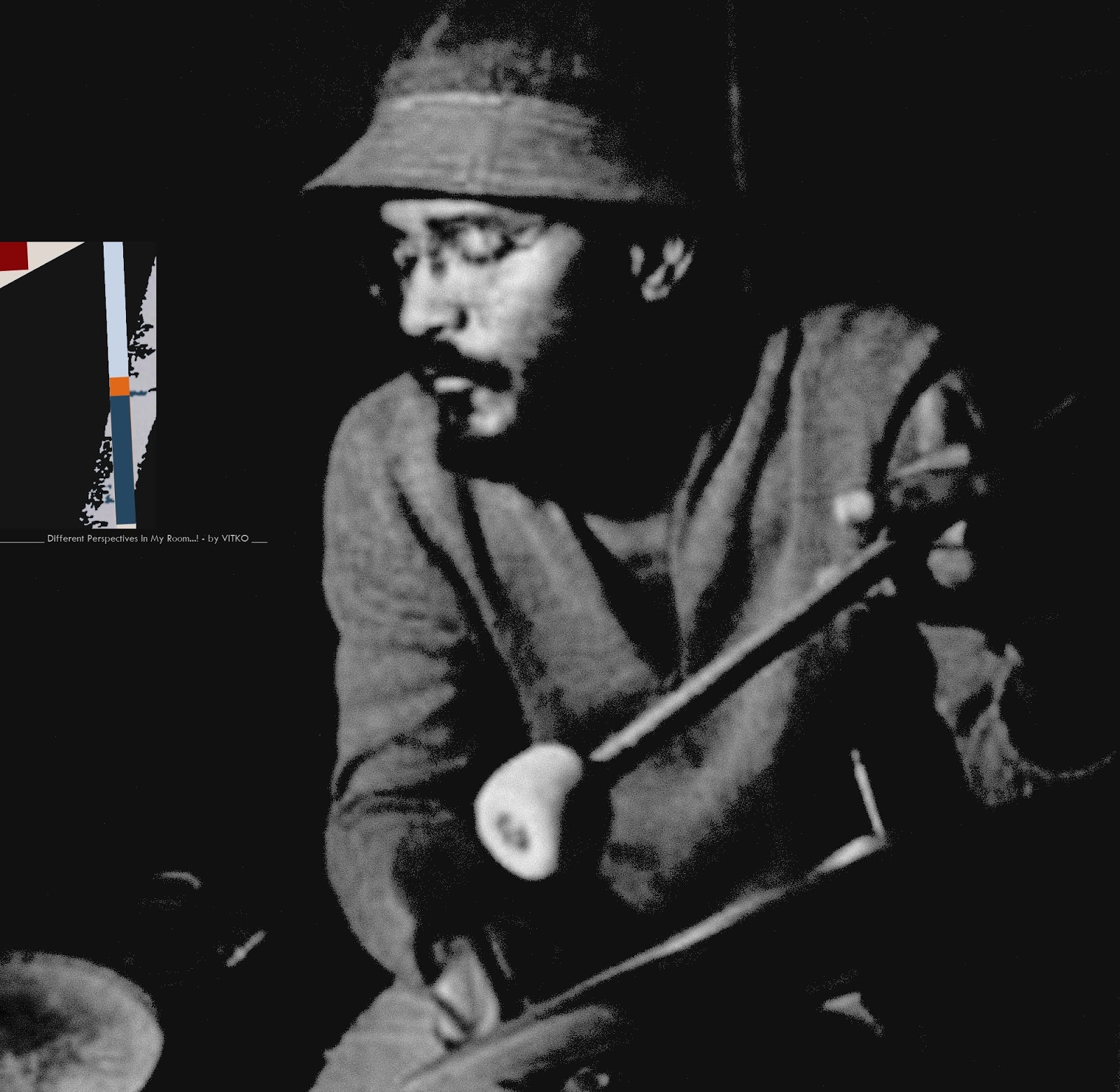
DON PULLEN / MILFORD GRAVES – In Concert At Yale University (LP-1966)


Label: JV – JV 003
Format: Vinyl, LP, Limited Edition, Numbered / Country: US / Released: 1966 -?
Style: Avant-garde Jazz, Free Improvisation
Recorded live on 30 April 1966 in concert at Yale University.
Originally released on their private Self-Reliance Project label (SRP, Milford Graves with the pianist Don Pullen): SRP Records - PG 286 (Vol. 1)
This (JV 003) is Reissue, Unofficial Release
Matrix / Runout (Etched Side A): S-23907 A
Matrix / Runout (Etched Side B): S-23907 B

A - P.G. I ............................................................................................ 18:50
B - P.G. II ........................................................................................... 23:10

Don Pullen – piano
Milford Graves – drums, percussion

Comes in a canvas type bag instead of a cardboard paper for the outer sleeve, printed on artwork on front, back covers and inner sleeve.


Notes:
Quite nice 1966 original pressing of this extremely rare privately issued free jazz LP. Very few pressed and each copy features an unique totally hand painted cover.
The pictures (about 100 pieces), handpainted by Milford Graves.

“Hey, man, I started something, Look, I did what I did.”
(Milford Graves)

What else can be said here? A great album.


If you find it, buy this album!

THE PHILLIP WILSON TRIO – Live - Fruits (Circle Records / LP-1978)


Label: Circle Records – RK 14778/10
Format: Vinyl, LP / Country: Germany / Released: 1978
Style: Free Jazz, Free Improvisation
Recorded live at the Northsea-Festival in Den Haag, July 14, 1978, Holland
Design, Photography By [Back Cover] – Rudolf Kreis
Photography By [Front Cover] – Günter Voss
Recorded,  Producer By – Rudolf Kreis
Published By – Phillisaundi / Leo Smith Publ. Co.
Matrix / Runout (Side A): F 666 343 A 1
Matrix / Runout (Side B): F 666 343 B 1

A1 - Electricity ..................................................................................... 11:20
A2 - Leo's Tune ................................................................................... 10:21
B1 - F & L ............................................................................................ 14:04
B2 - Death Aint Supposed To Be Negative .......................................... 9:45

Phillip Wilson – drums
Leo Smith – trumpet, pocket trumpet
Johnny Dyani – bass

Wilson assembled the trio featuring Smith and Dyani for a performance at the Northsea Jazz Festival in Den Haag. The performance was on July 14, 1978. The record was produced by Rudolf Kreis for Circle Records, a small German label that recorded mostly progressive jazz from 1977 to the mid 1980s.


“Electricity” starts the set off at a clip, the drummer setting the pace. Dyani’s fast pizzicato plucks go up and down the fret board as Wilson’s light hi-hats keep the momentum. Smith’s strong vibrato-less tone fills the melodic role as the piece pushes on. The bass is high in the mix and Dyani takes advantage as he really wrestles tones out. The dialog between Smith and Dyani is intriguing. The call and response sections are of interest as the two develop an interesting dialog.
This is pure energy music with a free pulse allowing the musicians to really invest in their own sound. Smith keeps the energy up and texture dense with thick swathes of sound. The communication is good. Wilson plays the accompanist role until the middle where he commands a solo that starts at mid intensity and builds, rollicking along. Dyani returns with a solo letting the harmonics ring from his instrument with runs through the registers. It isn’t about intonation and melodicism as much as it is about sound creation, rhythm and texture.
Smith joins back with a blustery tone. The last couple minutes are interesting for the gear shifts, each soloist gets a chance to drive. The bass begins to walk, steering toward the conclusion, then slows with loud twangs as Smith ends with a long tone and Wilson’s cymbal splash.

“Leo’s Tune” is a melody written by Smith. It has a more restrained and thoughtful nature. Smith’s long tones and haunting altissimo are contrasted with a minimal drum part and off beat low strums from the bass. The meditative quality and restraint create a nice balance to the firey “Electricity”.
The group begins to diverge as Smith takes the solo lead. Wilson is in his own world with very subtle hits, mild hints of swing on the hi-hats. Dyani throws in some of his fleet fingered tricks from time to time before he takes his solo. He remains focused on the various sounds that he can emit with his strumming before slowing into a blues-ish strolling line. Wilson begins his solo with rolling snare into an off kilter bounce. The high-pitched bass introduces the ostinato plucking and Smith’s return to the melody. This is a really lovely piece.


The B-side starts off with what is perhaps Dyani’s most intense performance on wax, Wilson’s “F & L”. He starts off with some incredibly nimble finger work and bent notes. Dyani is really the engine here as Smith plays a long tone melody and Wilson stays in the background until the main dancing melody comes in. Dyani’s muscles are flexing as he hints at a bass line but continues to deviate favoring his own fireworks.
Smith begins his solo over Dyani’s funky, distorted (?) bass line. The form keeps switching from quick jam to free space. Definitely a head nodder. Smith sounds strong with his unbroken but arresting tone. Wilson’s drumming keeps with a funky snare hit with off beat ride cymbal work. Dyani finds all sorts of wild, yet minimalist, percussive ideas to mess with. Some pretty left field.
Dyani’s unique sense of groove and physicality on the instrument are on full display. Wilson shows his command of time by bringing his solo down to bare essentials, quick resonant hits on this drum or that, slow builds, a cymbal hit… Dyani brings us back (who else?). Very, very cool piece.

Wilson’s “Death Ain’t Supposed To Be Negative” closes out the disc. Wilson’s unaccompanied drums start off a mid pace groove. Dyani and Smith are quick to start up with minimal plucks and thoughtful bluesy blasts. Smith’s raw tone is especially nice here as he begins to pick up intensity into a gallop. The waltzy tempo set by Wilson dances along nicely as Dyani frames the piece with a descending line, his most harmonic playing on the disc. He also tries different rhythmic phrases on the line.
Smith and Dyani remain in the front of the mix. Smith’s poignant solo breaks off as Dyani comes in with his thrummed tones following the basic form, descending and descending. His bass hums. A very simple yet resonant (in more ways than one) statement. Wilson’s solo finds him a little busier as his snare and cymbals start to sing. He remains within the jazz lexicon throughout with flourishes of out stuff. Smith comes in plaintively. Very controlled end to this one.

"Fruits" is a magical live recording...


If you find it, buy this album!

Thursday, May 18, 2017

JEROME COOPER – The Unpredictability Of Predictability /solo album (LP-1979)


Label: About Time Records – AT-1002
Format: Vinyl, LP / Country: US / Released: 1979
Style: Avant-garde, Free Jazz, Free Improvisation
Recorded live at Soundscape in New York City, July 6, 1979.
Album Design by – Therese Bolton
Cover and Liner Photographs by – Doug Fidoten
Engineer by – Larry Shengold
Produced by – Jerome Cooper in association with Verna Gillis
All music composed by Jerome Cooper
Matrix / Runout (A-side): AT-1002-A [DC] FW/NY (EDP in ellipse)
Matrix / Runout (B-side): AT-1002-B-1 (EDP in ellipse) [DC] FW/NY

Original US pressing. Solo album of a drummer of the LOFT team.

Tracklist:
A  -   The Unpredictability Of Predictability:
    1 - Movement A, B  (flute, whistle, chiramia, bass drum, sock cymbal) .................... 9:59
    2 - Movement C      (drum set / mallet) ..................................................................... 4:29
    3 - Movement C1    (floor tom-tom, bass drum, sock cymbal, voice) ........................ 6:40
B  -   Bert The Cat      (balaphone, chiramia, bass drum, sock cymbal) ...................... 20:37

"This is not just an album for drummers... anyone into music can dig it this music. Classical music people can dig it because it's structured, people into rock because of the beat, people into jazz because of the improvisation aspect, and those into ethnic music because of the instruments involved." -- Jerome Cooper


A great solo performance from Jerome Cooper – not just drums and percussion, but work on flute, balaphone, and other instruments too! Cooper really brings all of his most thoughtful elements into play here – working slowly, and covering space with ideas that really take some time to stretch out and find themselves – then confidently move forward to open up new chapters in the performance – a bit like some of the best early moments of the Art Ensemble Of Chicago, but presented here as a solo act! Side one features "The Unpredictability Of Predictability", in four movements – and side two features "Bert The Cat".


Not many jazz drummers present entire albums of themselves in solo format, but when they do, chances are they're going to haul out everything including the kitchen sink to dazzle the listener with their range and dexterity. Not Jerome Cooper. This superb musician, known primarily for his masterful and invaluable contributions to the fine trio Revolutionary Ensemble, treats his solo performances as free-standing compositions scored for only certain instruments from which he extracts huge volumes of sounds and rhythms. For example, "Bert the Cat" is written for balaphone (an African ancestor of the marimba), chiramia (a double-reed instrument that sounds liked a more softly-timbred shenai), bass drum, and sock cymbal. Using only these four elements, Cooper constructs a rich, propulsive theme so inherently fascinating that one soon forgets one is listening to only a solo percussionist. Cooper has no interest in wowing the listener by playing fast or loud, but simply desires to develop lovely rhythms and melodic patterns and allow them to flower. A fine recording and wonderful antidote for those who claim to be bored by drum solos.

(_Review by Brian Olewnick)


If you find it, buy this album!

LEROY JENKINS – Space Minds, New Worlds, Survival Of America (LP-1979)


Label: Tomato – TOM-8001
Format: Vinyl, LP, Album / Country: US / Released: 1979
Style: Free Jazz, Experimental
Recorded and mixed August / September 1978.
Design – Milton Glaser
Cover Photography By – Steve Salmieri
Engineer – James Mason
Liner Notes – Robert Palmer
Producer – Marty Cann
All compositions by Leroy Jenkins
Matrix / Runout (Runout Area Side A): TOM-8001-1 #4 34601
Matrix / Runout (Runout Area Side B): TOM-8001-2 #4 34601

Tracklist:
A  -  Space Minds, New Worlds, Survival Of America .......................................... 21:09
        I.  Blast Off Day (Love - Tolerance - Understanding)
        II.  Discovery (Knowledge - Doubt - Sensitivity)       
        III.  Euphoria (Beauty) 
        IV.  1984           
        V.  Self-Realization      
        VI.  Return Trip
B1 - Dancing On A Melody ..................................................................................... 4:37
B2 - The Clowns ..................................................................................................... 3:18
B3 - Kick Back Stomp ............................................................................................. 6:23
B4 - Through The Ages Jehovah ............................................................................ 3:05

Personnel:
Leroy Jenkins – violin
Richard Teitelbaum – synthesizer [modular Moog, micro Moog] (side A)
Anthony Davis – piano, electric piano
George Lewis – trombone, electronics
Andrew Cyrille – drums, percussion

Great Tomato label... What other imprint could boast a roster that included Doc Watson, John Cage, Townes Van Zandt, Harry Partch, Philip Glass and Sam Rivers? And of course Leroy Jenkins with his release from 1978, Space Minds, New Worlds, Survival of America. That this almost 40 years old artifact sounds as fresh as it does testifies to the vision of its creators.


The all star band includes Andrew Cyrille on drums, a young Anthony Davis on piano, George Lewis on trombone, and Richard Teitelbaum on Modular Moog/Micro Moog Systems. Teitelbaum, who would go on to further distinguish himself as a composer and performer, had played with George Lewis and Anthony Braxton. His unique programming on the Moog protects the session from quaint-sounding 38-year old electronics. The album features a long track with a wide spectrum of mood and well-integrated electronics from Lewis and Teitelbaum; the latter sits out on the last four cuts, which are all acoustic. Jenkins and company work wonders on the collective improvs, gracefully weaving and circling each other. But do not expect to get a jazz album here.


Space Minds, New Worlds, Survival of America represented Leroy Jenkins' first venture into a field where contemporary classical and jazz were beginning to merge, a more modern Third Stream. His quintet on the title suite includes Musica Elettronica Viva veteran Richard Teitelbaum on synthesizer, and also gives us one of trombonist George Lewis' first recorded forays into electronics. The piece uses extensive improvised passages, but both the written material and the rhythms employed are relatively distant from a jazz feel, though with Jenkins a strong blues affinity is never far beneath the surface. Much of it actually prefigures pianist Anthony Davis' work with his Episteme ensemble of a few years later, and one wonders if his experience with Jenkins was critical to his future development. The four subsequent tracks are acoustic, without Teitelbaum and with Lewis confined to trombone. They range through a similarly semi-classical landscape with a bit of jazzy emphasis on pieces like "Kick Back Stomp." But the true highlight of the session is the final song, "Through the Ages Jehovah," an utterly gorgeous melody that's reiterated by the violin and trombone over sumptuous accompaniment by Davis and Cyrille. It's one of those melodies that could go on forever; its brevity is its only fault. Space Minds... is a fine album, one of Jenkins' best outside of the Revolutionary Ensemble, and an excellent introduction to his world.

(_Review by Brian Olewnick)


If you find it, buy this album!

Wednesday, May 10, 2017

GEORGE ADAMS / ARCHIE SHEPP / HEINZ SAUER – Frankfurt Workshop '78: Tenor Saxes (Circle Records / LP-1978)


Label: Circle Records – RK 24978/31
Format: Vinyl, LP, Album / Country: Germany / Released: 1978
Style: Avant-garde Jazz
Recorded 24/9/1978 at the 16th German Jazz Festival in Frankfurt by Hessischer Rundfunk.
Photography – Heinz Sauer / Juliane Werner
Design and Other Photography – Rudolf  Kreis
Producer – Fritz Rau / Horst Lippmann
Executive Producer – Rudolf  Kreis
Executive Manager – Peter Zünkler
Artist Releations – Gabi Kleinschmidt
Matrix / Runout (A): F 669 294 A - I
Matrix / Runout (B): F 669 294 B - I

Tracklist:
A  -  Free For Three ................................................................................. 22:30
B1 - For Art´s Art Now ............................................................................. 14:50
B2 - In A Sentimental Mood ...................................................................... 5:20
B3 - Free Interlude .................................................................................... 1:30

Line-up/Musicians:
Archie Shepp – tenor & soprano sax
George Adams – tenor sax
Heinz Sauer – tenor sax
Rainer Brüninghaus – piano
Palle Danielsson – bass
Alex Riel – drums, percussion

Recorded 24/9/1978 at the 16th German Jazz Festival in Frankfurt by Hessischer Rundfunk.


Original German pressing. Artists: George Adams / Archie Shepp / Heinz Sauer featuring Rainer Brüninghaus, Palle Danielsson and Alex Riel. Recorded In 1978 At The 16th German Jazz Festival In Frankfurt. Rare.


If you find it, buy this album!

SAM RIVERS – Waves (Tomato Records – TOM-8002 / LP-1979)


Label: Tomato – TOM-8002
Format: Vinyl, LP, Album / Country: US / Released: 1979
Style: Free Jazz, Free Improvisation
Recorded at Big Apple Studio in New York City on August 8, 1978.
Design – Milton Glaser
Photography By – Steve Salmieri
Engineer – Elvin Campbell, James Jordan
Produced by Rivbea Music Company
Liner Notes – Robert Palmer
All compositions by Sam Rivers
Matrix / Runout (Side A Label): TOM 8002-A
Matrix / Runout (Side B Label): TOM 8002-B

A1 - Shockwave .............................................................................. 14:58
A2 - Torch ......................................................................................... 7:05
B1 - Pulse ....................................................................................... 10:33
B2 - Flux ........................................................................................... 6:10
B3 - Surge ........................................................................................ 5:18

Personnel:
Sam Rivers – tenor saxophone, soprano saxophone, flute, piano
Dave Holland –  bass, cello
Joe Daley – tuba, baritone horn
Thurman Barker – drums, percussion

Waves is an album by American jazz saxophonist Sam Rivers featuring performances recorded in 1978 and released on the Tomato label.

An explosive late '70s set with underrated composer, multi-instrumentalist, and arranger Sam Rivers leading a strong quartet. While bassist and cellist Dave Holland and percussionist Thurman Barker merged to form a strong, challenging rhythm section, Rivers and Joe Daley, playing tuba and baritone horn, worked together to create instrumental dialogues in sequence. Their array of contrasting voicings, with Rivers on tenor and soprano sax and flute, makes for compelling listening.
(_ Review by Ron Wynn)


Here's a LP that I love very much. Tomato Records (TOM-8002) as one of the great documents of 70s creative jazz. Sam Rivers is one of the all-time greats on tenor sax, and a mean soprano, flute, and piano player, as well. Anyone who's caught his trio live in recent years can attest to the fact that his talents are undiminished, even at the age of 80. This particular album was recorded in 1978, and prominently features bassist Dave Holland, one of Rivers' most sympathetic collaborators of the decade. Holland is the anchor here, with Thurman Barker's spare, understated, and masterfully economical drumming going from rapid hi-hat timekeeping to volcanic surges of Varese-like pile-ups. The bass player has an almost unreal sense of time, and his rapid, wandering lines are consistently articulated with impeccable clarity. Also holding the bottom end down is Joe Daley's tuba. He handles What one would assume to be an unweildly instrument for fast-paced improvisation with a deftness that allows him to flow easily amongst the quicksilver play of the other musicians. Daley also plays baritone horn on the opening cut "Shockwave", his lines and Holland's interlocking in a fluid tussle. The piece opens with Rivers on the piano, playing with a robust, but beautiful force that prefigures the style Matthew Shipp would take to the next level some years later. After the aforementioned duet between Holland and Daley, Barker gradually asserts his presence, while Rivers enters on tenor. His angular, clean lines evolve into impassioned shrieks, while the rapid free-bop pace never lets up. "Torch" is a similarly speedy number, with Rivers on flute. After the rhythmic, acoustic quasi-fusion of "Pulse", where Holland's playing most recalls his work with Miles Davis, "Flux" features the bassist's cello playing in a duet with Rivers' piano. The piece recalls twelve-tone classical in its more restrained moments, before building up into a dramatic cloud of sound accented by Barker's bells. Rivers' rich tenor returns on the closing "surge", as does Daley's tuba. Holland stretches out on arco bass while Barker lays low for much of the track, adding manic snare shapes at unpredictable peaks. Overall, this album met with my high expectations.


If you find it, buy this album!

Monday, May 1, 2017

NEIGHBOURS (with Fred Anderson and Bill Brimfield) – Accents (MRC / LP-1978)


Label: Musicians Record Co. – 1C 066-32 854
Format: Vinyl, LP, Album / Country: Germany / Released: 1978
Style: Free Jazz, Free Improvisation
Recorded February 1977 at Rüssl Tonstudio Hamburg, Germany.
Cover Design – Bruno Lefeldt
Rec. Engineer – Gero von Gerlach
Mix – Gero von Gerlach / Wolfgang Kunert
Printed – by 4P Nicolaus, Köln, Germany
(MRC / EMI Electrola, 1978)
Production – Musicians Record Co.
Label Code: LC 5527
Matrix / Runout (Side A, etched): 1C•066-32 854-A-0 PF
Matrix / Runout (Side B, etched): 1C•066-32 854-B-0 PF

A -  a) The Little Fox Run ........................................................................................ 8:00
           Composed By – Fred Anderson
       b) Adam´s Rib .................................................................................................. 9:25
           Composed By – Bill Brimfield
       c) Our Theme ................................................................................................... 0:35
           Composed By – Fred Anderson
B1 - Knautschlack / A Skelett .................................................................................. 4:15
        Composed By – John Preininger
B2 - Snales Pace .................................................................................................... 3:40
        Composed By – Dieter Glawischnig, Karl Berger
B3 - The Worm In Eve´s Apple / Twillight .............................................................. 12:55
        Composed By – Ewald Oberleitner, Fred Anderson

Dieter Glawischnig – piano
Ewald Oberleitner – bass
Joe Preininger – drums, percussion
+
Fred Anderson – tenor saxophone
Bill Brimfield – trumpet

Rare 1977 Original. Grey and white label with "MRC" in bold black and white letters. Rrecorded in Hamburg, Germany in 1977. Very inspirational, free jazz set by the superb Austrian trio Neighbours plus Fred Anderson on tenor sax and Bill Brimfield on trumpet.


In the sixties and seventies Fred Anderson played with musicians such as Bill Brimfield, Archie Shepp, Jack DeJohnette, Joseph Jarman and Muhal Richard Abrams, and other members of the AACM's. Europe was first visited in 1977 in the company of his longtime colleague, trumpeter Bill Brimfield. Chicago boys were the guests of the Austrian trio Neighbours (Ewald Oberleitner - bass, Joe Preininger - drums), led by pianist Dieter Glawischnig. In Hamburg they recorded the LP entitled Accents. In November 1978, Neighbours and Fred Anderson also performed in Ex Yugoslavia in the Amphitheater II, "Maribor Grammar School" (Slovenia) and RTV Zagreb (Croatia) live LP recorded Neighbours + Fred Anderson. Fred is at this time in Europe also played with his quartet (B. Brimfield - trumpet, Steven Palmore - bass, Hamid Drake - drums) and recorded the album Another Place and Live in Verona.   (by V. S.)


If you find it, buy this album!