Thursday, October 4, 2012
JUMALA QUINTET – Turtle Crossing (2000) [Repost]
Label: Clean Feed – CF038CD
Format: CD, Album; Country: Portugal; Released: 2005; Style: Free Jazz, Free Improvisation
Composed By [All Spontaneous Compositions] – Joe McPhee, John Voigt, Laurence Cook, Paul Flaherty, Steve Swell
Recorded October 19, 2000 at PBS Studios, Westwood, MA. Mixed and mastered November 21, 2000 at PBS Studios.
Executive-producer – Trem Azul
Illustration [Inside Illustrations] – Paul Flaherty; Illustration, Design – Rui Garrido
Liner Notes – Paul Flaherty, Steven Loewy
Producer – Paul Flaherty
Recorded By, Mixed By, Mastered By – Peter Kontrimas
Liner Notes:
"Few players have forged the free jazz genre with the unmitigated intensity and purity of Paul Flaherty, the organizer of The Jumala Quintet. Among diehard aficionados, Flaherty ’ s albums are the stuff of legend: They are difficult to find, uncompromising in concept, cathartic in intensity, and impressive in the level of performance.
For this extraordinary session, the saxophonist invited two experienced players to join him on the “ front line. ” The versatile Joe McPhee, who performs on tenor and soprano saxes and pocket trumpet, adds a breadth of experience and level of musicianship that have catapulted him to the higher echelons of jazz improvisation. Steve Swell, the other horn, has emerged as one of the most exciting trombonists on the New York scene, and if you listen closely you can hear in his solos the whole history of the trombone from Kid Ory to Roswell Rudd and beyond, all delivered with a suave irreverent swagger. Rounding out the group are bassist John Voigt and drummer Laurence Cook, each of whom has recorded before with Flaherty as well as with a host of other players in the now-decades old tradition of Free Jazz.
It seems inconceivable that this is the first time the group ever played together, without even a single rehearsal. But it is true: Not only had these players never performed in concert or recorded together as a group, but there were no discussions in advance as to what was to be played. The quintet simply went into the studio and blew.
It is a tribute to the quality of the players that the results are as special as they are, and undoubtedly this is one of, if not the, best albums put together by Paul Flaherty. (He prefers not be called the “ leader ” as he insists the music came strictly from a group effort.) Considering that Paul Flaherty has been pursuing his path of purity for many years, and recognizing his reputation as a flame-thrower, it is more than likely that not a few will do a double take after hearing his sensitive, highly integrated performance on this album. Who is this purveyor of simple pleasures, this consummate executant of the phantasmagorical who leads the unwary down undiscovered paths? Who is this explorer, this Christopher Columbus of the twenty-first century, a seeker of the unknown?
Open the doors and be prepared for something new."
_Taken from the original Steven Loewy liner notes.
Paul Flaherty — Sax (Alto)< Sax (Tenor)
Joe McPhee — Sax (Soprano), Sax (Tenor), Trumpet (Pocket)
Steve Swell — Trombone
John Voigt — Double Bass
Laurence Cook — Percussion, Drums
Tracks :
1. The Gift of Nowhere 11:37
2. Turtle Crossing 19:23
3. Unspoken Oath 8:47
4. Weighing of the Heart 11:27
5. Borrowed Light 9:02
6. All Is Always Now 12:47
Review:
His is a great date featuring a first time unit lead by Paul Flaherty on alto & tenor saxes, Joe McPhee on tenor & soprano saxes & pocket trumpet, Steve Swell on trombone, John Voigt on double bass and Laurence Cook on drums. Over the past few years a number of my favorite players like Flaherty, McPhee and Swell, have been getting recorded on a more regular basis and getting some of that well deserved recognition. No doubt that Paul Flaherty and Joe McPhee are not spring chickens as both must be pushing sixty. The Boston-area based rhythm team are also older cats who have played with Thurston Moore and Flaherty on occasion. This is quite a fine free-jazz session with inspired playing from all five of these veteran musicians. They take to time to work through more spacious areas and there is strong interaction between all participants. The turtle mentioned in the title is a creature that moves very slowly but does eventually get to where it is going and that is a good metaphor for these great, determined explorers.
"Turtle crossing" is the testimony of the one and only occasion when Paul Flaherty, Joe McPhee, Steve Swell, John Voigt and Lawrence Cook met and spontaneously played together, five years ago. A quintet armed with two saxophones, trombone, double bass and drums, Jumala spins its wheels right from the start, moving away from jurisdictional phraseologies and adding a few ounces of haywire poorhouse energy as a product of intense interactions during some challenging propositions. Swell's trombone in "Weighing of the heart" is something to be clinching to in the context of what's maybe the best track in the disc; the smart arco elucubrations by Voigt often help avoiding the fall into the feared (at least by me) "swingy/jazzy" vibe. The real best comes when the group travels near to well behaved - if never rehearsed - organic counterpoints, thus liberating the music from any aura of "domestic freedom" that could have ruined even the best intentions. Ever the perfect players, Flaherty and McPhee exchange educated opinions, bitter darts and incendiary omens, finding reciprocal comprehension in Cook's rhythmic discrepancies even during the most abundant blowing tides.
_ TheJAZZLOFT
Welcome to new prog-blog "Different Perspectives In My Room...!".
Enjoy the music, and please leave a comment. Thanks in advance.
Link in Comments!
Sunday, September 30, 2012
JUHANI AALTONEN, REGGIE WORKMAN, ANDREW CYRILLE – Reflections (Live - 2002)
Label: TUM Records – TUM CD 007
Format: CD, Album; Country: Finland; Released: 2004
Style: Free Improvisation, Free Jazz
Artwork – Lars-Gunnar Nordström; Design – Juha Lökström, Santtu Parikka;
Re Design by ART&JAZZ Studio SALVARICA
Liner Notes – Petri Haussila, Reggie Workman
Mastered By – Henrik Otto Donner; Mixed By – Esa Santonen, Otto Donner; Photography By – Maarit Kytöharju; Photography By [Cover Painting Photographed By] – Janne Mäkinen
Producer – Petri Haussila
Recorded at Finnvox in Helsinki, Finland, on November 23, 2002 (tracks 1-6) and by Esa Santonen at the Chamber Music Hall of the Finlandia House in Helsinki, Finland, on November 22, 2002 (track 7). Mixed and mastered at DER in Tammisaari, Finland.
Juhani Aaltonen
Active Decades: '80s, '90s and '00s
Born: Dec 12, 1935 in Kouvola, Finland
Genre: Jazz Styles: Modern Creative
This Finnish saxophonist and flutist is largely associated with the fusion jazz efforts of bandleader Edward Vesala. Juhani Aaltonen began playing professionally in the late '50s and, by 1961, was somewhat of a veteran at the numerous dance gigs his fellow countrymen used to keep from freezing to death. One of his first professional jobs was in a sextet led by trumpeter Heiki Rosendahl. More serious matters on his mind, he began studying the classical flute at the Sibelius Academy, then came stateside for a stint at the Berklee College of Music in Boston. At this point, he was heavily influenced by John Coltrane and was leaning toward the free side of things, as in free improvisation and free jazz. Berklee did not round this up to a threesome and offer free tuition, however. Soon after returning to Finland, he made the jump to the big city, in this case Helsinki. There he found plentiful work as a studio hack, but was also making a name for himself on the jazz scene. It was certainly the ground floor for jazz-rock and fusion experiments, and while American artists such as Miles Davis led the way, there was much interesting music in this idiom coming out of all parts of Europe, as well. He began a successful collaboration with Edward Vesala, in the beginning involving long duo sessions. Aaltonen blew in the jazz-rock outfit Eero Koivistoinen, also laying down his first creative recording tracks in his stint with the band. He worked with this group off and on for the next four years, but the association with Vesala was also going on during this entire period. A fellow Finn, the percussionist and composer Vesala was actually the younger man by a decade. Because of this bandleader's success at cracking the international fusion jazz market, these recordings remain Aaltonen's highest profile work. A recording with the big band of Thad Jones and Mel Lewis represents even further mainstream jazz identification, although the jazz-rock ethos made an impact on this band as well after the '60s. The recording does not provide Aaltonen with much soloing space, however. He recorded with Heiki Sarmanto in 1969 and 1972, and from 1974, concentrated his energy on his efforts as a leader. He released his debut solo album, Etiquette, in 1974. In 1975, he was a member of Helsinki's New Music Orchestra. The Nordic All Stars have of course called on Aaltonen, and he has worked with the quartet of bassist Arild Andersen in the late '70s and with the hearty German saxophonist Peter Brötzmann. Aaltonen nabbed a lot of studio work in the '80s and also toured Europe with Andersen, regularly appearing on albums. The UFO Big Band project allowed him a regular solo spotlight in this period, putting him in the company of both Jan Garbarek, perhaps the most famous Scandinavian reed player, and Charlie Mariano, a bop-era saxophonist who expatriated to Europe. In the mid-'80s, something of a dream for any musician came true for Aaltonen when he received a 15-year state grant, again allowing him to concentrate on his own projects. Spirituality began to be a strong influence and he began to perform more frequently at church concerts and related events and much less at rowdy jazz- rock gigs. In the '90s, he presented a remarkable solo flute recital at the Tampere Biennale and returned to the collaboration with Sarmanto. In 1990 and 1992, Aaltonen toured with his own quartet. "For me life is an ongoing school and I am an enigma even to myself," is an example of Aaltonen's philosophy as provided by the Finnish Music Information Centre, the enigma compounded by the Centre's assertion that this comment was made on the musician's "150th birthday." In 2000, the duo of Aaltonen and Sarmanto released their most successful venture together to date, the duo recording Rise.
---Eugene Chadbourne, All Music Guide
Reviews:
The six pieces on this album turn the extroverted expressiveness of free jazz into an introverted study of quiet intensity. Recorded during a 2002 visit to Finland by Cyrille and Workman that also produced the chamber orchestra collaboration of Strings Revisited , Reflections showcases three mature voices of free jazz ’ s first wave. Their mutual respect shows in the ample room each gets to mold the trio ’ s improvisations, giving the music an expansive, exploratory atmosphere.
Five of the seven tunes are Aaltonen ’ s, and they lean towards wandering lyrical journeys. The ballad “ Serenity ” simmers with Aaltonen ’ s smoky, raw tone and Cyrille ’ s shimmering cymbal backdrop. “ Supplications ” pulls the spiritual weight of a Coltrane dirge, the trio ’ s voices merging in an impassioned cross talk. Workman first bows, then adds thick, picked phrases, Cyrille points out multiple rhythmic directions on snare and cymbal while Aaltonen unwinds long strings of husky, rasping tenor sax.
But it is Aaltonen ’ s flute that provides the album ’ s most meaningful moments. On Cyrille ’ s suite “ The Navigator, ” his full-bodied tone and heavy vibrato gives the melody lonely immediacy, contrasting sharply with Cyrille ’ s low-key march and Workman ’ s piercing upper- register stabs and double-stops. Workman underpins the second part with a cyclical, swinging 6/8, and Aaltonen shows a more rhythmic, though still melodic side. “ Still Small Voice ” again features Aaltonen, this time darting in and out of Workman and Cyrille ’ s fragmented pulse.
But the real proof of this group ’ s maturity and inventiveness is “ Effervesce, ” a tune that embodies its title. Aaltonen sets the pace with a rapid, stuttering fragment, like a bebop phrase set free from its harmonic foundation. Cyrille at first colors with shakers, a gong and glass bottle, then falls silent for Workman to enter with a churning pulse. When Cyrille re-enters, he brings the trio to a rolling boil. Just when you think they will ascend to a full out peak, Workman takes a bowed solo that is a smear of upper-register clusters and percussive beating. They create the feeling of freedom, but with an unfelt craftsmanship.
On Reflections Aaltonen, Workman and Cyrille demonstrate that free music and lyricism are not mutually exclusive ideas. By using a restraint learned from experience, they show that intense introspection can generate as much raw emotional impact as the most explosive expression.
By Matthew Wuethrich (AAJ)
While bassist Reggie Workman and drummer Andrew Cyrille are famous in advanced jazz circles, Juhani Aaltonen is lesser known despite being a veteran. Based in his native Finland, Aaltonen has long been one of the leading lights in Scandinavian free jazz. He has also performed religious music and orchestra works. His collaboration with Workman and Cyrille, despite having some very fiery and explorative moments, emphasizes ballads, lyricism and spiritual moments. While Aaltonen sometimes hints at John Coltrane (including not-too- surprisingly Trane's "Selflessness" and the opening "Serenity"), his flute playing has no obvious past role model. Taking its time, this is very much an ensemble music with Aaltonen being the lead voice among equals. It has a quiet strength all its own and grows in power and purpose with each listen. Recommended.
~ Scott Yanow, All Music
Welcome to new prog-blog "Different Perspectives In My Room...!".
Enjoy the music, and please leave a comment. Thanks in advance.
Link in Comments!
Thursday, September 27, 2012
LOU REED, JOHN ZORN, LAURIE ANDERSON - Live At Middelheim Park (2009)
Lou Reed, John Zorn, Laurie Anderson - Live At Middelheim Park
Date: 2009-August-13
Venue: Middelheim Park; City: Wilrijk (Antwerpen); Country: Belgium
Style: avant-garde, free improvisation, jazz, modern rock
Original Design by ART&JAZZ Studio SALVARICA
Artwork and Complete Design by Vitko Salvarica - 2012
Jazz Middelheim 2009
Park Den Brandt
Antwerpen, Belgium
The Jazz Middelheim festival is nearing its fortieth anniversary, but it's a weekender that hasn't relinquished a fondness for adventure. Nuzzling up against its stellar bookings are acts, Belgian and otherwise, who seek to jolt the expectations of many audience members. The entertaining middle way is subverted by the sideways thrust of jazz extremity. This, too, can often be entertaining. 2009 is the second year that Bertrand Flamang has been in charge of organization and programming. He's already known for nearly a decade's sterling work running the nearby Gent Jazz Festival, and has rapidly established a house style at Jazz Middelheim.
There's a similar format, in terms of stylistic contrasts, timing structure, food vendors and Belgian beer range. The main practical difference to the Gentfest is that the marquee stage is more integrated with the landscape of its park setting; all of the bars, stalls and food outlets ranged in a roughly circular fashion around the festival's musical heart. It's possible to sprawl on the lawn and still enjoy a (distant) view of the performers, should such a casual engagement be desired. If choosing to sit up close, an early arrival is advised, as attendance is gratifyingly swollen, even in these hard times.
Review:
Lou Reed and John Zorn played their first gig at The Stone, a New York experimental joint operated by the saxophonist. This was in January of 2008, severely stretching the capacity of a space that can just about contain 73 punters. Laurie Anderson was their special guest on that night, and here that threesome was reunited, this time performing in front of a thousands- strong throng, seemingly a one-off festival exclusive for Jazz Middelheim. Reed and Anderson are to play subsequent European dates, but without Zorn. When Reed and Zorn met again at New York's Poisson Rouge club in November 2008, the target was eardrum destruction, with the pair in a highly aggressive state that didn't waver all night. Reed churned and Zorn caterwauled, to ripping effect. The addition of Anderson might be a factor in this gig's greater lyrical content, as she's fond of crafting layered electro-violin washes, often disguising her output by making sonic processing tweaks.
For the first thirty minutes or so, the trio flailed around, attempting to locate the sometimes elusive coalescence of improvisational magic. It was Zorn who primarily took the lead, frequently turning up a new direction as he graduated from compressed squawking to open bebop grace, then reverting that same flow. Reed appeared the most unfulfilled, riffing sluggishly and failing to connect. This is the big risk of free improvisation, particularly when taken in front of a huge (and hugely expectant) festival audience. Around halfway through the set, all three suddenly intersected, catching onto a simultaneous energy. The hypno-riffing locked, built and burst, with Reed even singing primitivist fragments at one stage, before ditching his guitar and triggering grimy samples on his mixing desk/keyboard. Zorn was both technician (gloriously precise shrieks) and hysterical intuitive (gloriously throttling bell-into- inner-thigh glottalisms).
This was a divisive performance. Even punters who have obviously turned out on the strength of these star names (either one, two or maybe even all three) were drifting off impatiently into the night, presumably displeased by such experimental antics. What did they expect? The majority, though, were transfixed, and ultimately enthusiastic, rewarding this now-laughing sternoid three for their extremely involved noise-sculpting session. Yes, Zorn and Reed were looking remarkably cheerful, a demeanor that was already expected from Anderson.
By MARTIN LONGLEY, Published: September 28, 2009 (AAJ)
Comment underneath was for the record in "The Stone", New York, 2008:
If you haven ’ t heard of John Zorn, Lou Reed, or Laurie Anderson , you probably don ’ t follow progressive rock or experimental music all that closely.
The three are what seem to be the “ three musketeers ” of experimental music and have been playing it since the heyday of Andy Warhol ’ s Factory.
You'll find plenty of over-blowing saxophone, electric violin, screeching, and singing throughout this recording.
If you are in the mood for a relaxing, calming sound, this is not for you.
If you are in the mood for a musical performance that will get you thinking, you have found the right catalyst.
The Stone: Issue Three is filled with plenty of arresting, cinematic, and sonic textures that will have you on the edge of your seat – if this is your sort of thing. If not, you ’ ll be heading for the door.
The record is a performance of freedom run wild with three iconic New York City Downtowners put to the test to collaborate and come up with something meaningful, sonic, and interesting.
They do not fail, though many critics would rather pan this work than see it for what it is – a truly innovative and worthy experience.
The album is one without structure, which is everything and nothing these three musicians are about. Reed, Anderson, and Zorn hail from making music with a strong narrative, rock sound, jazzy influence, and lyrical influence and this is what we get a glimpse of on The Stone: Issue Three though it seems that they do move away from their norm in each performance. There is no specific parameter nor is there a specific structure.
There are three tracks on the album aptly titled Part 1, Part 2, and Part 3. There is no use for a name on this record.
John Zorn plays an awesome saxophone, Laurie Anderson provides her cool, disembodied voice, and Lou Reed offers up his guitar genius.
This is a truly avant-garde record if there ever was one.
Since this is a performance album, it is worthy to note the venue at which it was recorded. The Stone is a non-profit performance space strictly dedicated to experimental and avant- garde works.
There is no sale of merchandise or refreshments here, and everyone is always welcome.
The Stone is located in New York City ’ s Lower East Side.
The Stone: Issue Three was recorded during a performance by the three artists, who are legendary in and of themselves. The venue itself books performances only on a curatorial basis and never accepts a demo.
It is a place where artists may come, perform, and feel free in their freedom of expression.
Even if you are not completely interested in experimental music, The Stone: Issue Three is worth a few minutes of your time.
When listening to this record, you will be allowed to experience the genius of three truly modern rock geniuses.
This is a legendary record, even for those who were not at the actual performance.
Welcome to new prog-blog "Different Perspectives In My Room...!".
Enjoy the music, and please leave a comment. Thanks in advance.
Link in Comments!
Tuesday, September 25, 2012
TIM BERNE – The Empire Box (1998) - 5CDs
Label: Screwgun Records – SCREW U 70009
Format: 5 × CD, Album Box Set, Compilation
Country: US Released: 1999; Style: Jazz, Free jazz
Engineer – Kazunori Sugiyama; Mastered By – Bob Ludwig
Producer – Brian Horner, Jon Rosenberg
Compiles four early vinyl LPs released on Berne's own label, Empire Productions
All albums have been digitally remastered.
CD 1 - THE FIVE YEAR PLAN
1. The Glasco Cowboy (For Julius Hemphill)
2. A.K. Wadud (For Abdul Wadud)
3. Computerized Taps for 12 Different Steps
4. N.Y.C. Rites
Personnel: Tim Berne (alto saxophone); Vinny Golia (baritone saxophone, alto flute, piccolo); Glenn Ferris (trombone); John Carter (clarinet); Roberto Miranda (acoustic bass); Alex Cline (percussion).
Producers: Tim Berne, Alex Cline, Nels Cline.
Engineers: Bruce Bidlack, Tony.
Recorded at Melnitz Hall, UCLA, Los Angeles, California on April 25, 1979.
CD 2 - 7X
1. Chang Tim Berne
2. The Water People (For Brian Horner)
3. 7x
4. Flies
5. A Pearl in the Oliver C.
6. Showtime (For Don and Thelma Cline)
Personnel: Tim Berne (alto saxophone); Vinny Golia (baritone saxophone, flute, bassoon, khene); Nels Cline (electric 6- & 12-string guitars, Hawaiian steel guitar); Roberto Miranda (acoustic bass); Alex Cline (percussion).
Producers: Brian Horner, Alex Cline, Nels Cline, Tim Berne.
Engineer: Bruce Bidlack.
Recorded at Intermix Studio, Los Angeles, California on January 8, 1980.
CD 3 - SPECTRES
1. Hot and Cold
2. Spectres
3. Grendel (For Hamid Drake)
4. Stroll
5. For Charles Mingus
Personnel: Tim Berne (alto saxophone); Olu Dara (cornet); James Harvey (trombone); Ed Schuller, John Lindberg (bass); Alex Cline (percusion).
Producers: Tim Berne, Gary Halvorson.
Recorded in Brooklyn, New York on February 5, 1981.
CD 4 - SONGS AND RITUALS IN REAL TIME (Vol. 1)
1. San Antonio/The Unknown Factor
2. Roberto Miguel (For Roberto Miguel Miranda)
3. New Dog/Old Tricks
CD 5 - SONGS AND RITUALS IN REAL TIME (Vol. 2)
1. Shirley's Song (For Shirley Britt) /The Mutant of Alberan
2. Flies/ The Ancient Ones (For Alex Cline)
Personnel: Tim Berne (alto saxophone); Mack Goldsbury (soprano & tenor saxophones); Ed Schuller (bass); Paul Motian (drums).
Producer: Tim Berne.
Engineer: Kazunori Sugiyama.
Recorded at Inroads, New York, New York on July 1, 1981.
Review:
The most remarkable thing about this box set of four of Tim Berne's reissued releases from the JMT label is that the wealth, depth, and breadth of the material here was recorded in only two years. This is astonishing, if one considers -- merely by cracking the box set open (a very handsome cardboard sleeve, really) and looking at the notes -- that Berne composed, arranged, and performed on these albums with no less than four different bands during the period. For starters, from 1979 there is The Five Year Plan, which featured Berne alongside the late clarinetist John Carter, wind and reedman Vinny Golia, drummer Alex Cline, and bassist Roberto Miranda. This is a live date with Berne's aggressive saxophone work taking a back seat to his leading a band full of strident personalities. Certainly he blows here, especially on alto on "The Glasco Cowboy," written for his mentor and hero, the late Julius Hemphill. Carter and Golia entwine each other, playing through separate harmonic architectures through the entire gig. Everything is crash and burn, and let's see who gets there first. Next is 7x, with Miranda, Cline, his brother Nels on guitars, Golia, and trombonist John Rapson. Here, the aggression factor is heightened by the presence of Nels Cline, whose overdriven scree and amplitude push Berne into the red zone and make Golia carry the structural frameworks and harmonic structures of most of the numbers. An excellent example is when Berne and Cline begin to solo at each other in "The Water People," and Golia and Rapson offer a contrapuntal intervallic figure to hold them in check while the rhythm section moves the tune into more open territory to accommodate them.
On Spectres, from 1981, Berne's counterparts include trombonist James Harvey, Olu Dara on cornet, and John Lindberg and Ed Schuller on alternating basses. On the title track and on "Hot and Cold," Berne utilizes the humorous aspects of Dara's attack on the cornet. Dara is the king of tricks on the instrument, and gives everything a loose carnival feel, even in the heat of a chromatic solo. When the band launches into "Stroll" with Lindberg, it's two players with a wry sense of jester's humor moving through Berne's raw emotionalism and roughing out the edges; the tempered moments of free- swinging post-bop are joyous in both their levity and intensity. Finally, on the double album Songs and Rituals in Real Time, Berne's compositions are in the hands of a band that includes drummer Paul Motian, Ed Schuller, and saxophonist Mack Goldsbury. In this quartet, also recorded in 1981, Berne found the perfect balance of aggressive improvisatory innovation and hardcore, taut ensemble playing. His compositions and arrangements walked the tightrope between restrained, reserved timbral and tonal equanimity and a swinging, blowing rhythmic intensity that had each saxophone player trying to move the other up the scale, not in terms of competition, but in expression. From a knotty, shimmering blues-like figure on "New Dog/Old Tricks," Berne slips into a modal R&B as Goldsbury answers him by taking the modal scale out of the rhythm section's interval, carrying it into an empty one (a diminished fourth), and roaring into the stratosphere with it. For their part, Motian and Schuller play around with time a lot, they stretch intervals to the breaking point and somehow roll them over, and conversely break apart small units of time into bebop-like figures. The 25-minute "The Ancient Ones" is one of Berne's finest moments as a composer and as a soloist, as he goes head to head with Schuller and Motian for ten minutes and clips through the entire chromatic range of his chord progression's palette. Each color becomes another figure upon which to build and deconstruct.
This set is a must for Berne's fans who didn't have the opportunity to get the records the first time around and, for those who did, hearing them in this way, as a set of music spanning only two years (the albums themselves were issued over a longer period), it becomes a revelation of Berne's development as a bandleader and as a soloist. Here is the shop work that witnessed him harnessing his considerable power as a composer and his frighteningly deft ability as a soloist, while leading not just one but four bands in a variety of settings with the same clarity and quality. Essential.
~ By Thom Jurek
Welcome to new prog-blog "Different Perspectives In My Room...!".
Enjoy the music, and please leave a comment. Thanks in advance.
Link in Comments!
Monday, September 24, 2012
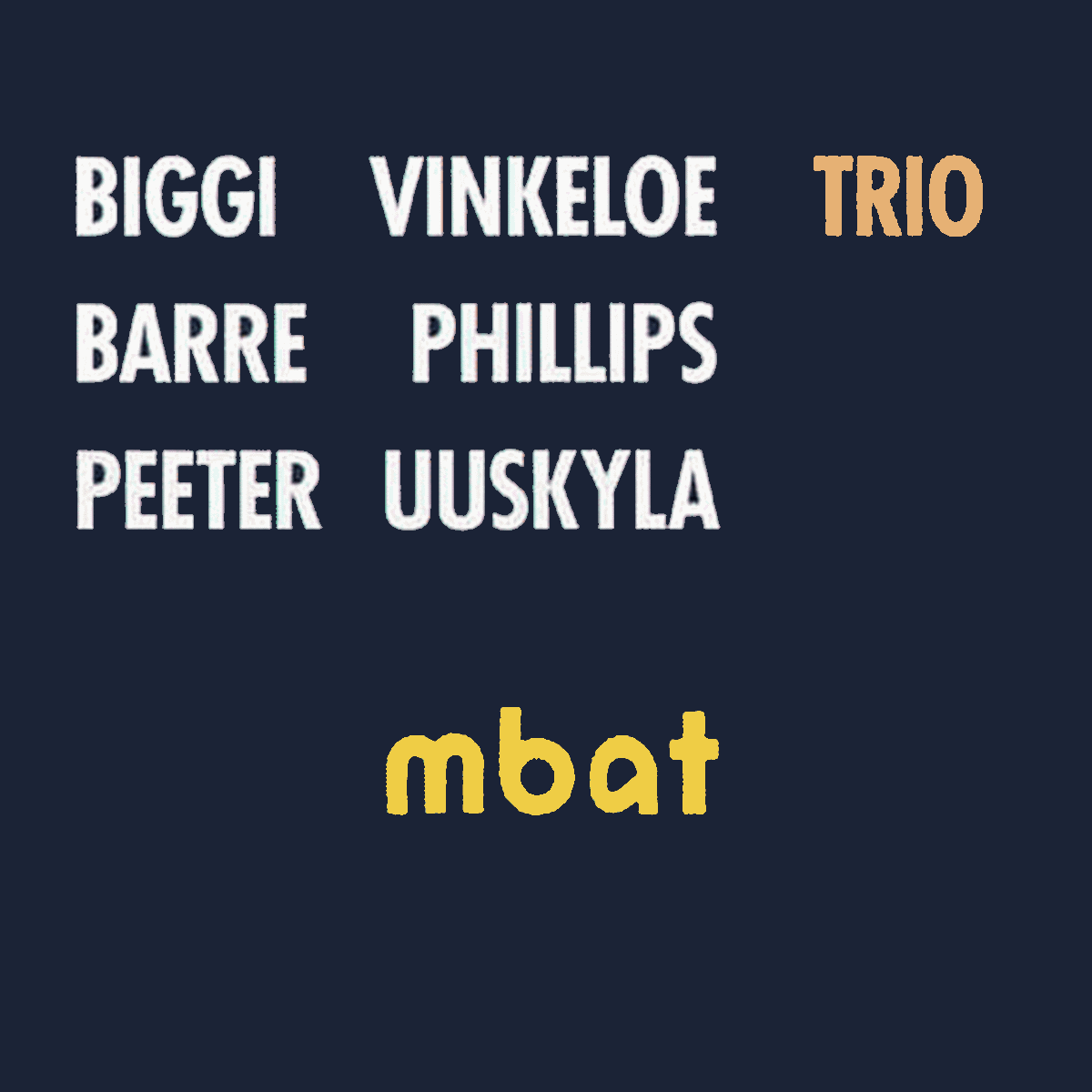
BIGGI VINKELOE TRIO – Mbat (1993)
Label: LJ Records; Catalog#: LJCD5209
Country: Sweden; Year: 1993
Style: avant-garde, free improvisation, Contemporary Jazz, Free Jazz
Recorded live during a tour in Sweden 1993.
Mbat with Peeter Uuskyla and Barre Phillips voted best CD of the year in Finland 1997
Note:
LJ Records has the great pleasure of introducing unique music to you. Unique because it would be impossible without these special musicians, unique because it is impossible and unthinkable to repeat this performance. Biggi Vinkeloe, alto saxophone and flute, has lived in France and Germany and is now living in Sweden. She has performed with amongst others André Jaume, Jacques Veillé, Alain Rellay, Cecil Taylor and Barre Phillips before starting her own trio in 1990. The Biggi Vinkeloe Trio recorded the album "Mr Nefertiti" (Canastero Records) in Cologne, Germany 1991. Peeter Uuskyla, drums, grew up in Sweden. He went to Berlin 1988 to play with Cecil Taylor, stayed in Germany and played with different groups and since 1990 mostly with Biggi Vinkeloe Trio. Barre Phillips is an American bassplayer living in France, who has put his bass in the foreground in whatever project he is playing! He made the first-ever album of solo bass improvisation as long ago as 1968. This edition of Biggi Vinkeloe Trio is of first performances from 1992 and this album was recorded during a tour in Sweden 1993.
Biggi Vinkeloe Biography
Born: March 8, 1956
Instrument: Saxophone
Born in Germany. Studied and lived in France from 1974 to 1988. Since then lives and works in Sweden.
Working bands: Trio REV, with Lisle Ellis and Donald Robinson / Duo Robinson--Vinkeloe / Trio Chris Brown, Donald Robinson, Biggi Vinkeloe / She performs as a soloist as well.
Biggi Vinkeloe has performed in Sweden, France, Germany, England, Finland, Italy, Denmark, Switzerland, Austria, Czech Republic, Canada, USA , with Peeter Uuskyla, Barre Phillips, Peter Kowald, Cecil Taylor, Ken Filiano, Steve Swell, Joel Futtermann, Alex Cline, Chris Brown, Jacques Veille, Giancarlo Locatelli, Alberto Braida, Filippo Monico, Roberto Bellatalla, Paul Plimley, Jackson Krall, Joachim Zoepf, Georg Wolf, Gino Robair, Gianni Gebbia, Jerome Bryerton, Wayne Lopes, Paul Obermayer, Rex Casswell, Peter Friis Nielsen, Perry Robinson, Lotte Anker, Sylvie Degiez, Vinny Golia, Harris Eisenstadt, Damon Smith, Mark Weaver, Mischa Feigin, Marco Eneidi, Mary Oliver, Miya Masaoka, Donald Robinson, Lisle Ellis among others.
She has performed with musicians from other boards, such as heavy metal bass player Magnus Rosén and drummer Anders Johansson; organ player Karin Nelson or New Music accordion player Marie Wärme; different choirs with music ranging from Saint Birgitta to modern music.
Collaboration with dancers and choreographers, such as Inka Tiitinen (FIN), Tommy Kitty (FIN), Katie Duck (NL), Carmen Olsson (S) / with visual artists, Jake Tilson (GB), Andrew Cowie (GB), Ebbe Pettersson (S), Gilda Previn (USA).
She has initiated and produced major projects: Over the Ocean, October 2000, Sweden, with visual artists, dancers, poets and musicians from Hamburg, Gothenburg, New York, London. Echoes, ‘ events in the exhibition ’ , Sweden, music series with international musicians, since 2001, at the Art Space ‘ Röda Sten ’ in Gothenburg (rodasten.se). European Echoes / United Nations, multi/media projects with artists from different countries. Performances in Sweden, Denmark, Germany, Finland and Italy. Since 1993. M.A.D. (music, art, dance) with financial support by ESF-Radet (European Social Funding) and Roda Sten, with performers from the US and Sweden. Festivals: Du Maurier Jazz Festival, Vancouver, Canada / Taktlos Festival, Bern and Zurich, Switzerland / Kerava Jazz Festival, Finland / Umea Jazz Festival, Sweden / Göteborgs Jazzdagar, Sweden / Eldenaer Jazznights, Germany / Nancy Jazz Pulsation, France / Festival de Franche Comte, France / Cecil Taylor in Berlin, FMP, Germany / Documenta Kassel, Germany / Sounds Festival Stockholm, Sweden / Copenhagen Jazz Festival, Denmark / Jazz Festival Prague, Czech Republic
Artist in Residence at the Headlands Center for the Arts, San Francisco, spring 2001 Grants: City of Kungalv 1995, Bohus Landstinget 1997, Region of Vastra Gotaland 2005, Adalbertska Stiftelse (Foundation) 2005, Swedish Council for Cultural Affairs 1995, 1998, 2003 and 2005. Artist in Residence at the Headlands Center for the Arts in San Francisco spring 2001.
Grants for specific projects, mostly in Sweden.
Mbat with Peeter Uuskyla and Barre Phillips voted best CD of the year in Finland 1997. Imagine a Place with Magnus Rosen voted best CD of the year in Bresil 2001. Best concert of the year in Manchester 2000 with Peeter Uuskyla. – AAJ
Welcome to new prog-blog "Different Perspectives In My Room...!".
Enjoy the music, and please leave a comment. Thanks in advance.
Link in Comments!
Saturday, September 22, 2012
BRÖTZMANN, McPHEE, KESSLER, ZERANG - The Damage Is Done (Live At Alchemia 2008)
Label: Not Two Records – MW 823-2
Format: 2 × CD, Album; Country: Poland/USA; Released: 2009
Style: Free Improvisation
Design – Brötzm; Mixed By, Mastered By – Lou Malozzi; Music By – McPhee/Brötzmann/Kessler/Zerang Producer – Marek Winiarski
Packaging: Cardstock Gatefold Sleeve
Recorded at 'Alchemia', Krakow, March 16th, 2008, Mixed and mastered June 2009.
Reviews:
This live date features legendary free jazz pioneers Peter Brötzmann and Joe McPhee, and Chicago's leading rhythm section, bassist Kent Kessler and drummer Michael Zerang. The four also make up 4/10 of Brötzmann's Chicago Tentet, maybe the most successful large new music jazz ensemble ever assembled.
As they have in the past while touring with the Tentet, they step away and perform in this more intimate lineup. This quartet has released two previous recordings, Tales Out Of Time (hatOLOGY, 2004) and Guts (Okka, 2007), with The Damage Is Done's two discs recorded live at Alchemia in Krakow, Poland in March of 2008.
While the players can (and do) perform volatile energy jazz here, their preference is for music that's dissectible enough for the players to be distinguished in parts and direction.
The obvious reference point here is the legend of Albert Ayler and his brother Donald. Brötzmann has never shied away from his admiration for free jazz's holy ghost. With Brötzmann on tenor and McPhee sporting the trumpet role, the attention to Ayler can be heard on "With Charon" and the title track (all 30-plus minutes). Brötzmann and McPhee's stamina, both nearing 70, is impressive. The pair delivers an onslaught of energy with a relentless attack, the only pause being for Zerang and Kessler's solos. With that, the pace slows, allowing Brötzmann to paint from a different palette. This gentler approach acts as a collection point before the music again spreads its energy patterns outward.
Kessler and Zerang open "Alchemia Souls," with itchy bowed bass and sound effect brushes on drums. Brötzmann enters, playing a persistent tarogato before McPhee's twitchy alto joins. The rhythm section maintains the energy through constant motion. The more affable music making here comes at the urging of the rhythm section. Slowing down the pulse or playing with mallets coaxes the horn players to decelerate and clarify the sound.
The breadth and power of these four players comes through with an exhaustive clarity in this crisp and vigorous live recording.
By MARK CORROTO, Published: December 24, 2009 (AAJ)
Marek Winiarski and Peter Brötzmann, Alchemia 2008
The reason why Joe McPhee and Peter Brötzmann form a great horn section is because their styles are linked and still quite different. McPhee can be violent and fierce, but he has that touch of sentimentality - in the good sense of the word - and spirituality that is entirely lacking with Brötzmann. The latter is a force of nature, all power and energy, but he has his poetic side too. Besides the violence, they share technical skills, musical vision and first and foremost instruments that are a direct conduit to their feelings, unaltered, without embellishment, without unnecessary ornaments or fake feelings. They deliver directly : raw, authentic, true to themselves. Ken Kessler on bass and Michael Zerang on drums feed the hurricane that is blowing in front of them, relentlessly.
But the hurricane can become a light breeze too. And that is to a certain extent largely to be ascribed to both McPhee and Kessler, who add more nuance and subtlety, melodic elaboration and lyricism, but don't get mistaken about Brötzmann either: the slow and very beautiful melody that he develops in the quiet middle part of the thirty-minute title song is entirely his, almost sounding like McPhee. It is a real pleasure how the German manages to find the common ground, but don't worry either, it doesn't take long before he blows his lungs out again, so much so, that it almost becomes an entertainment by itself. The second track, "Alchemia Souls", is more free improv, a sound dialogue between the four musicians, and the title refers to the Alchemia Club, in Krakow, Poland were the performance took place on March 16, 2008.
The second disc is even better, with titles referring to the descent into the Greek underworld. Soft and poetic flowing passages alternate with gut-wrenching sound blasts and the most excruciating emotional explorations - after all: you are in hell, yet it all fits, it has coherence and purpose, indeed like Acheron, the river of pain, that flows through Hades. Anger, human misery, dissatisfaction with the world, yes. But also musical beauty and great artistic delivery, very balanced in a very varied performance.The only downside of the performance is that Brötzmann's sax comes across much louder than McPhee's, but whether that's a question of sound mixing or because of sheer decibels produced, remains unsolved.
By Stef (FreeJazz, December 14, 2009)
Welcome to new prog-blog "Different Perspectives In My Room...!".
Enjoy the music, and please leave a comment. Thanks in advance.
Link in Comments!
Different Perspectives In My Room...! – 'Brötzmann', Poster No.3
Graphic Design
Different Perspectives In My Room...!
'Brötzmann', Poster No.3
The original photo by...?
Design by ART&JAZZ Studio SALVARICA - 2012
"Both sets from the meeting of trumpeter and alto saxophonist Joe McPhee and reed player Peter Brötzmann with Kent Kessler and Michael Zerang performing live at Alchemia in 2008. From gritty determination to melodic beauty, this is jaw-dropping free jazz from four masters of the form."
Welcome to new prog-blog "Different Perspectives In My Room...!".
Enjoy the music, and please leave a comment. Thanks in advance.
Regards, Vitko
Subscribe to:
Posts (Atom)